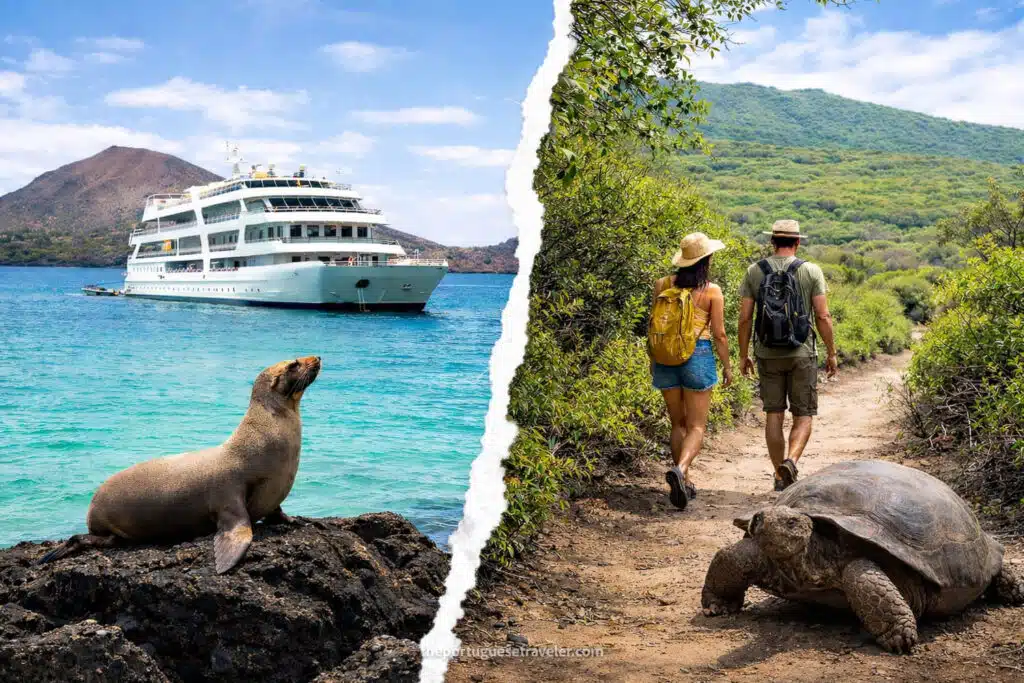
The Galapagos Wildlife is unlike anything you’ll see anywhere else on Earth. From giant tortoises roaming volcanic highlands to blue-footed boobies performing quirky courtship dances, every corner of the archipelago feels like stepping into a living documentary. What struck me most on my visit was how unafraid the animals are — sea lions napping on benches, iguanas sunbathing on lava rocks, and birds practically posing for your camera. It’s a reminder that here, nature sets the rules and humans are simply guests.
In this guide, I’ll walk you through the incredible diversity of species you can expect to encounter on land, in the air, and underwater. Whether you’re planning your Galapagos itinerary to snorkel with penguins, hike among nesting albatrosses, or watch frigatebirds puff up their scarlet pouches, this Galapagos Wildlife guide will give you a sense of what awaits — and hopefully inspire you to experience it for yourself.
Table of Contents
Your Galapagos Islands Essentials - Quick Guide
Short on time? This quick Galapagos guide will help you plan!
Extras you’ll Need: – Travel Insurance with Heymondo (5% discount). – Mobile eSim with Holafly (5% discount) or Airalo
Important: Tours sell out fast – book early and plan a backup day.
How to Spot Galapagos Wildlife
The Galapagos are often described as a living museum, where animals seem completely at ease around visitors. While wildlife is everywhere, a few simple strategies can help you notice even more during your trip. Choosing the best time to visit the Galapagos Islands is just as important as following a good guide—different seasons and islands offer unique wildlife experiences, from nesting birds to mating marine iguanas.
Trust Your Naturalist Guide
If you’re on a cruise or day tour, your naturalist guide is your best resource. They know the behaviour patterns of each species and can point out camouflaged iguanas, hidden nests, or sea turtles gliding under the surface that you might otherwise miss.
Walk Slowly and Scan Your Surroundings
Many encounters happen right along the trails: giant tortoises lumbering through the highlands, lava lizards darting across the path, or marine iguanas basking on dark volcanic rocks. Move slowly and you’ll start noticing the details—like a tortoise’s shell peeking through tall grass or iguanas blending with the terrain.
Look to the Skies
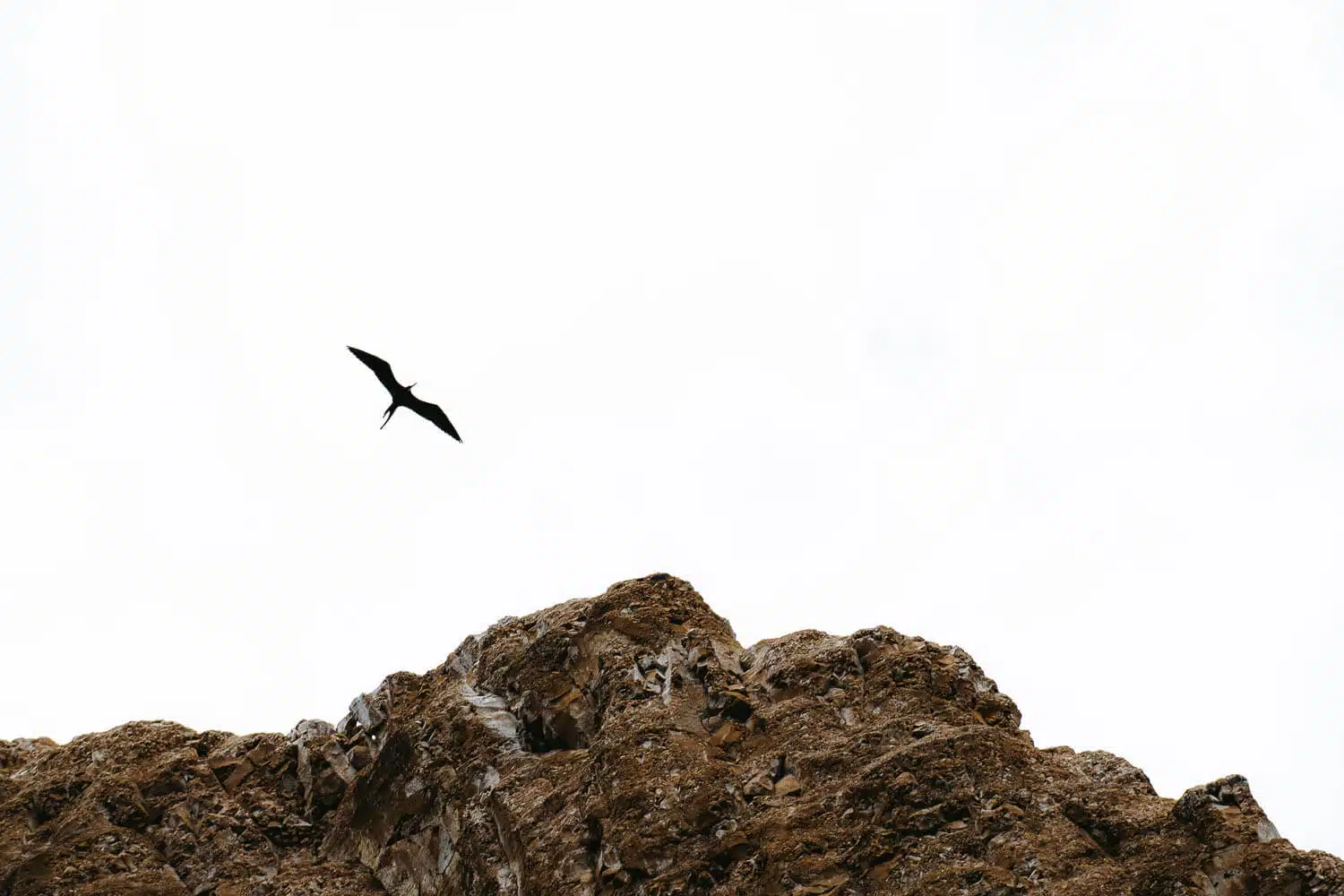
Birds are a constant presence. Frigatebirds, in particular, are easy to spot circling overhead—and during sunset, you’ll often find them resting on posts, poles, or perches where they’re clearly visible.
Don’t Forget the Waterfront
The coastline and piers are among the best places to observe wildlife. Sea lions often nap on benches or stretch across beaches, especially around the malecón of San Cristobal. From piers, you can look straight down into the water to spot rays gliding like shadows, sea turtles surfacing for air, or even small sharks moving below.
Highlands & trails: Giant tortoises, finches, and other land birds.
Open water: Dolphins, whales, penguins, and seabirds.
Be Quiet and Patient
Sometimes the best way to see wildlife is to stop moving and simply wait. Curious sea lions may swim around you while snorkeling, and birds often land closer when you give them space.
Use the Right Tools
A zoom lens or binoculars will let you enjoy wildlife from a respectful distance, especially for birds or marine animals that don’t always come close.
Respect the Rules
Follow Galapagos National Park guidelines to protect both wildlife and yourself:
Always keep at least 2 meters away from animals.
Don’t touch or feed them.
Stay on marked trails.
These rules keep the animals safe and preserve the unique behavior that makes the Galapagos such a special place to visit.
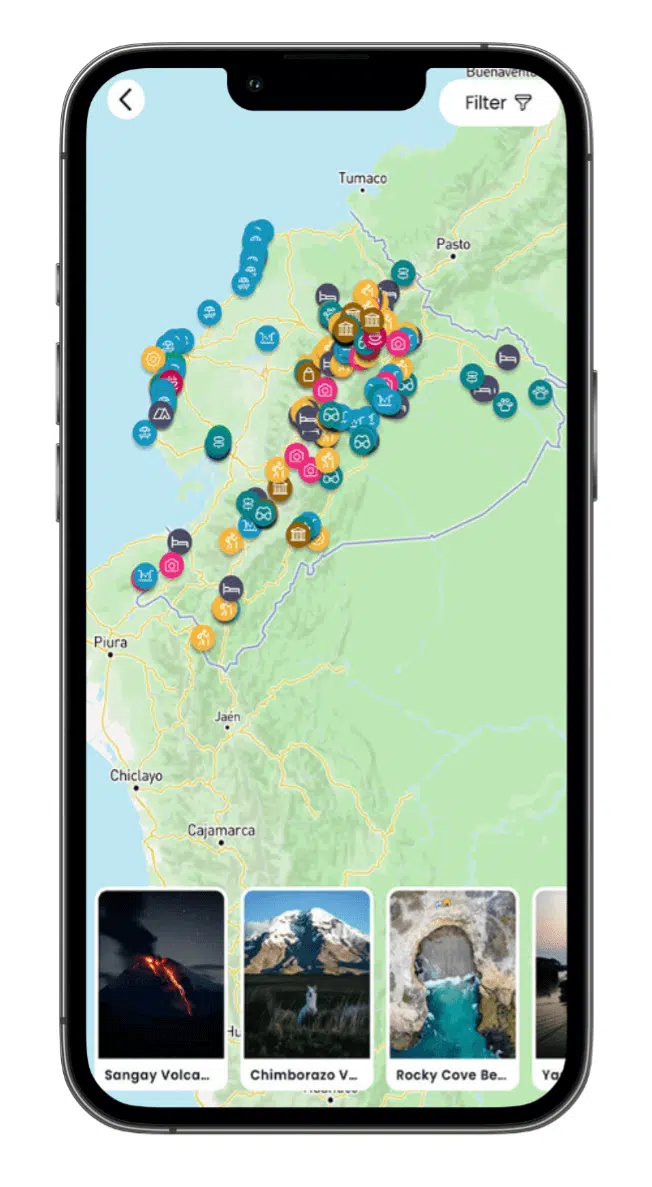
Get access to my curated list of all the best viewpoints, hiking trails, secret waterfalls, diving spots, wildlife tours, accommodations, and more, that will make your trip to Ecuador and The Galapagos unforgettable.
All of this, in an interactive guide featuring a mobile-friendly map, pre-designed itineraries, all my favourite photos, and helpful travel tips to guide your journey in this amazing unexplored country.
If you want personalized advice write me in-app and we can plan it together.
Plan Your Galapagos & South America Trip (Free Quote)
We’ve had many readers ask us for help planning a Galapagos & South America trip. While we don’t handle trip reservations or bookings ourselves, we partnered with Happy Gringo, a trusted local agency we 100% recommend. Share your travel details, and their team will help plan and book everything for you.
The Galapagos Islands are home to a unique array of terrestrial wildlife, much of it found nowhere else on Earth. The islands’ isolation has allowed species to evolve independently, resulting in extraordinary adaptations. From giant tortoises to remarkable iguanas, the terrestrial ecosystems vary widely depending on the island, altitude, and habitat type. Many species are highly specialized and exhibit behaviors shaped by the islands’ volcanic landscapes and limited resources.
Reptiles
Reptiles are among the most unique land animals of the Galapagos Wildlife. The islands host a diversity of tortoises, iguanas, and smaller lizards, many of which are endemic. Adaptations among reptiles vary by island: tortoises can differ in shell shape and size depending on their habitat, while iguanas have evolved to exploit either terrestrial or marine resources. These reptiles are not only fascinating to observe but also play important roles in the islands’ ecosystems as grazers, herbivores, and prey for native predators.
Giant Tortoises
Chelonoidis spp.
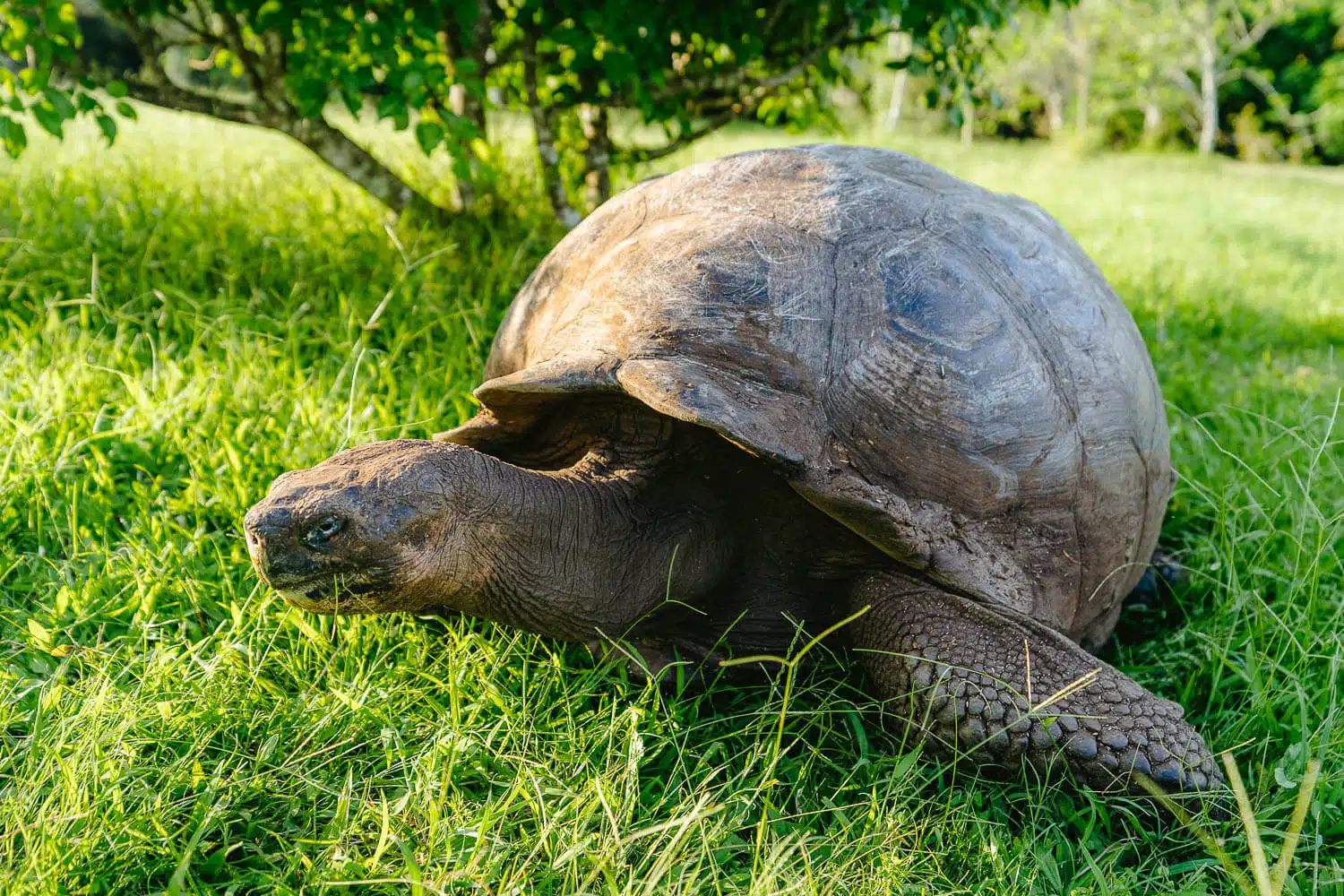
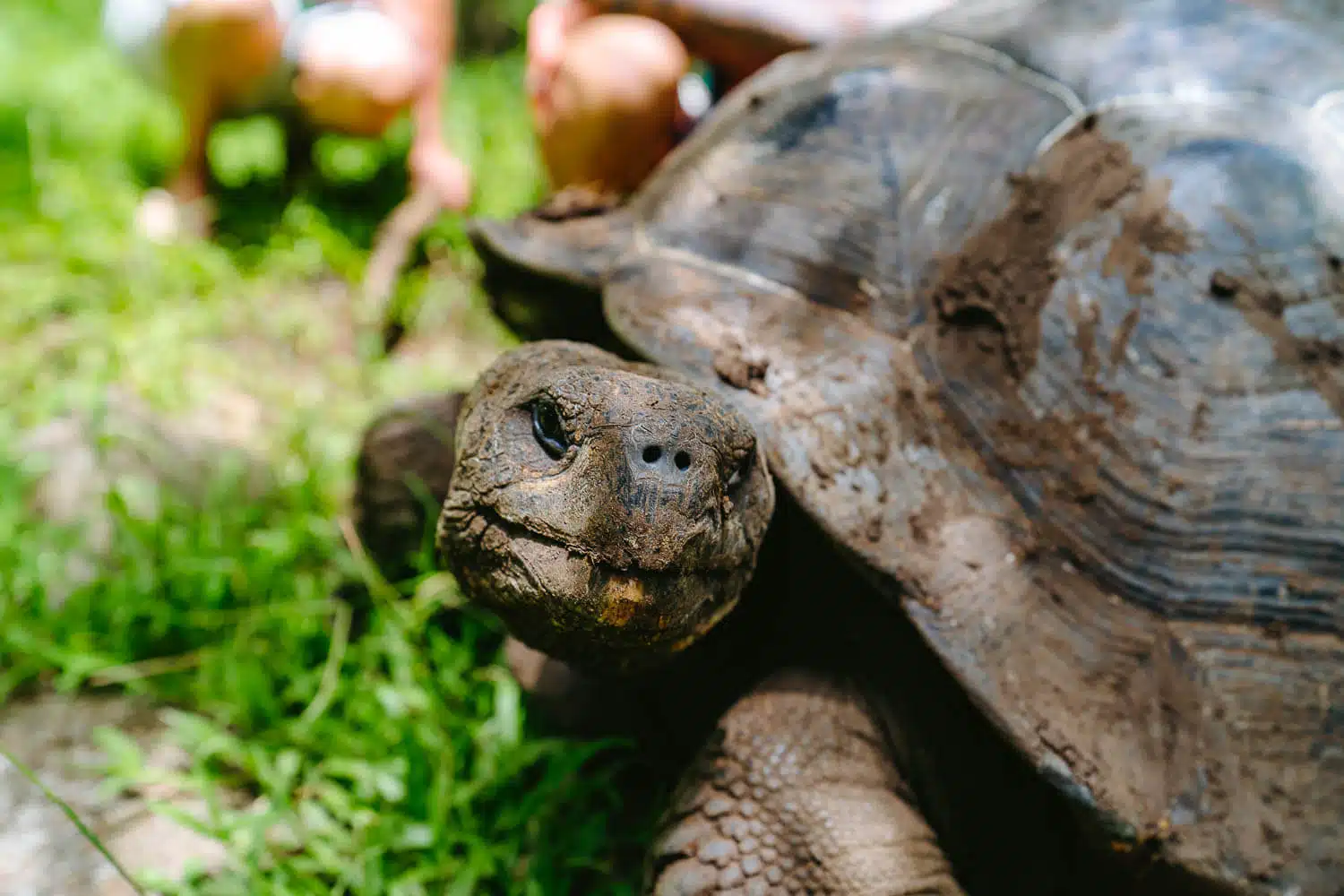
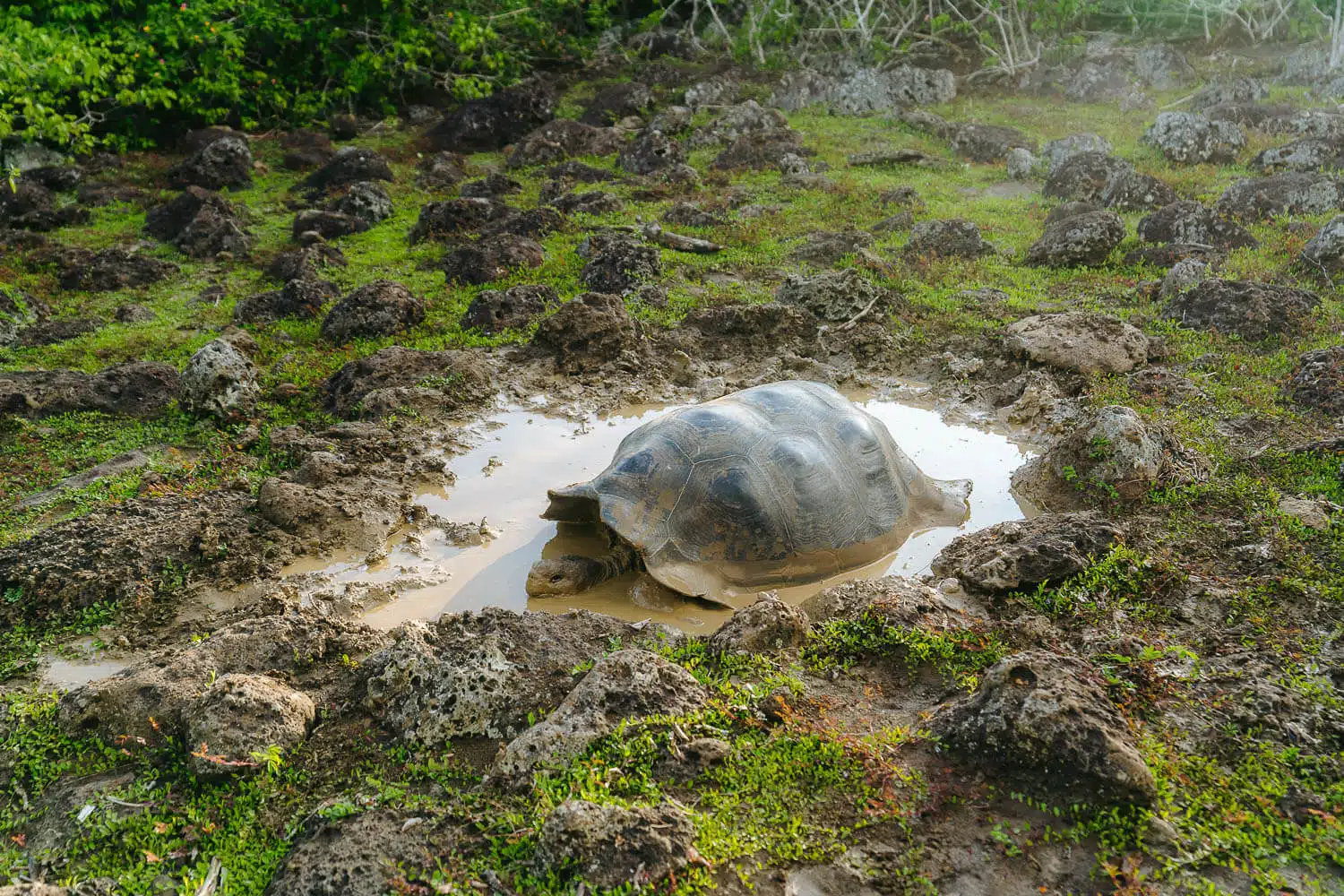
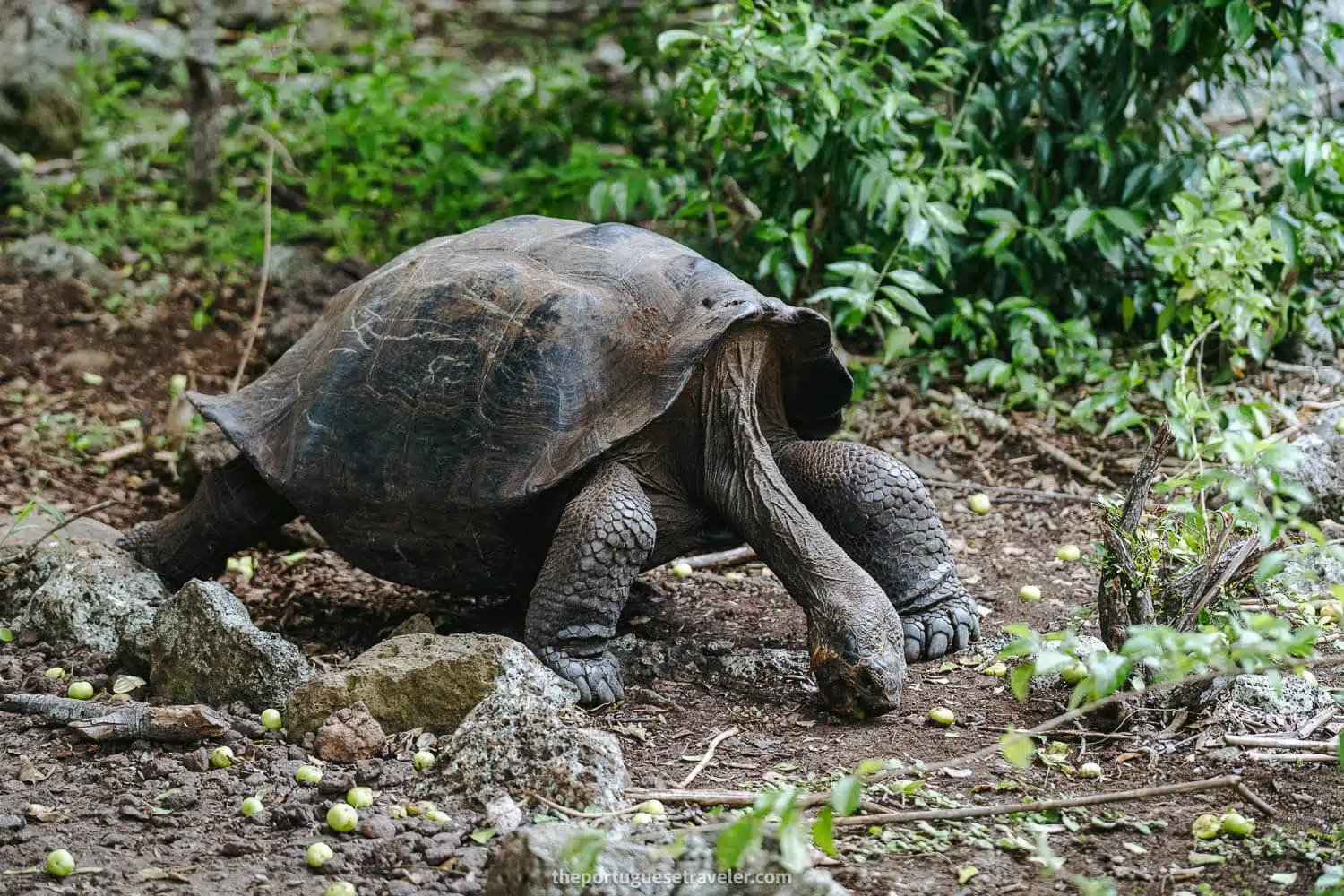
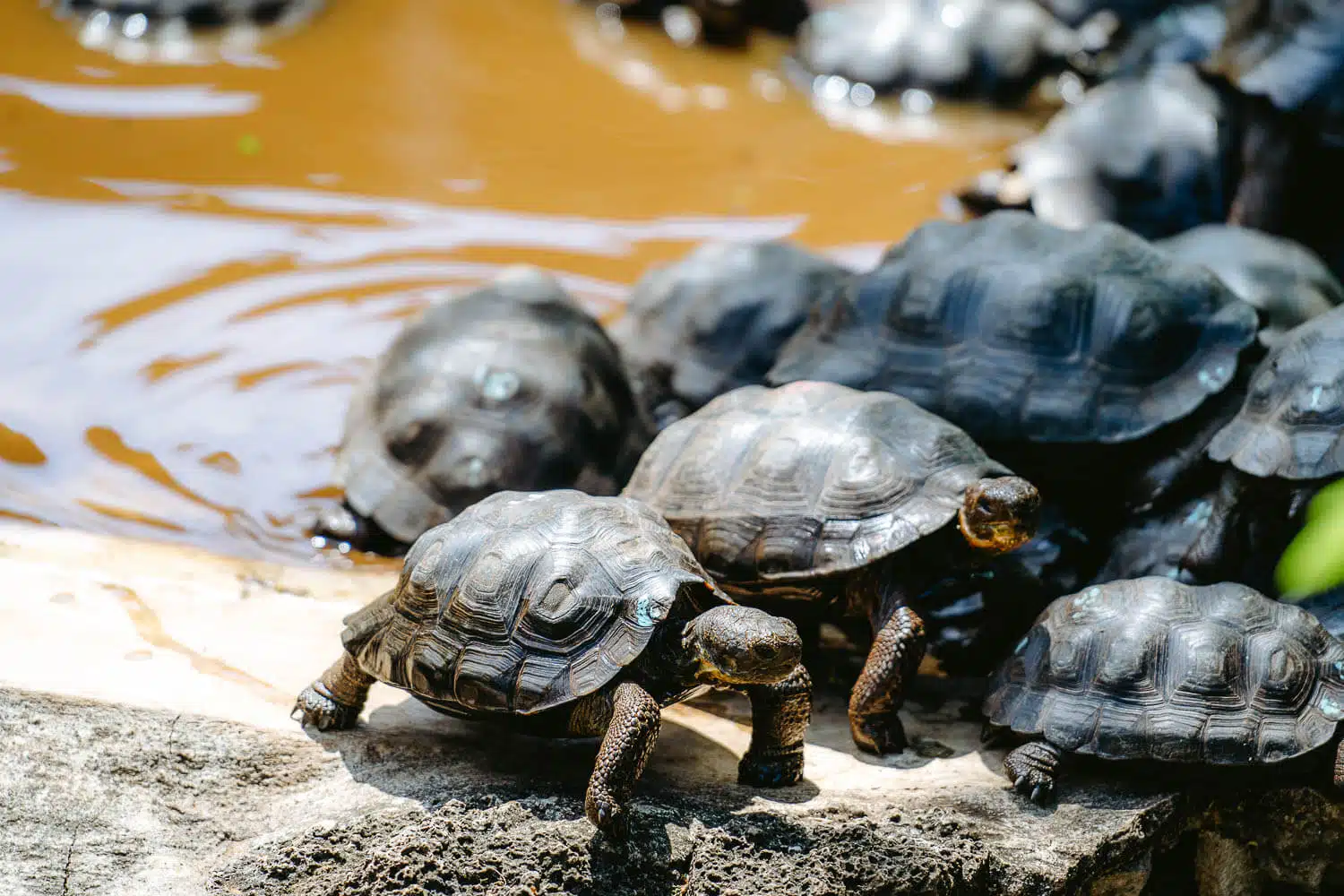
Giant tortoises are the most iconic animals of the Galapagos, renowned for their enormous size, longevity, and unique shell shapes, which vary between islands. Today, there are 10 living species, plus the recently rediscovered Fernandina tortoise, once thought to be extinct.
Some islands, like Santa Cruz, are home to dome-shaped tortoises suited for grazing low vegetation, while others, like Española, have saddle-backed shells that allow them to stretch upward for cacti. They are primarily herbivores, feeding on grasses, leaves, and cacti, and play a key role in seed dispersal and shaping plant communities.
Each island population has evolved distinct traits, making them one of the clearest examples of adaptive radiation in action.
Where to see: San Cristobal, Santa Cruz, Isabela (multiple subspecies on different volcanoes), Floreana (restored population), Pinzón, Española.
The giant tortoise in the visitor site
A giant tortoise in "La Galapaguera" in San Cristóbal, Galápagos
A giant Galapagos tortoise
Baby giant tortoises at the nursery of Charles Darwin Research Station
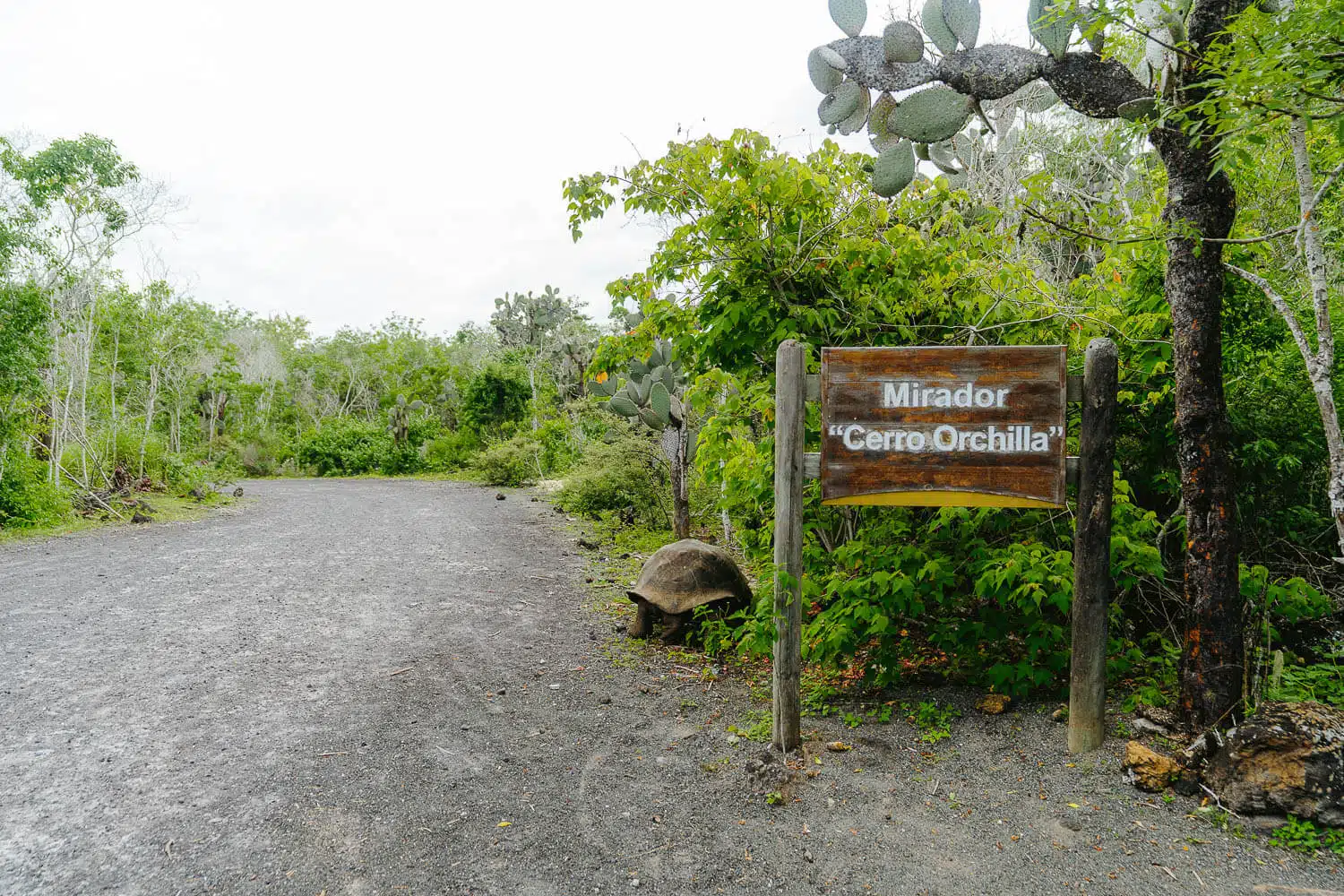
The entrance to Cerro Orchilla
Land Iguanas
Conolophus subcristatus, C. pallidus, C. marthae
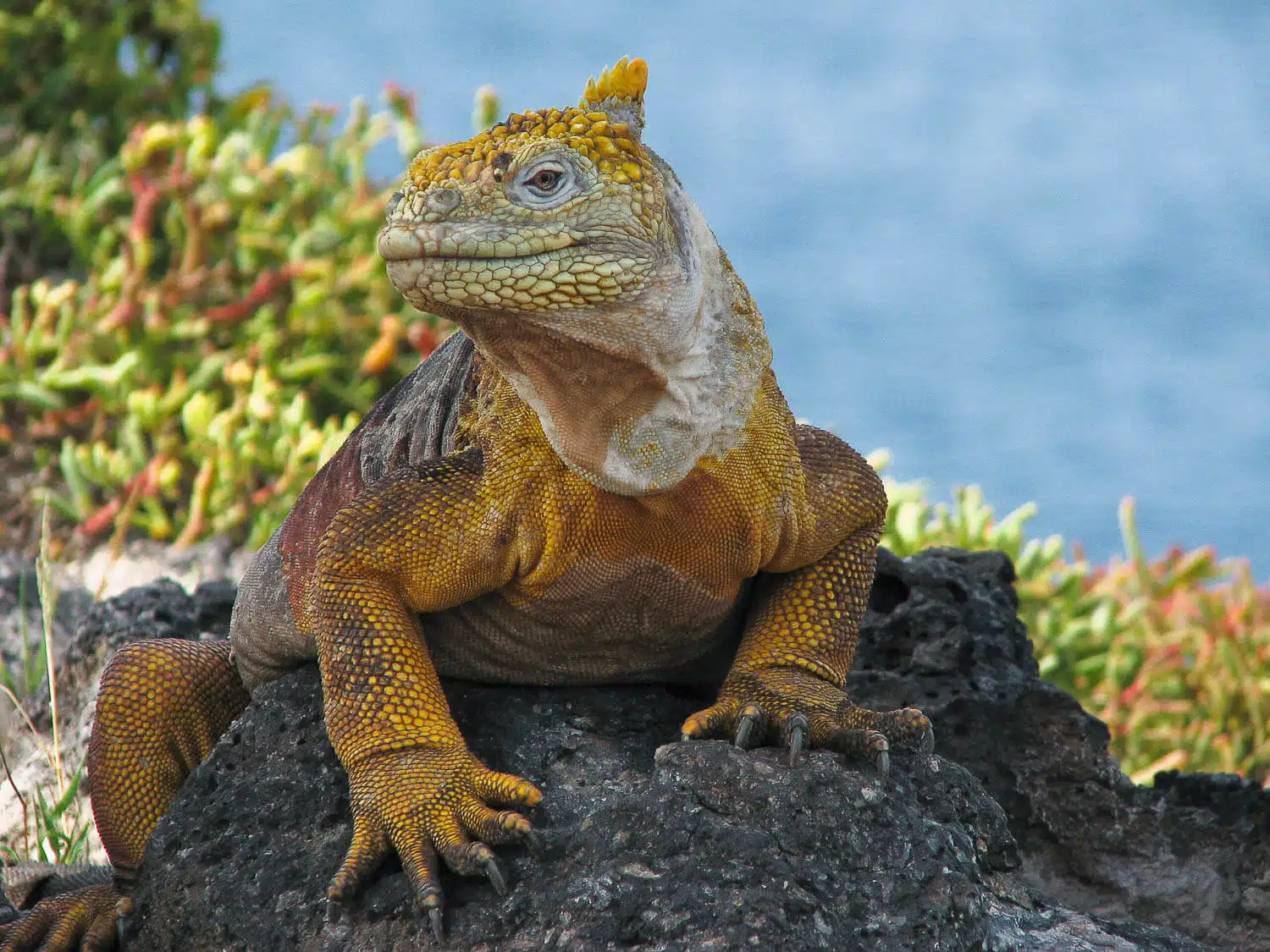
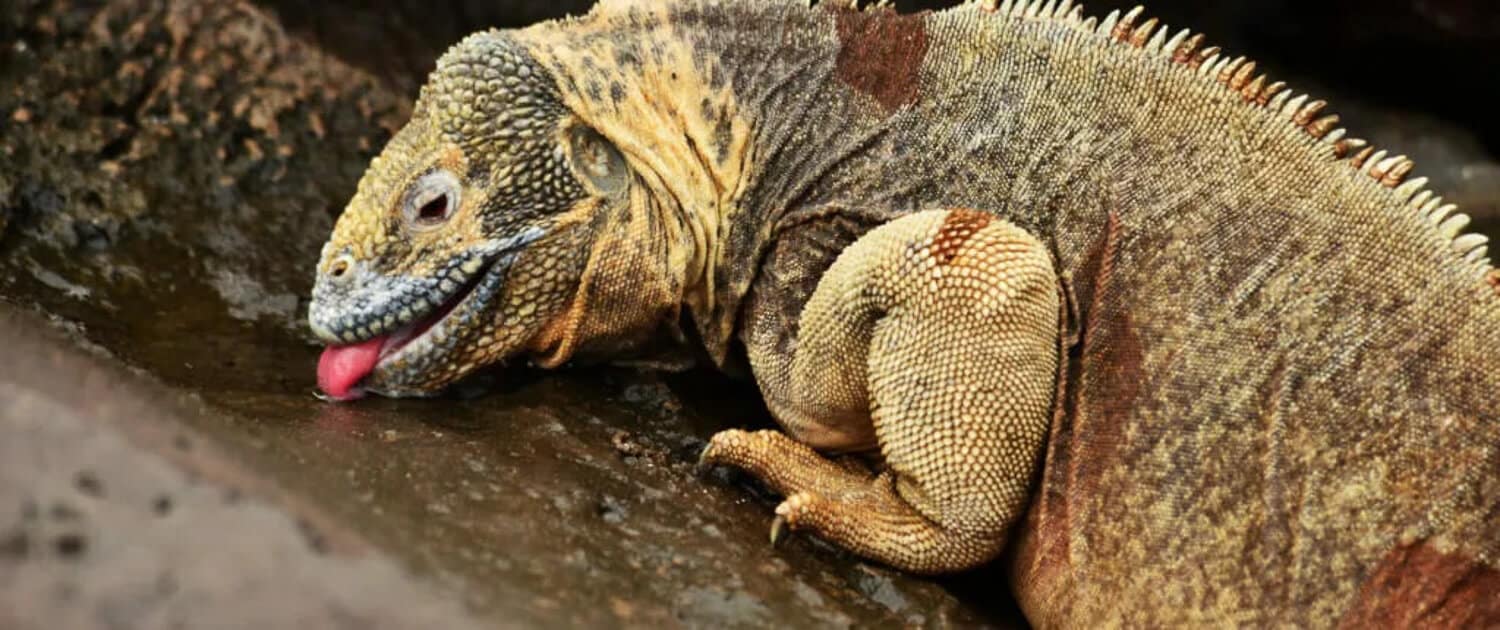
The Galapagos land iguana (Conolophus subcristatus) is a large terrestrial reptile with a yellowish-brown body, a robust build, and strong claws for digging. They are herbivorous, mainly consuming cacti, fruits, and other vegetation. Males are territorial, defending feeding areas and harems of females. Females lay eggs in sandy or volcanic soil, which incubate for around four months before hatching.
Young iguanas are vulnerable to predators and tend to stay in shallow, protected areas until they grow larger. As an iconic part of Galapagos wildlife, these iguanas play an important ecological role by helping control cactus populations and dispersing seeds.
Where to see: Isabela (Urvina Bay), North Seymour (reintroduced).
Land Iguana | Credit: Neil Bruce @ https://galapagosconservation.org.uk/
Santa Fé Land Iguana
Conolophus pallidus
The Santa Fé land iguana is a rarer species restricted to Santa Fé Island. It is paler than other land iguanas, has a longer, more tapered snout, and pronounced dorsal spines. Like other land iguanas, it primarily feeds on Opuntia cactus but will also consume insects and carrion opportunistically. Males defend territories of up to 20 m² during the breeding season, mating with several females, who lay up to 20 eggs. This species highlights the high degree of endemism and island specialization found in the Galapagos.
Where to see: Santa Fé (only).
Santa Fé Land Iguana | Credit: Luiz Flavio Geo de Siqueira @ https://galapagosconservation.org.uk/
Marine Iguanas
Amblyrhynchus cristatus
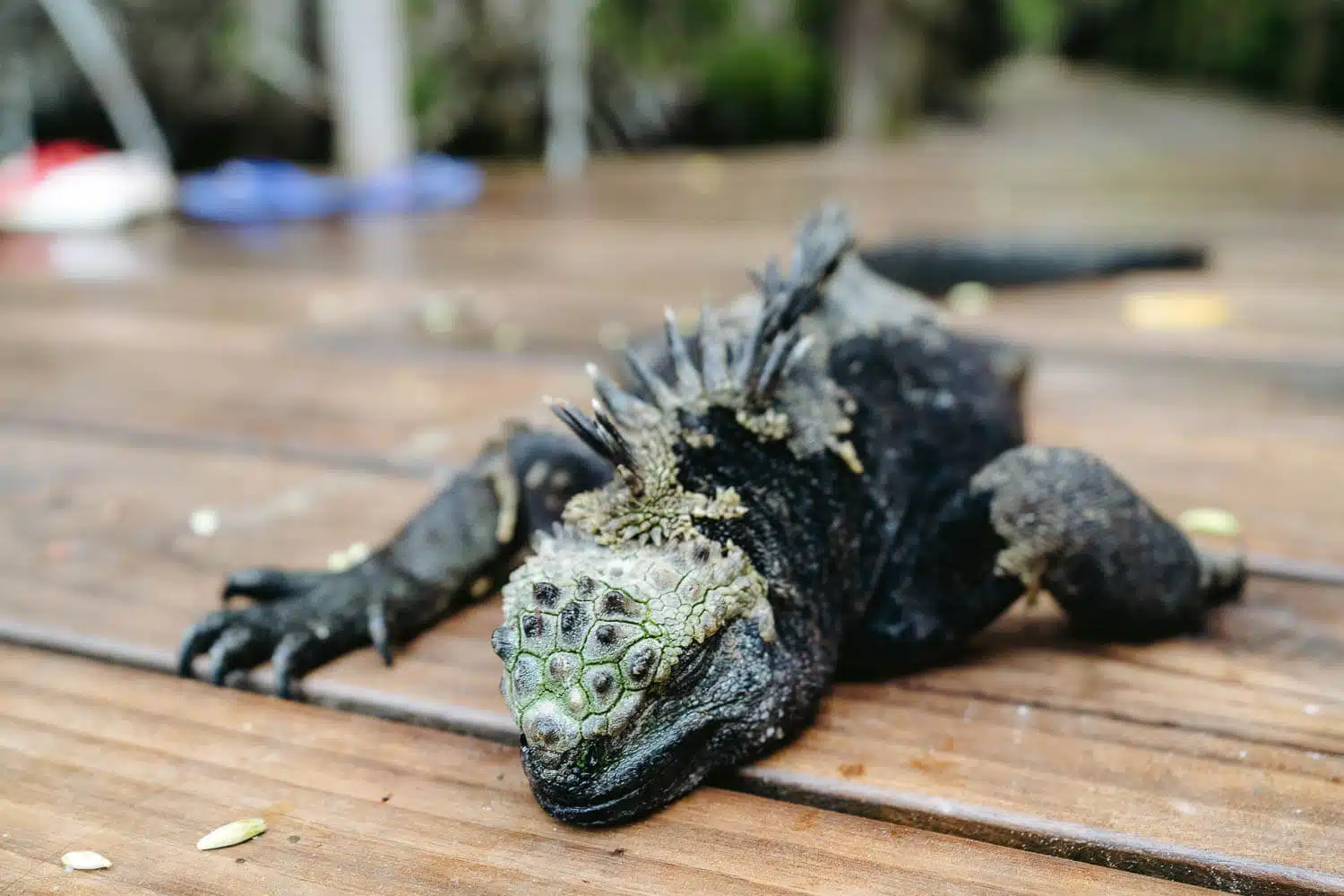
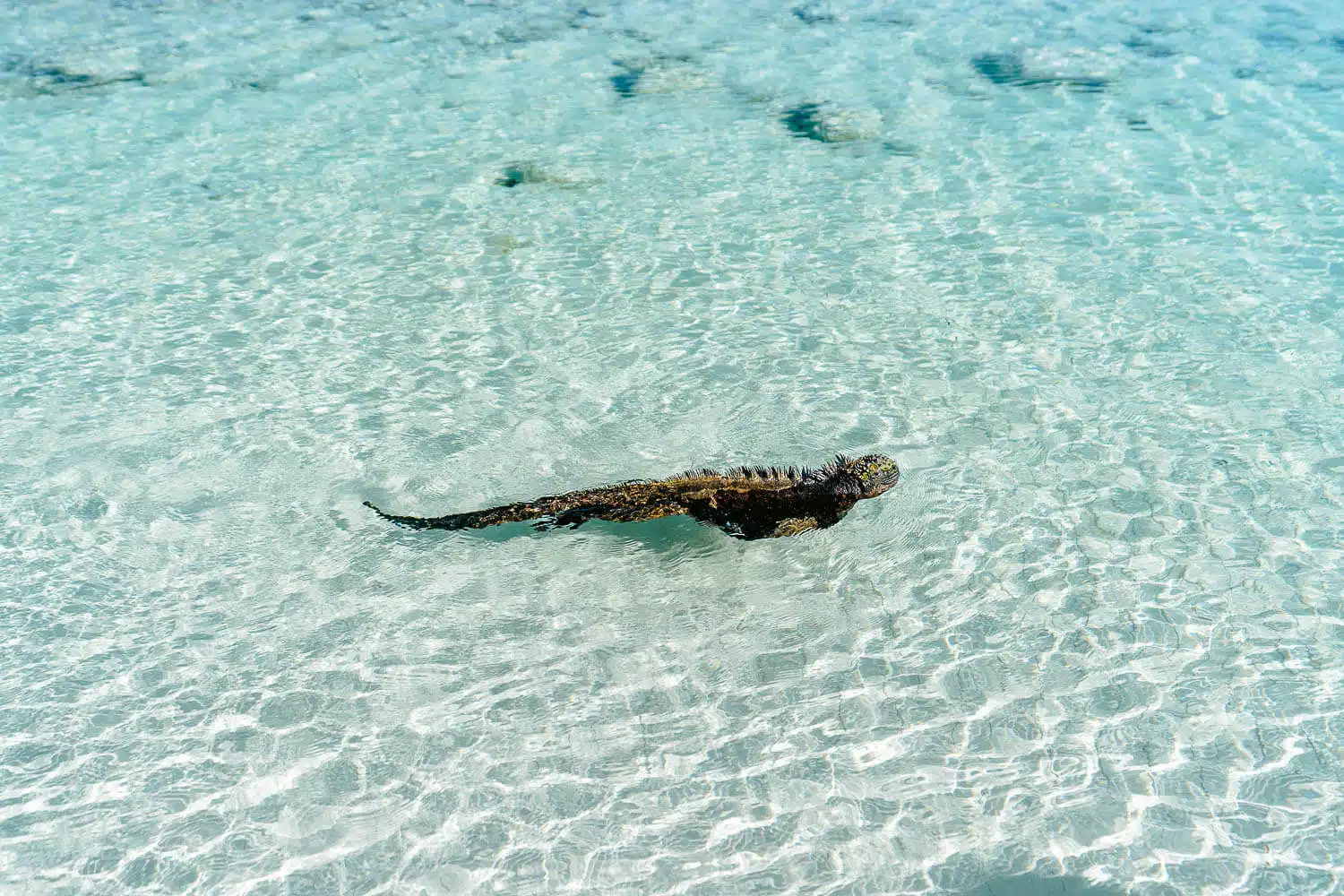
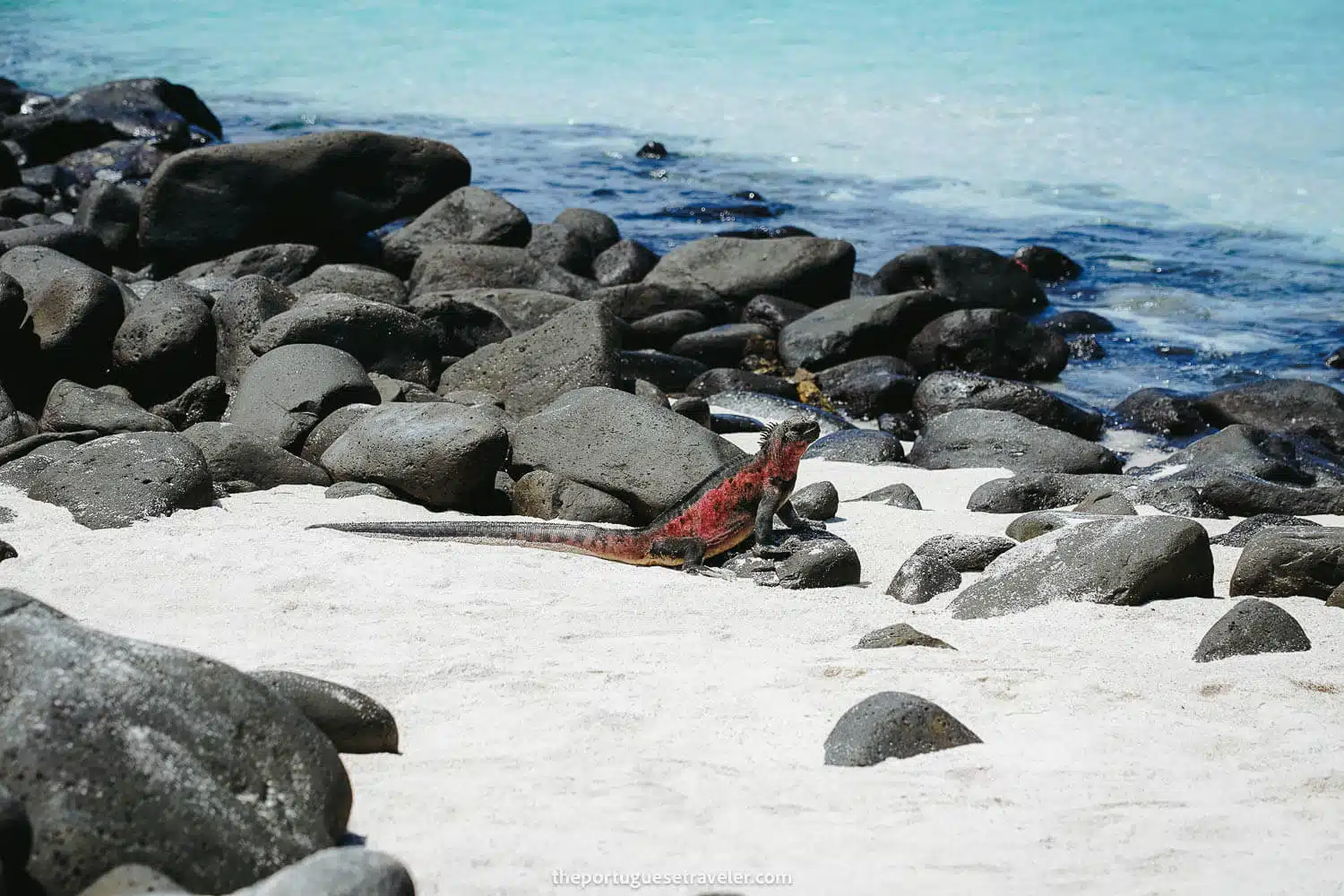
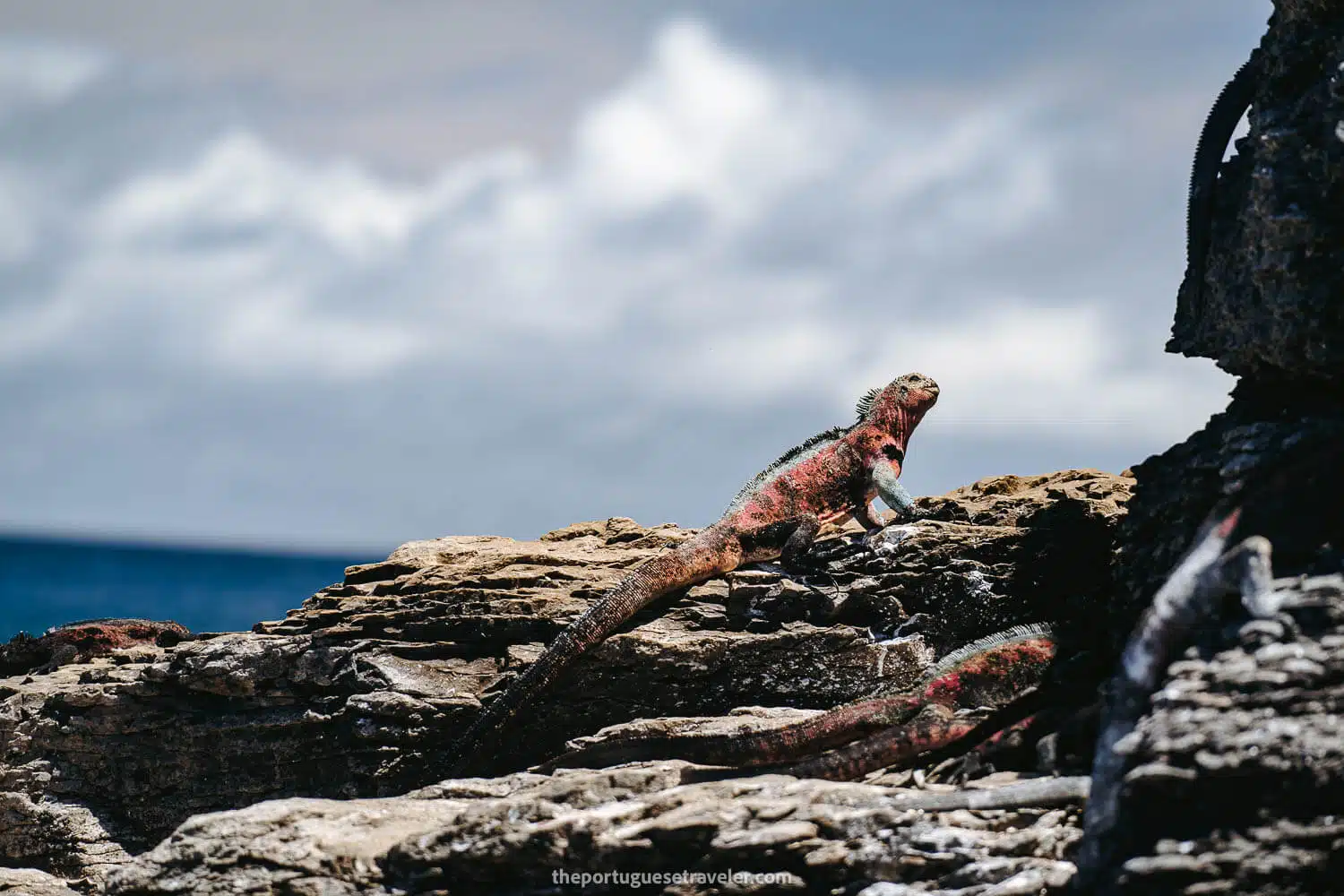
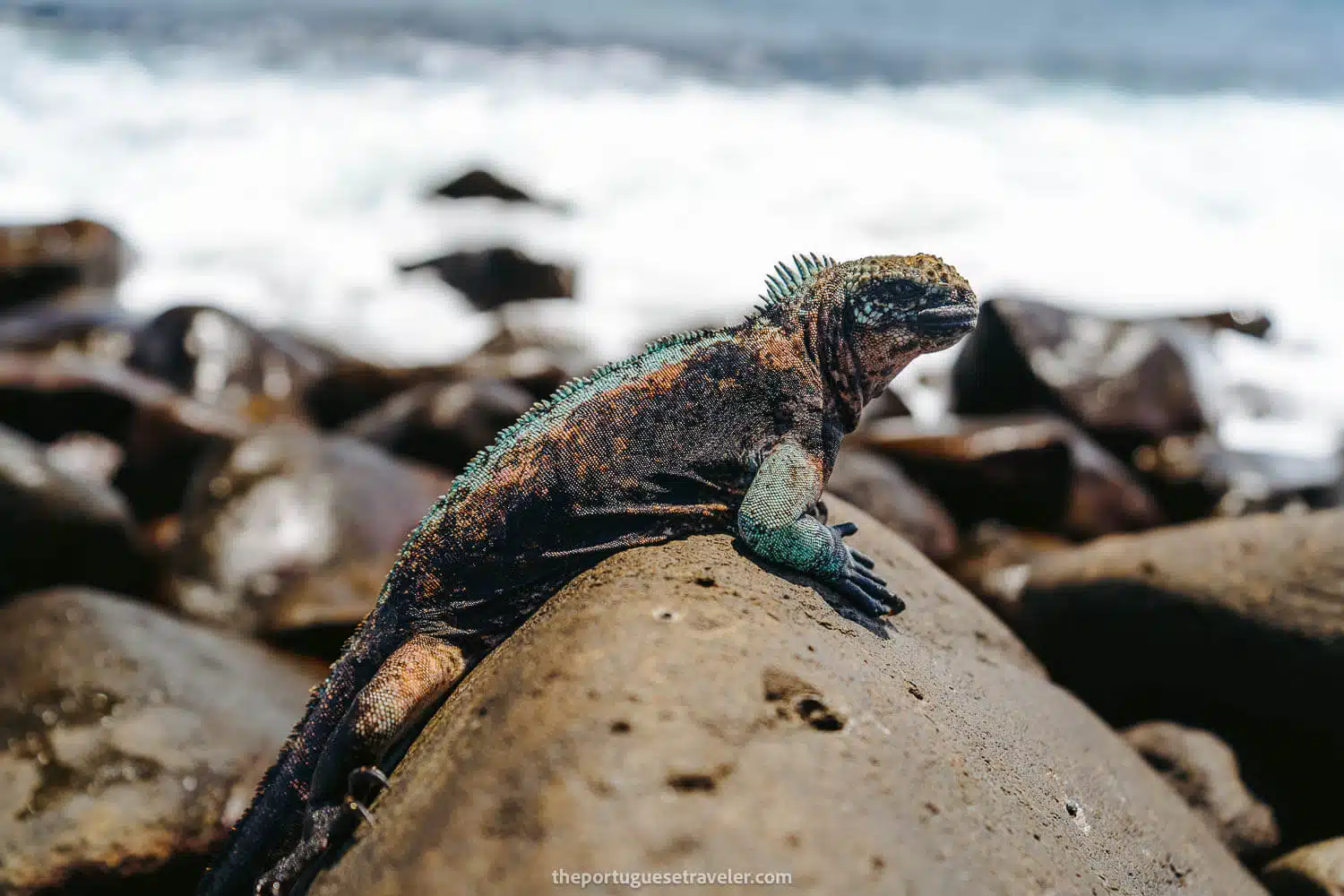
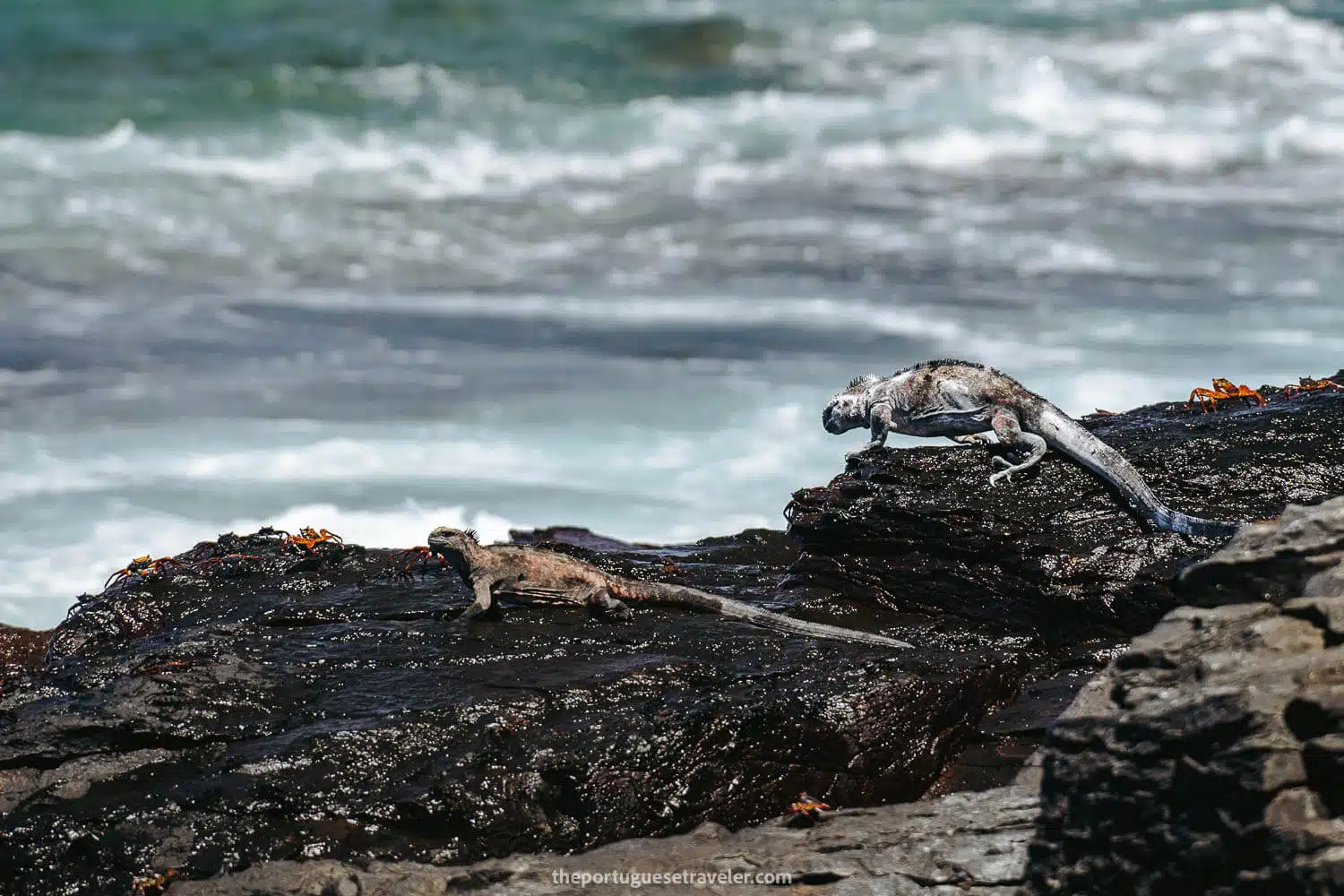
Marine iguanas are the world’s only lizards capable of foraging at sea. Endemic to the Galapagos, they feed on algae along rocky shorelines, using powerful claws to hold onto rocks in strong currents. Adults display seasonal color changes, with males turning bright green and red (special mention to the Christmas Española Island iguana) or red and black during mating season, depending on the island. Juveniles remain mostly black for camouflage.
Marine iguanas are a fascinating example of Galapagos wildlife, often seen huddling together on land to conserve heat and expelling excess salt from their bodies through specialized nasal glands. They demonstrate extraordinary adaptation to both terrestrial and marine environments.
Where to see: All major islands; Española (red/green breeding morph), Fernandina & Isabela (largest colonies), San Cristobal (urban beaches), Floreana, Santiago, Bartolomé, Rábida.
A marine iguana chilling on the wooden deck, at Concha Perla lagoon
Marine iguana swimming in Tortuga Bay, Santa Cruz, Galápagos
Red christmas iguana
Christmas Iguana in Punta Suarez
Lava Lizard & Geckos
Microlophus spp., several island endemics
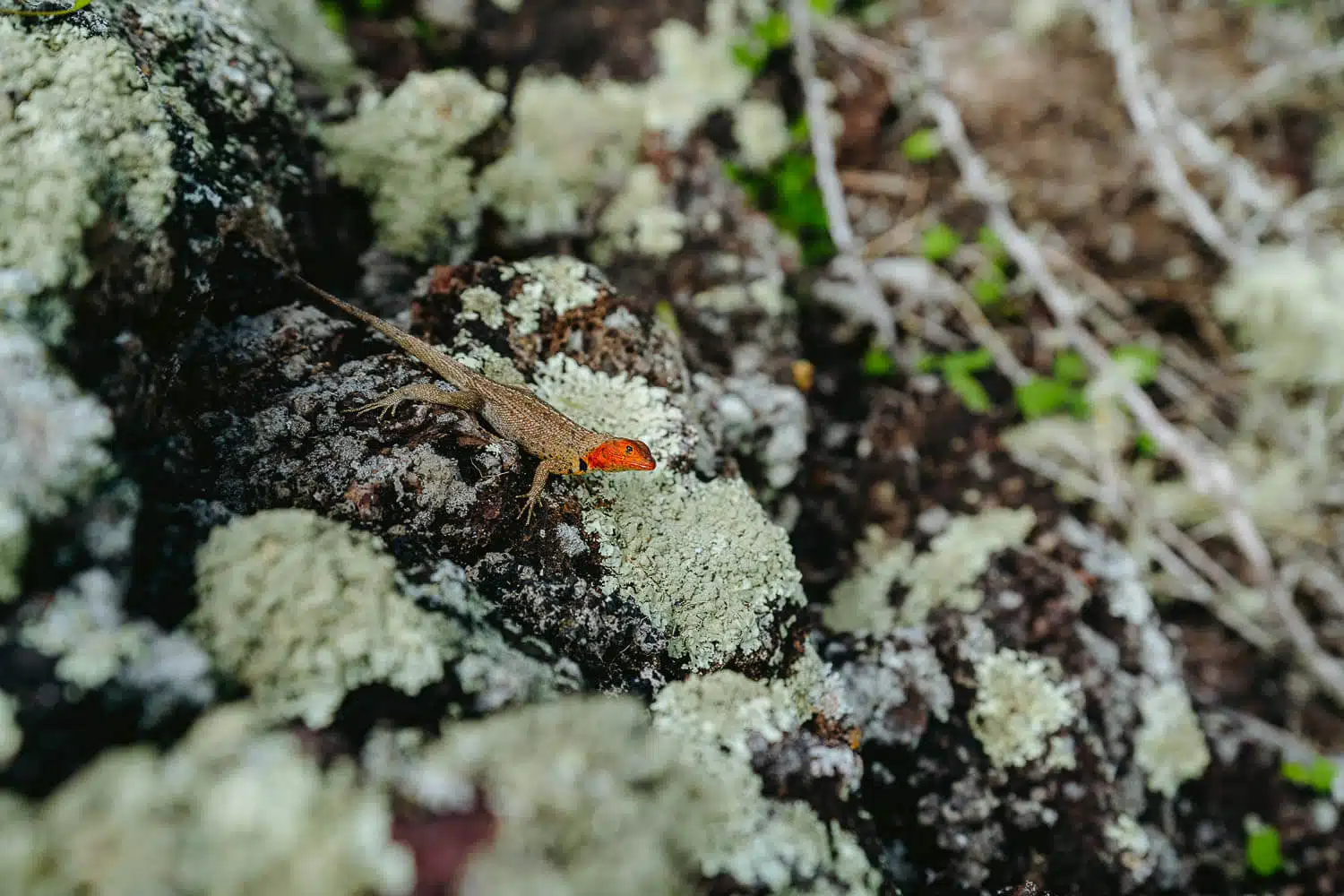
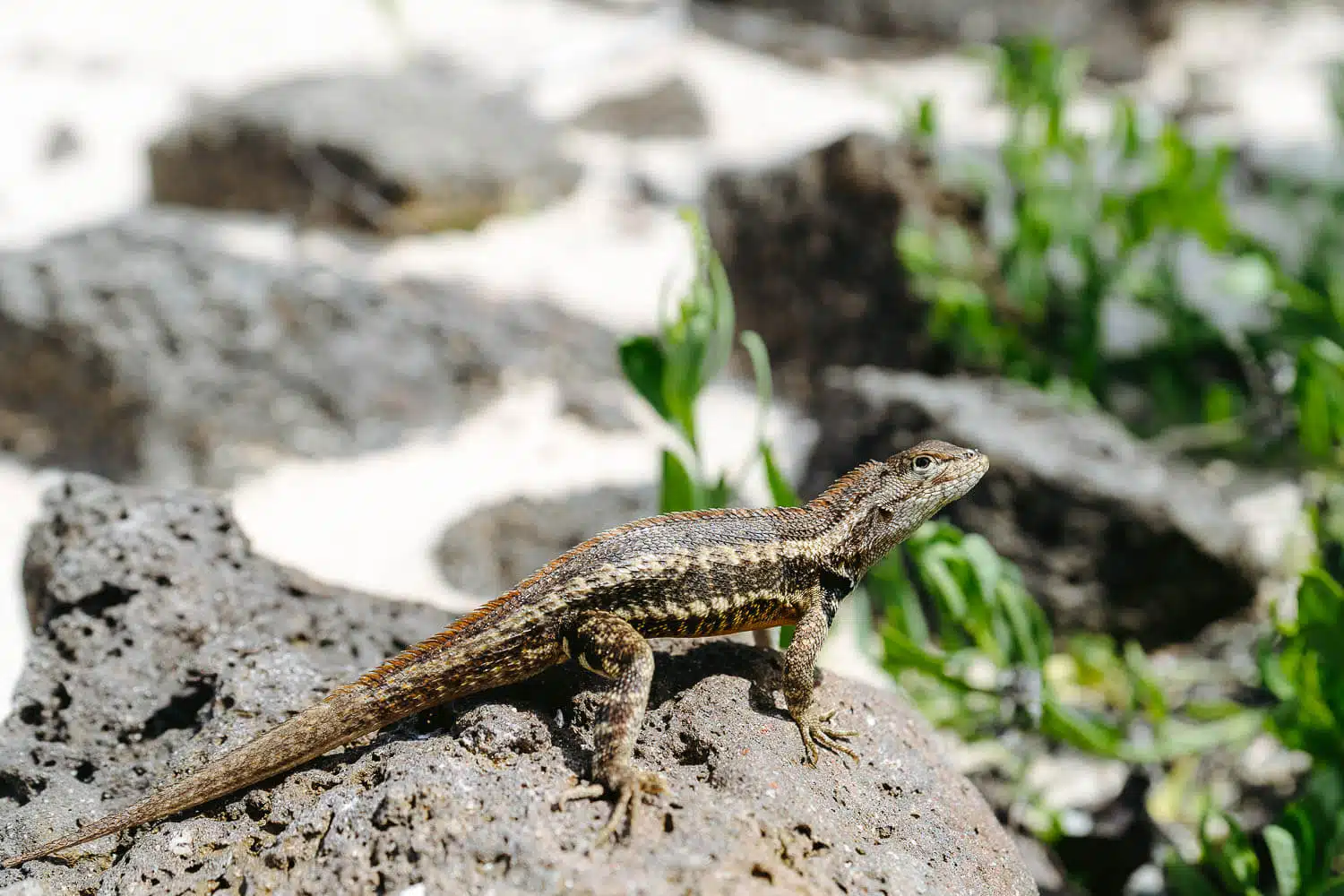
Lava lizards are small, agile reptiles that are among the most common reptiles of the Galapagos wildlife. Belonging to the genus Microlophus, they are found on almost every island, often sunning themselves on volcanic rocks. Males are brightly coloured with yellow or gold patterns, while females are duller with occasional red markings. They defend territories with push-up displays and can engage in short fights if challenged. Lava lizards feed on insects, spiders, and plant matter, and breeding occurs in the warmer months, with females laying several small eggs in burrows.
Where to see: Common on most islands, with local endemic subspecies; especially Santa Cruz, Española, Isabela, Santiago, Santa Fé, Fernandina, Rábida, Genovesa, Bartolomé.
A lava lizard
A lava lizard at Puerto Grande beach
Galapagos Racer Snake
3 species, mildly venomous
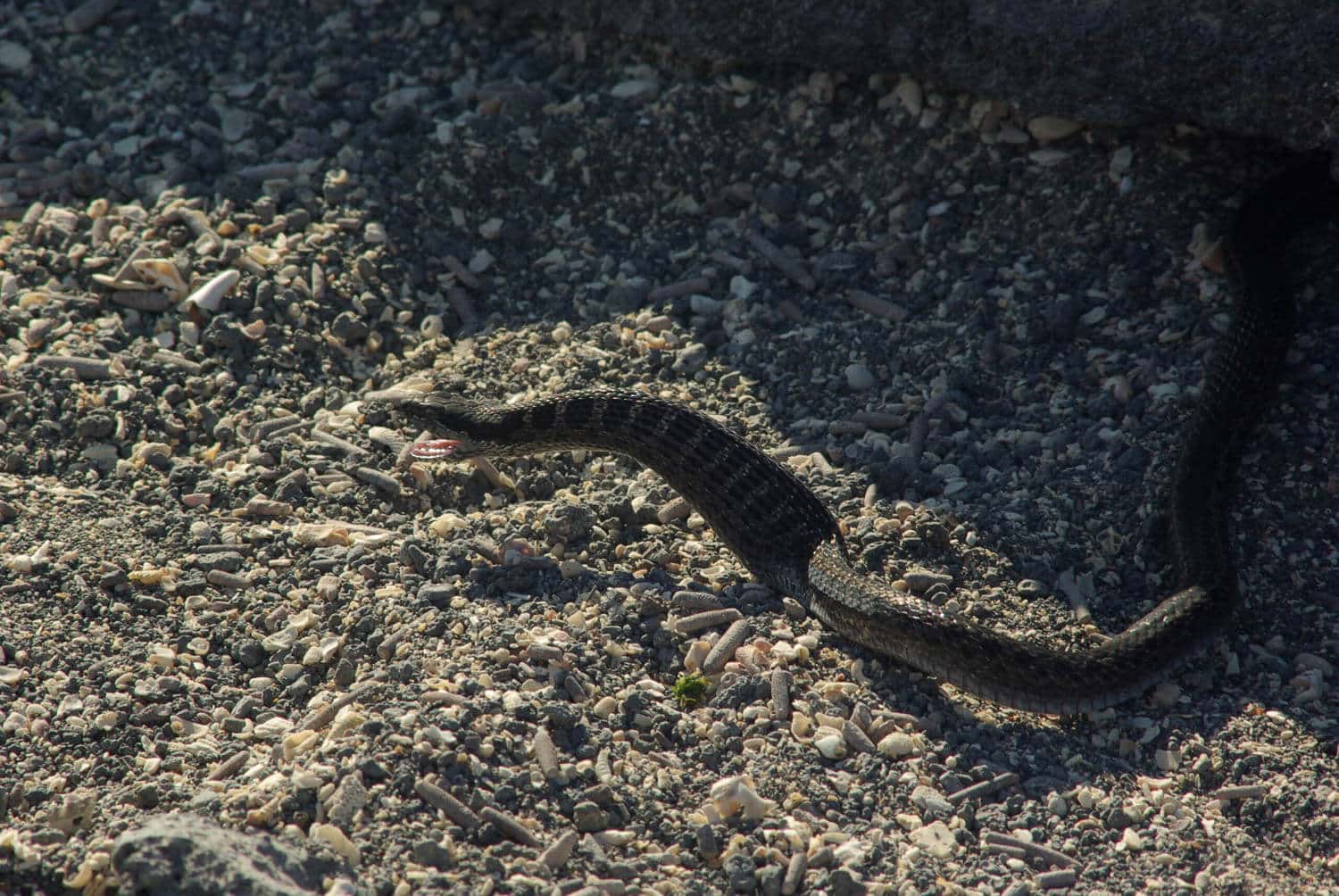
The Galapagos racer (Pseudalsophis biserialis) is a non-venomous snake endemic to the Galapagos Islands. It is slender, fast, and highly adaptable, feeding on small reptiles, eggs, insects, and occasionally young rodents or birds. Adults can grow up to 1.5 meters long. These snakes are diurnal and use their keen sense of smell to hunt. As part of the unique Galapagos wildlife, Galapagos racers play an important ecological role by controlling populations of small animals, helping to maintain the balance of island ecosystems.
Where to see: Found on several islands but best known on Española, Santa Cruz, and Fernandina.
Galapagos Racer Snake | Credit: Jeff Anderson @ https://galapagosconservation.org.uk/
Mammals on Land
Although the Galapagos has few native land mammals, human-introduced species have had a significant impact. Goats, cats, rats, dogs, and donkeys compete with native species for resources, prey on eggs and young, and alter habitats. Conservation efforts focus on controlling or eradicating invasive mammals to protect vulnerable endemic reptiles, birds, and invertebrates.
Galapagos Bats
The only native land mammals
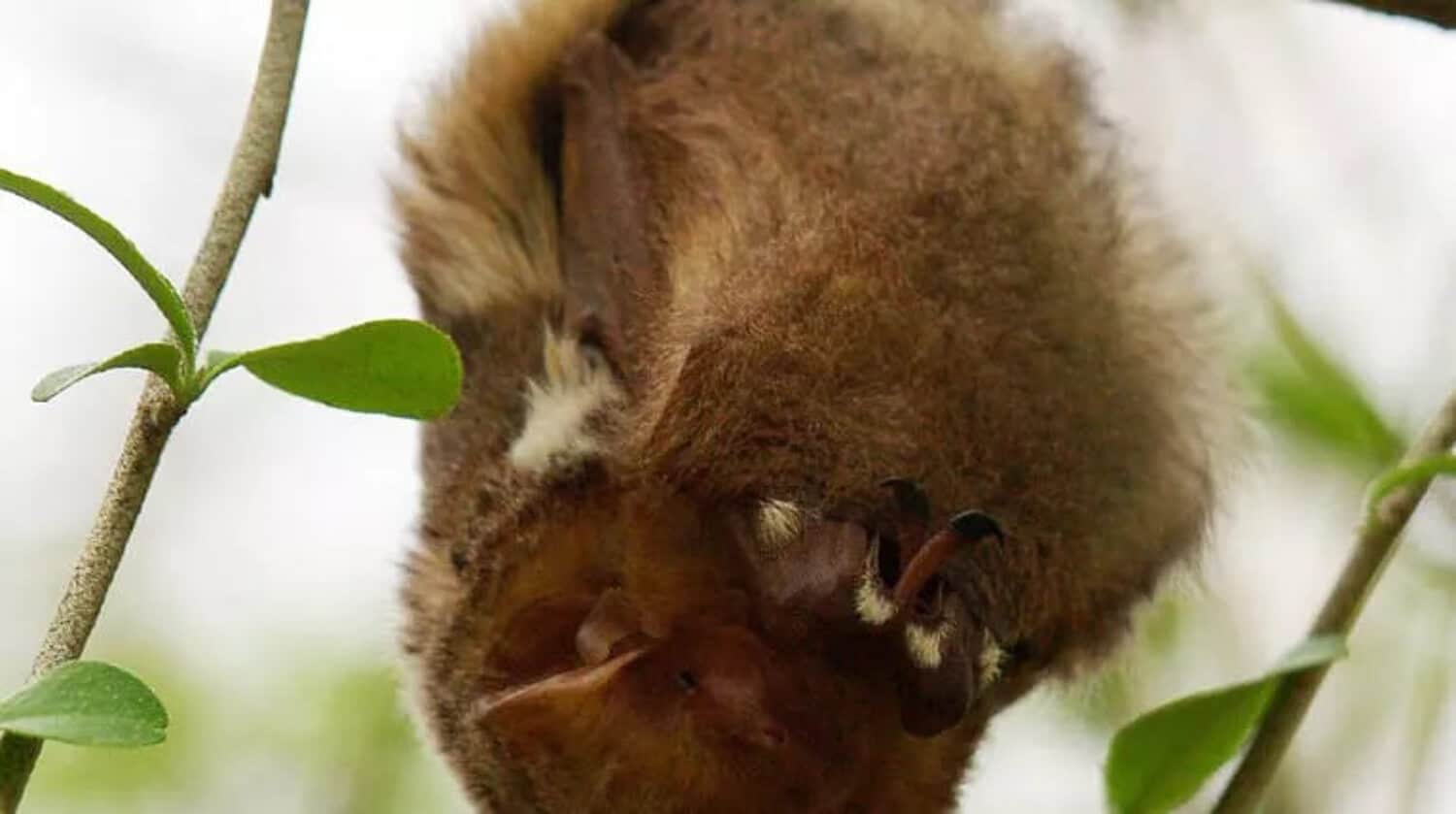
The Galapagos have just two native land mammals, both bats: the Hoary Bat (Lasiurus cinereus villosissimus) and the Western Red Bat (Lasiurus blossevillii brachyotis). These small, nocturnal insect-eaters are rarely seen by visitors but are remarkable for being the only naturally occurring land mammals in the islands.
Where to see: Recorded on Santa Cruz, San Cristobal, Isabela.
Galapagos Red Bat | Credit: Chris Hershaw @ https://galapagosconservation.org.uk/
Several introduced mammals pose serious threats to Galapagos wildlife and ecosystems. Goats were brought by humans for food and quickly became feral, overgrazing vegetation and preventing the regeneration of native plants such as cacti and Scalesia trees. Rats prey on eggs and chicks of native birds and compete with native species for food. Cats hunt small birds, reptiles, and invertebrates, significantly impacting populations of endemic species like the mangrove finch and lava lizards. Dogs and donkeys, while less numerous, can disrupt wildlife habitats and occasionally prey on smaller animals. Collectively, these invasive mammals have been major drivers of habitat degradation and species decline, making control and eradication efforts crucial for the protection of Galapagos wildlife.
Invertebrates
The islands’ invertebrate fauna may be less conspicuous than the giant tortoises, but it is just as vital. Galapagos land snails, insects, spiders, and scorpions form essential components of terrestrial ecosystems. Many species are highly localized, showing remarkable diversity even within a single island. These small creatures support nutrient cycling, pollination, and serve as key prey for other endemic animals.
Galapagos Land Snails
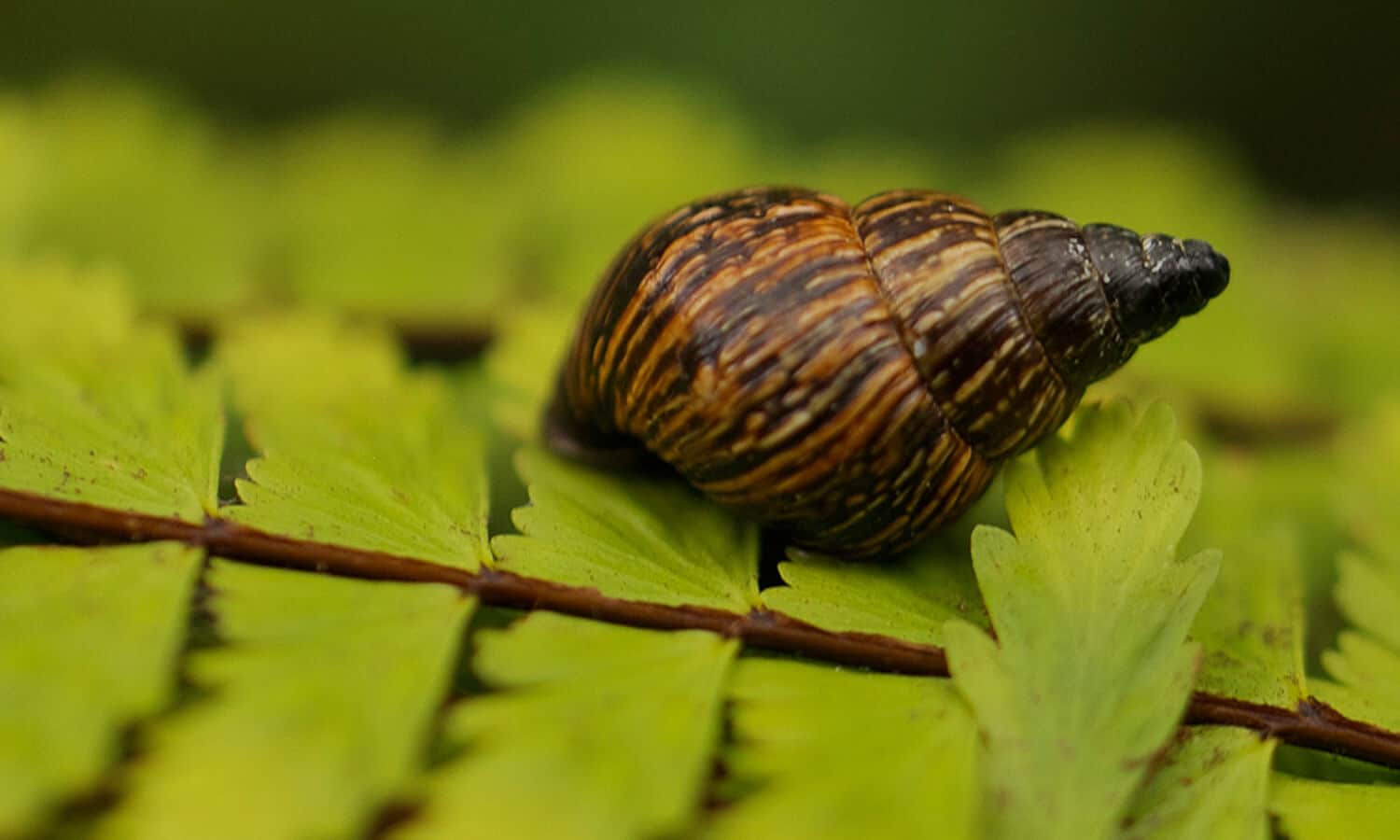
Bulimulus spp., 60 species
Galapagos land snails, particularly the bulimulid species, are endemic to the islands and vary widely in size, shell shape, and color. They play a key role in the ecosystem by helping decompose plant material and recycle nutrients into the soil. Many species are highly localized, often found only on a single island or even one part of an island, making them vulnerable to habitat loss and introduced predators like rats. Their shells also provide a microhabitat for small insects and mites.
Where to see: Santa Cruz highlands, Isabela, Floreana.
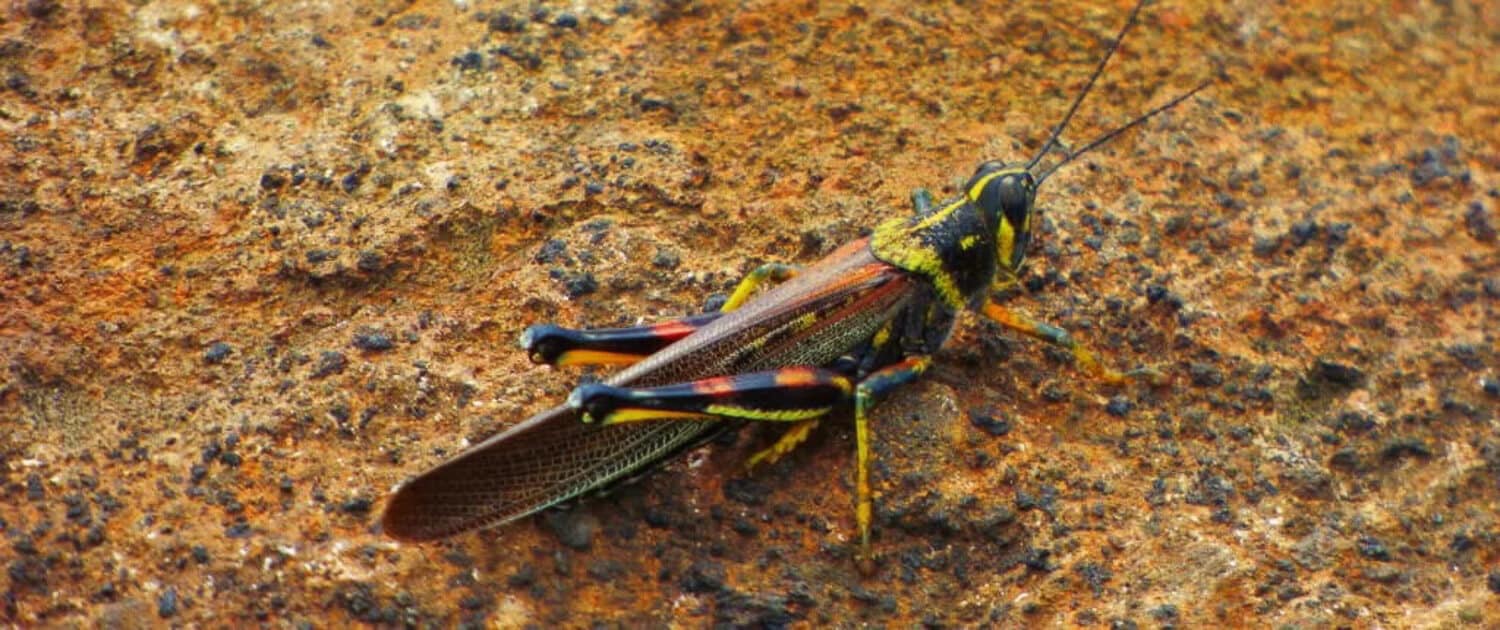
The large painted locust is endemic to the Galapagos and can be found on all islands except Española, where the smaller painted locust resides. They are brightly colored, strong fliers, and excellent jumpers, reaching distances of up to three meters. These locusts are a major food source for lava lizards and Galapagos hawks. They tend to be most abundant in the lowlands, especially after heavy rainfall, and their swarming behavior resembles that of other locust species, although they remain mostly solitary.
Where to see: Common in arid zones of most islands.
Large Painted Locust | Credit: Dan Wright @ https://galapagosconservation.org.uk/
Galapagos Carpenter Bee
Xylocopa darwini
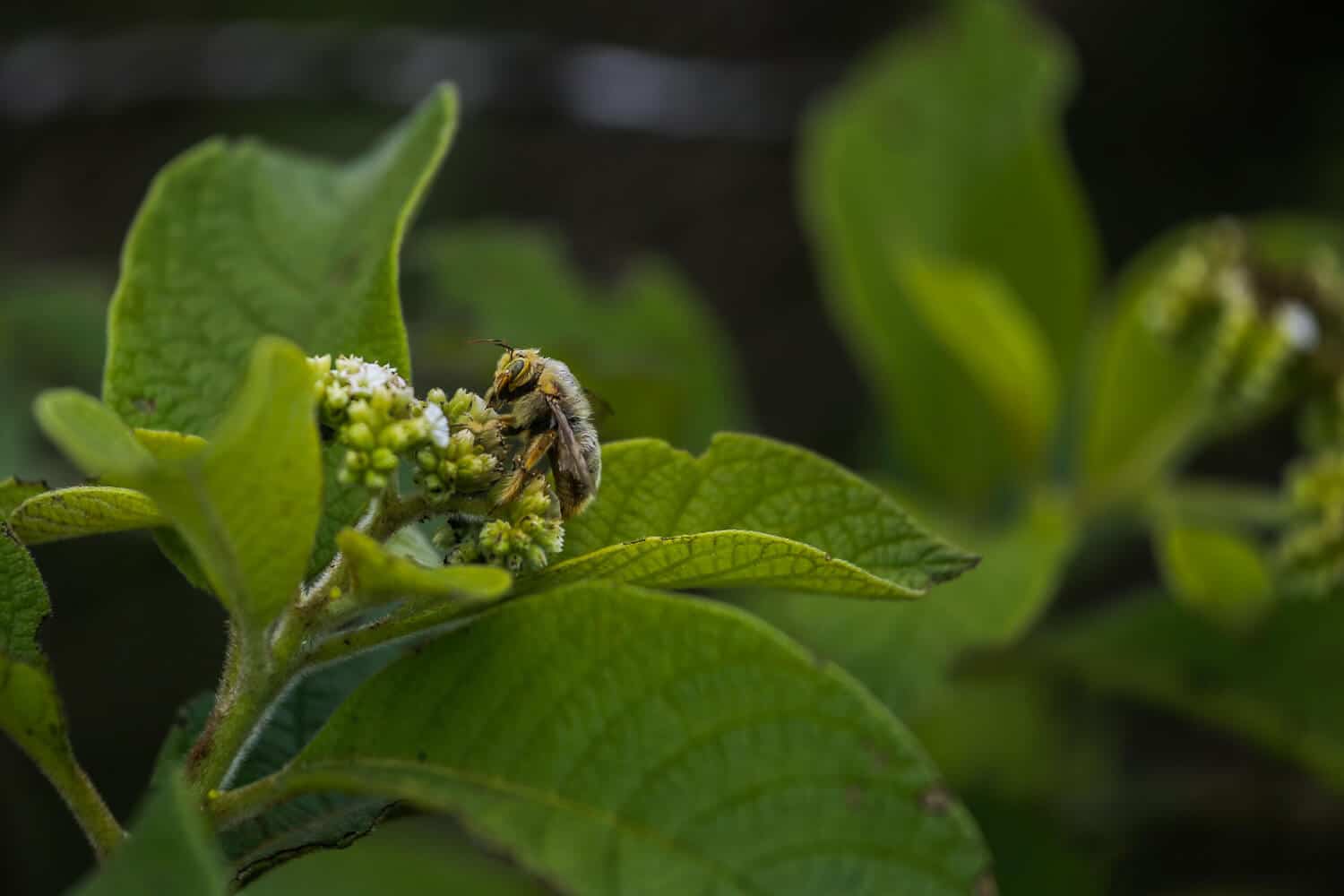
The Galapagos carpenter bee is the archipelago’s sole native bee, playing a vital role in pollinating many of the islands’ endemic plants. Unlike more familiar honeybees, these solitary bees nest in wood and plant stems, quietly supporting the unique ecosystems of the islands without forming large hives.
Where to see: Widespread on main islands (Santa Cruz, Isabela, San Cristobal).
The Galapagos host several native and migratory butterfly species, including the striking Phoebis sennae. These colorful insects contribute to pollination and add vibrant life to the islands’ landscapes, from arid lowlands to humid highlands.
Where to see: Santa Cruz, Isabela, San Cristobal.
Spiders, Scorpions, and Centipedes
Scolopendra galapagoensis
The islands’ terrestrial invertebrates include a variety of spiders, scorpions, and centipedes, such as the venomous Scolopendra galapagoensis. These small predators help regulate insect populations and are an important, though often overlooked, part of the Galapagos ecosystem.
Where to see: Throughout the archipelago, especially dry lowland zones.
Galapagos Wildlife in the Air
The Galapagos’ birdlife is world-renowned, forming a key part of Galapagos wildlife. Birds here display extraordinary adaptations, from the highly specialized feeding habits of Darwin’s finches to the dramatic courtship displays of albatrosses. Seabirds dominate the coastline, while some terrestrial species thrive inland, often interacting with the unique reptile populations that define Galapagos wildlife.
Iconic Endemic Birds
These birds define the Galapagos. Darwin’s finches, mockingbirds, doves, hawks, and owls all evolved in isolation, displaying unique traits and behaviors. Many play essential roles in seed dispersal, insect control, and pollination. Observing these birds provides insight into evolution in action and the ecological balance of the islands.
Darwin's Finches
13 species, adaptive radiation
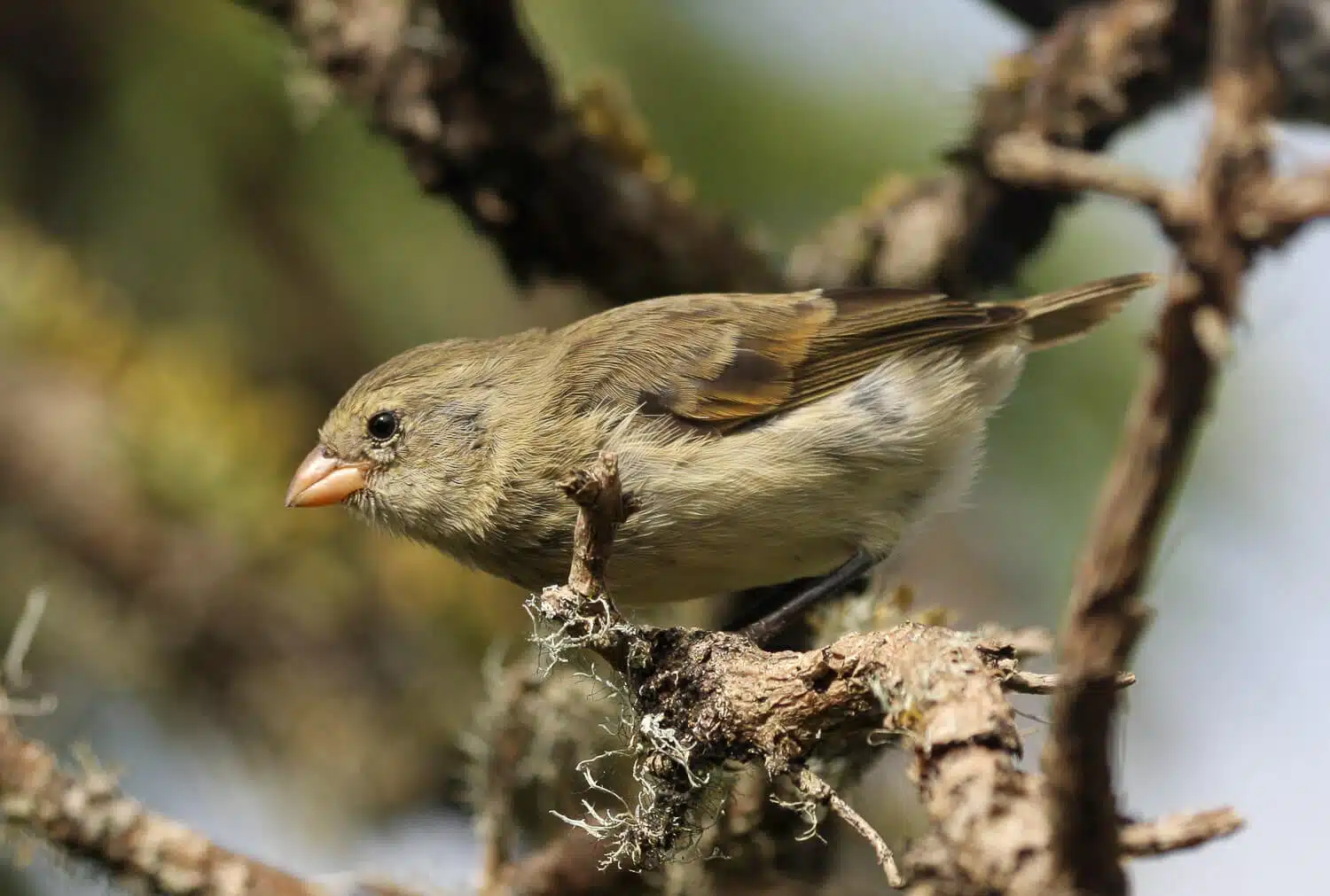
Darwin’s finches are a group of small, endemic birds found across the Galapagos Islands, famous for their role in studies of evolution. They vary in beak size and shape, each adapted to specific diets such as seeds, insects, or cactus. The medium tree finch, for example, lives on Floreana Island and nests in Scalesia forests, laying four eggs per clutch. The mangrove finch is extremely rare, restricted to two mangrove areas on Isabela, and feeds on insects, using its pointed beak to probe tree bark and leaf litter. These finches are usually monogamous, maintain territories, and exhibit specialized foraging behaviors that highlight the islands’ adaptive radiation.
Where to see: All major islands (diversity highest on Santa Cruz, Isabela, San Cristobal, Floreana, Española).
Small Tree Finch | Credit: Prof. W. G. Hale @ https://galapagosconservation.org.uk/
Galapagos Mockingbirds
4 species
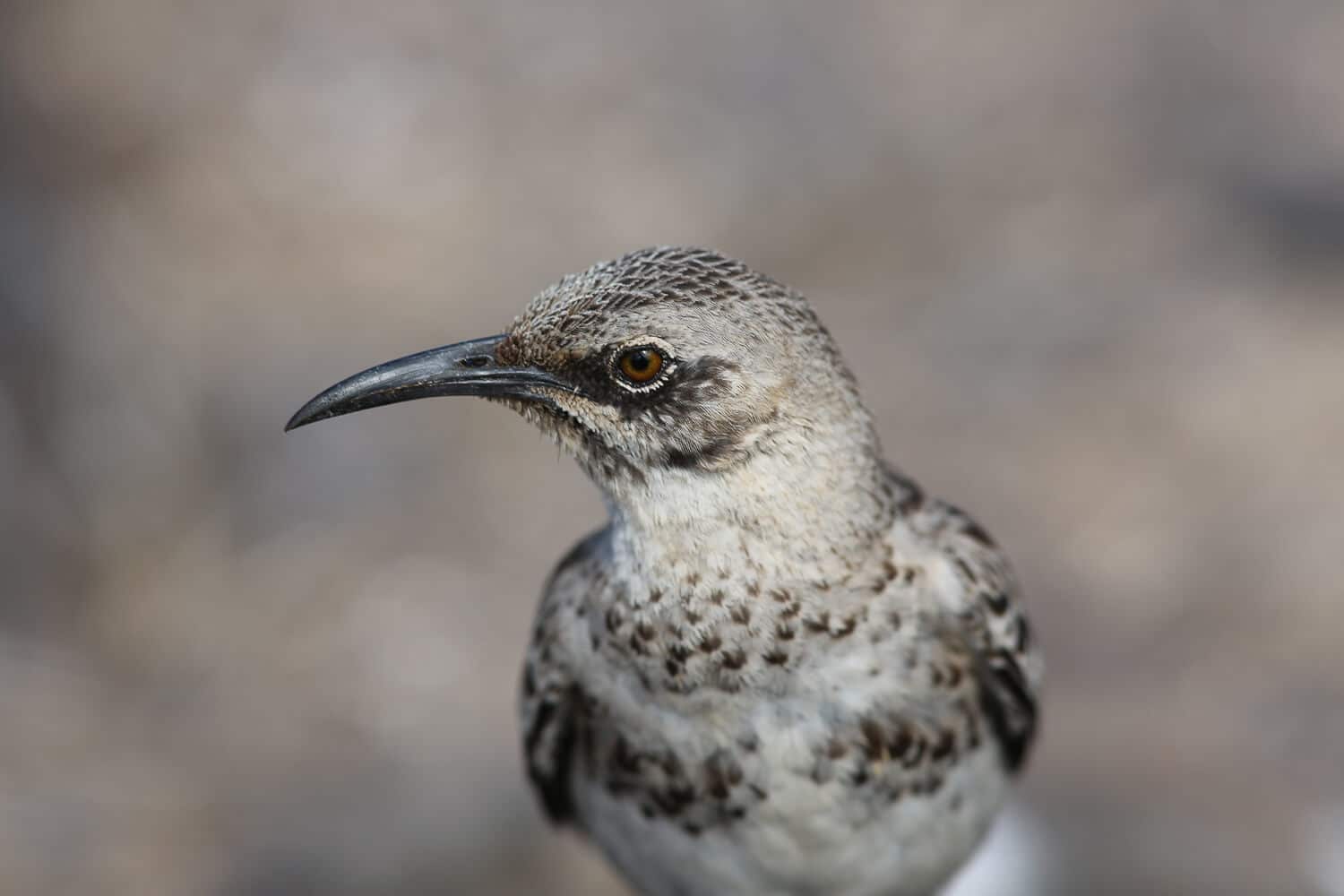
The San Cristobal mockingbird is one of four endemic Galapagos mockingbird species. It is omnivorous, feeding on insects, fruit, small lizards, and crabs, occasionally removing ticks from iguanas. Unlike other mockingbirds, they do not cooperate in raising young; a single pair holds its territory. Nests are built in trees or Opuntia cacti, with two to five eggs per clutch. These birds are medium-sized, with grey and white plumage and long tails, and juveniles exhibit spotted breasts.
Where to see: San Cristobal, Española, Floreana (nearby islets), Santa Cruz, Genovesa.
Espanola Mockingbird | Credit: Luis Ortiz Catedral @ https://galapagosconservation.org.uk/
Galapagos Hawk
Buteo galapagoensis
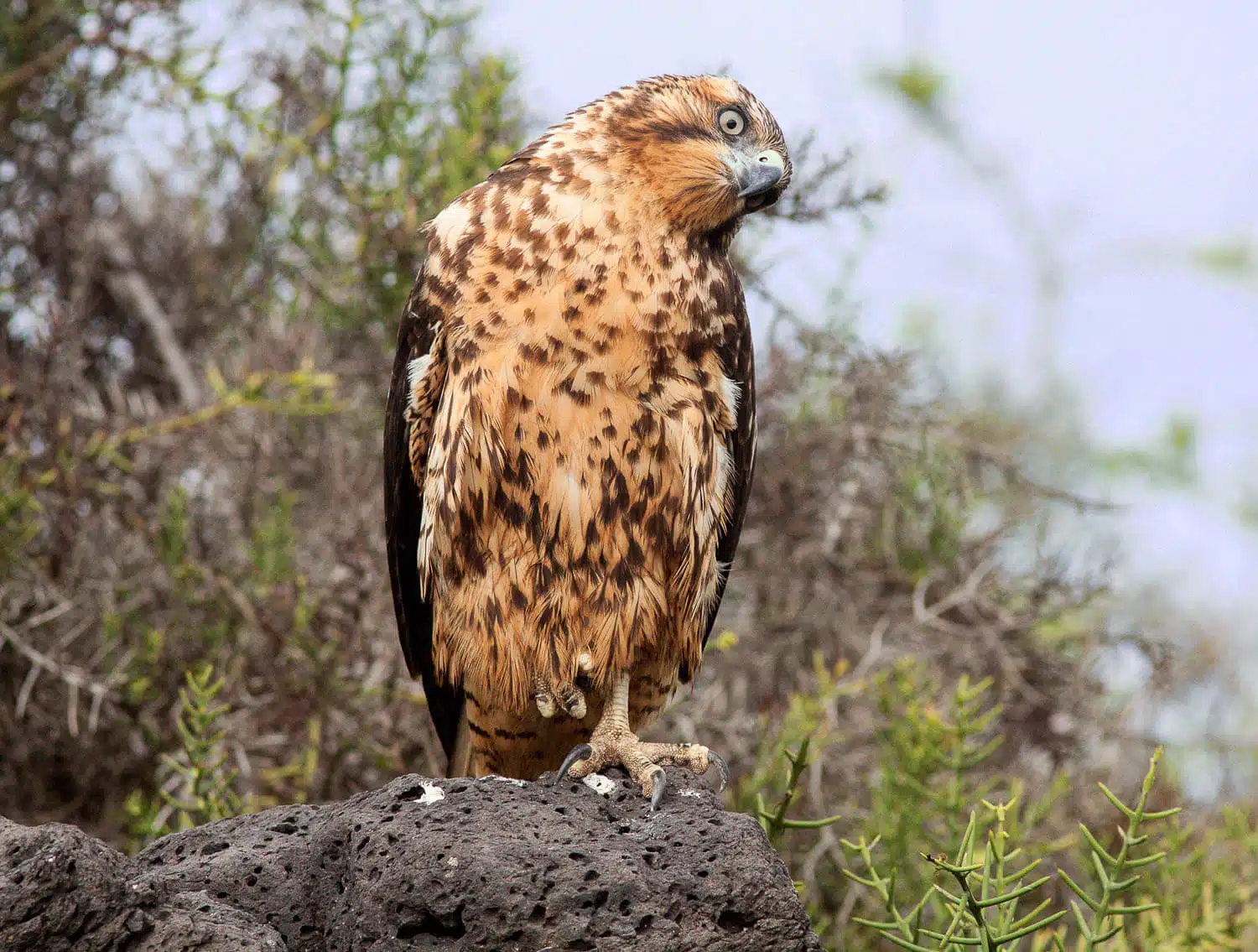
The Galapagos hawk is the top terrestrial predator in the islands, feeding on birds, lizards, insects, and small mammals. Highly territorial, they often form small groups to defend hunting grounds. Adults are brown with pale streaking, and juveniles are darker. The species is slow to reproduce, usually laying two eggs, with both parents caring for the young. Their presence influences the behavior and population dynamics of other terrestrial species.
Where to see: Isabela, Fernandina, Santiago, Española, Santa Fé.
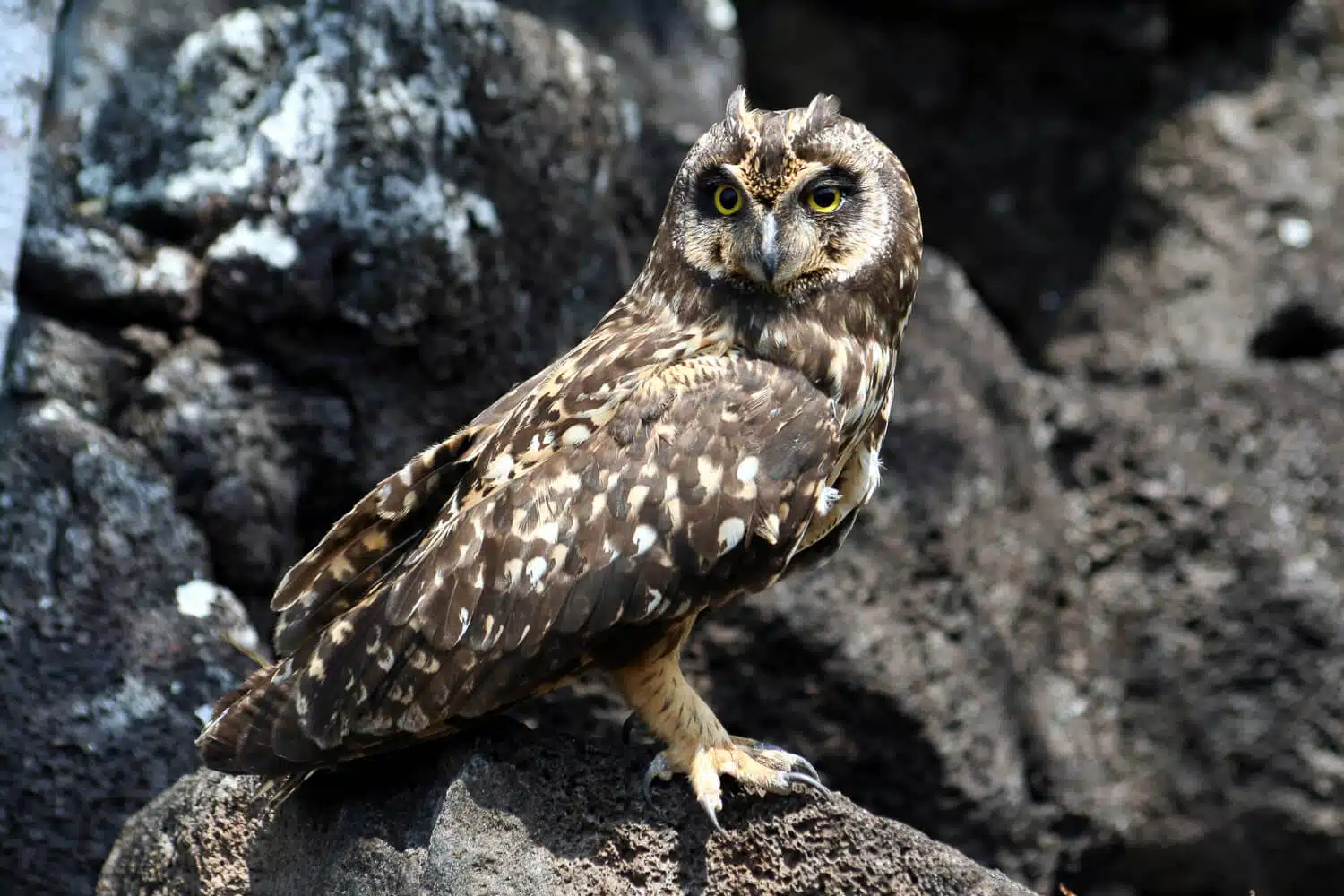
The Galapagos short-eared owl is endemic, smaller, and darker than mainland counterparts. It hunts by flying low over open grasslands or lava rock, feeding on rats, lava lizards, and birds. Unlike most owls, it is active during the day to avoid competition with the Galapagos hawk. Unique hunting techniques include ambushing storm petrels by waiting near lava tunnels. Nests are placed under shrubs or trees, with two to four eggs per clutch.
Where to see: Genovesa, Floreana.
Short Eared Owl | Credit: Hafdis Hanna Aegisdottir @ https://galapagosconservation.org.uk/
Famous Seabirds
The Galapagos is home to globally recognized seabirds, including boobies, frigatebirds, gulls, and albatrosses. These species are remarkable for their feeding strategies, social behaviors, and breeding adaptations. Many nest on cliffs and rocky shores, and some, like the waved albatross, undertake long oceanic migrations.
Blue-footed Booby
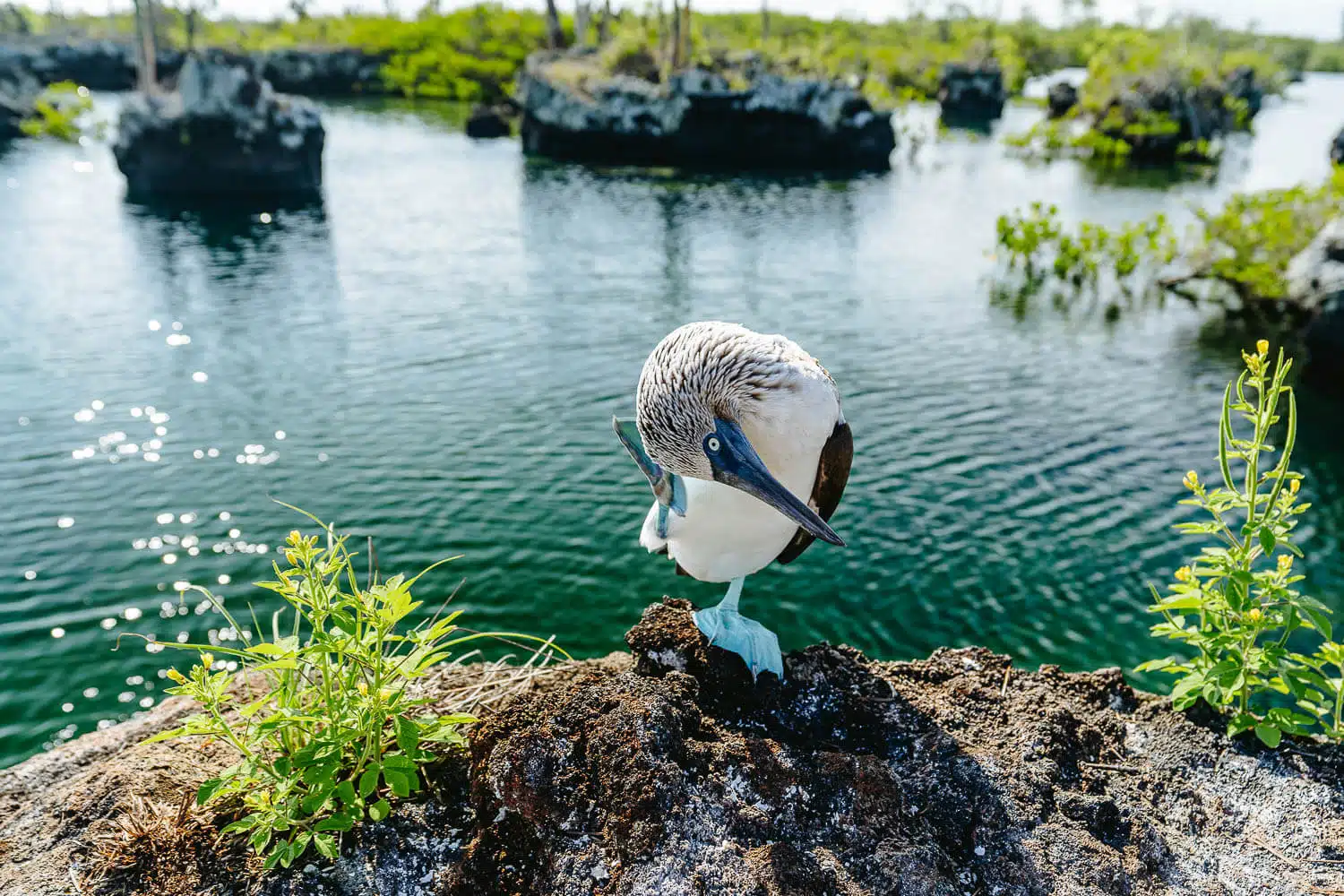
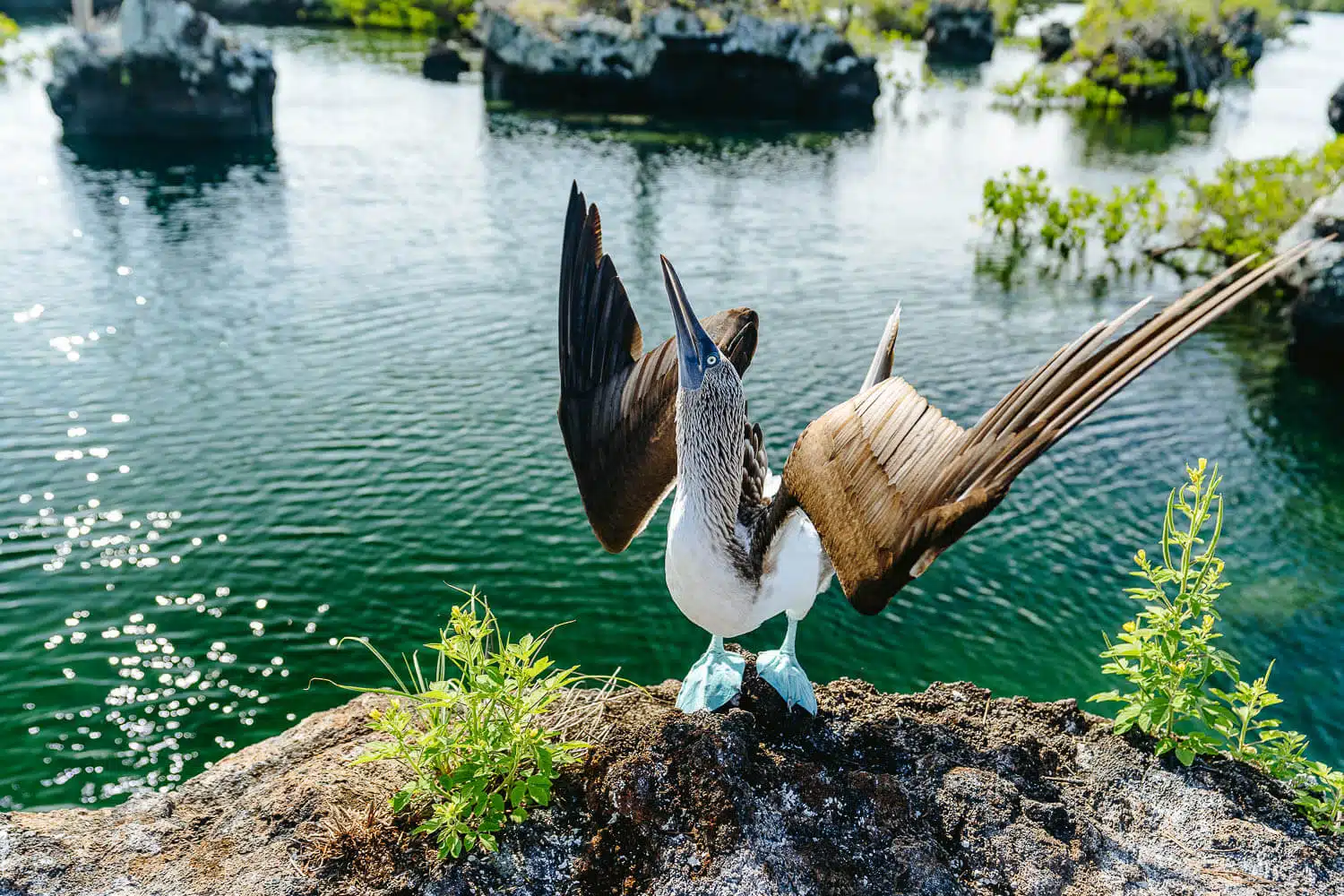
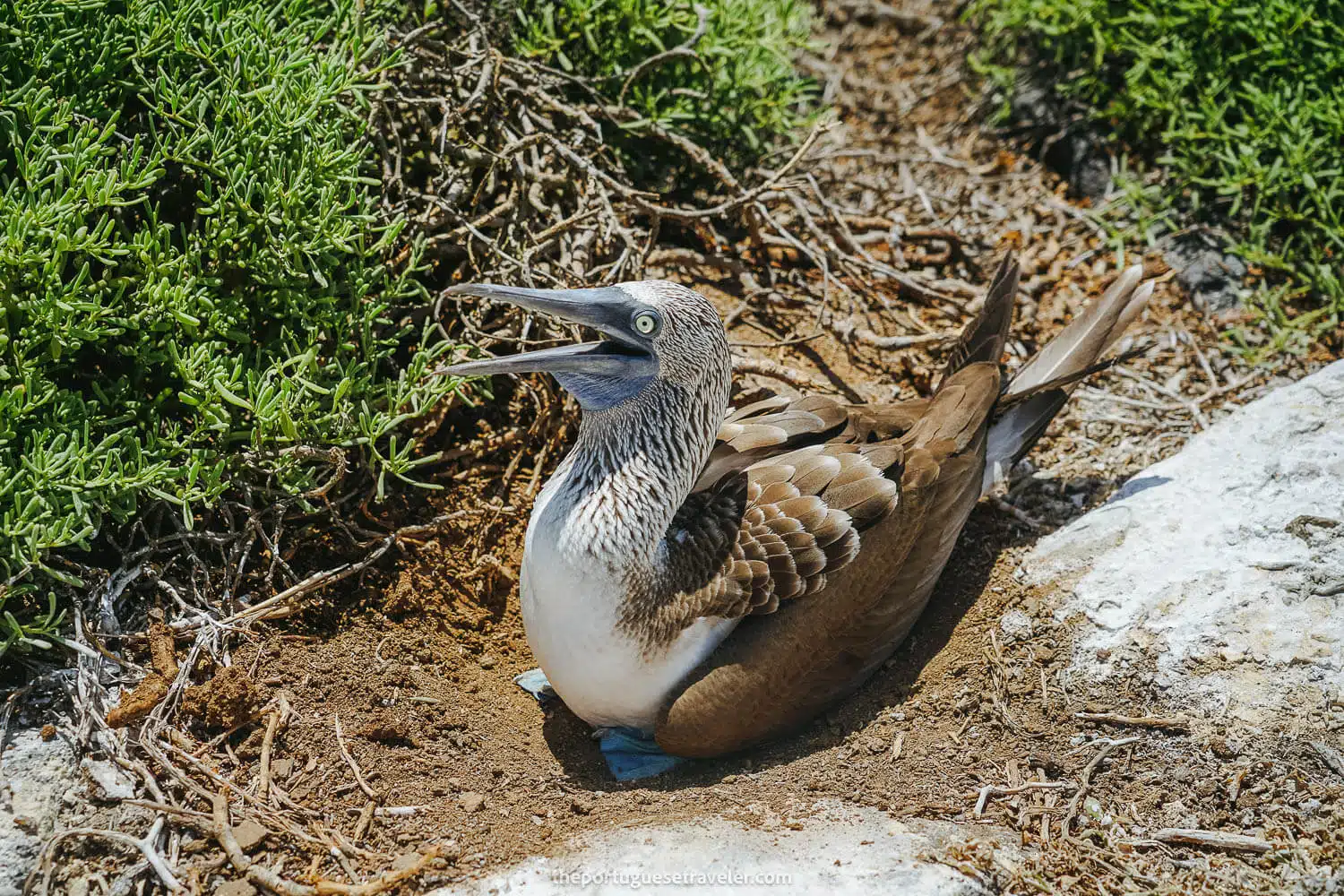
The blue-footed booby is a medium-sized seabird and a well-known part of Galapagos wildlife, found throughout the islands. Its striking blue feet are used in courtship displays, where males lift their feet high to attract females. They primarily feed on fish, such as sardines and flying fish, by plunge-diving from heights up to 30 meters. Blue-footed boobies breed in colonies, building nests on the ground or low vegetation. Clutches usually consist of two eggs, and an unusual behavior called obligate siblicide often occurs, where the stronger chick outcompetes or kills the weaker sibling.
Where to see: Española, San Cristobal, Santa Cruz, North Seymour, Isabela.
A Blue footed booby in Los Tuneles tour
A blue-footed booby trying to call a female's attention
A blue-footed booby in Espanola Island
Red-footed Booby
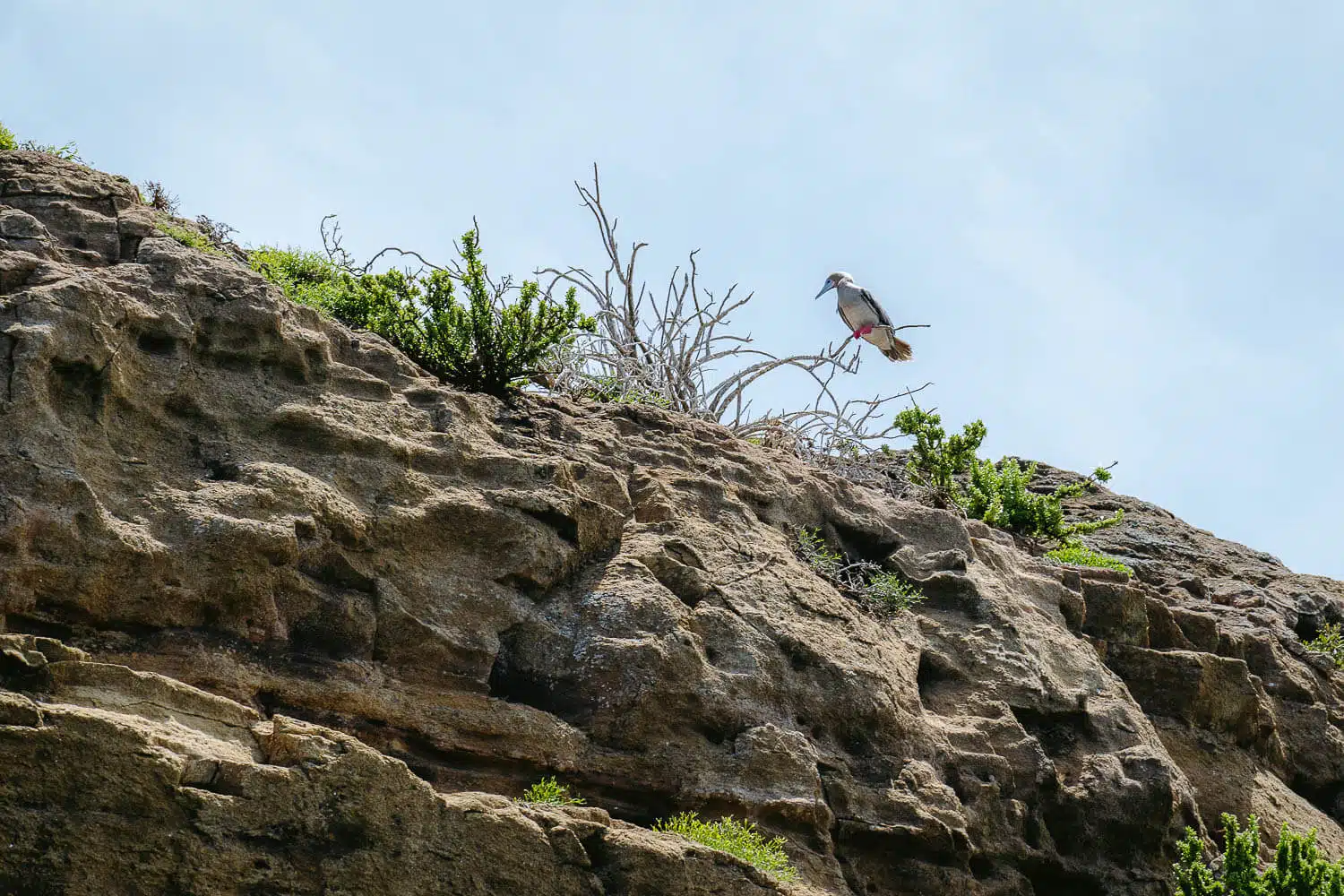
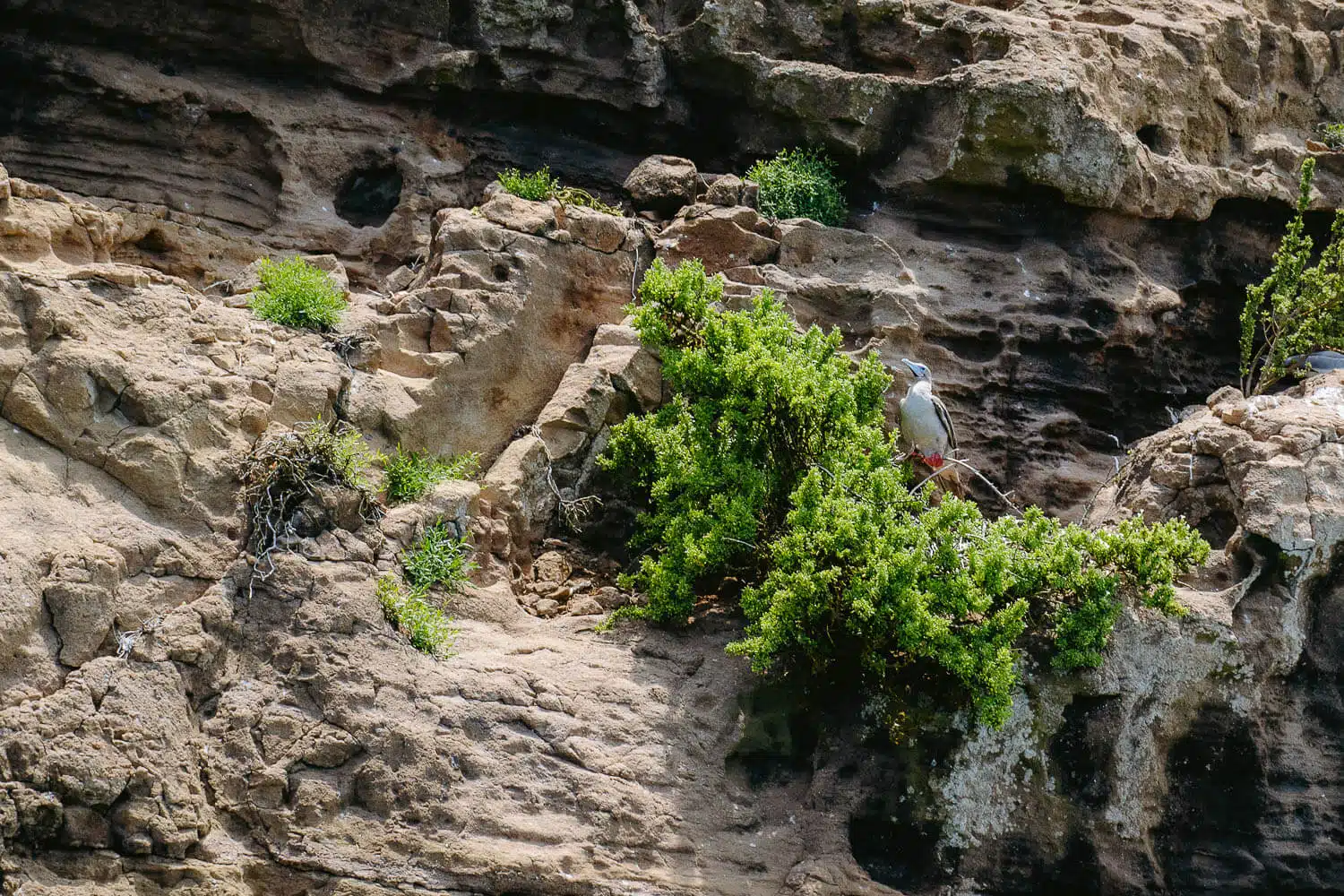
The red-footed booby is the smallest of the Galapagos boobies and shows several color morphs, with the brown morph most common. Its red feet are used for courtship displays, including the male’s “skypointing” ritual. These birds are excellent divers, feeding primarily on fish and squid, and are highly social, forming large breeding colonies in shrubs or small trees. They usually lay a single egg per breeding attempt, with both parents incubating and feeding the chick.
Where to see: Genovesa (largest colony), San Cristobal, Wolf & Darwin.
A Red-Footed Booby
A Red-Footed Booby
Nazca Booby
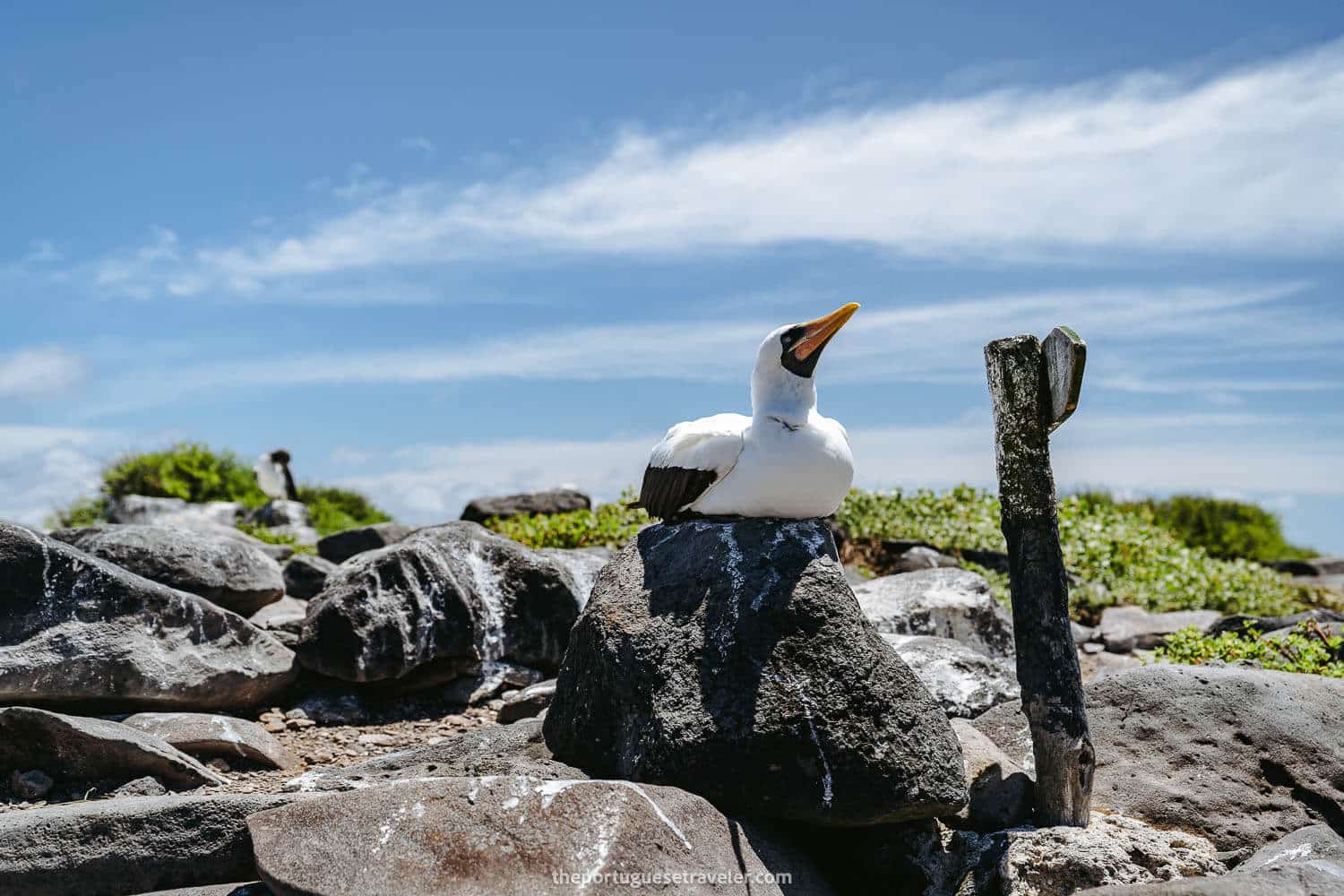
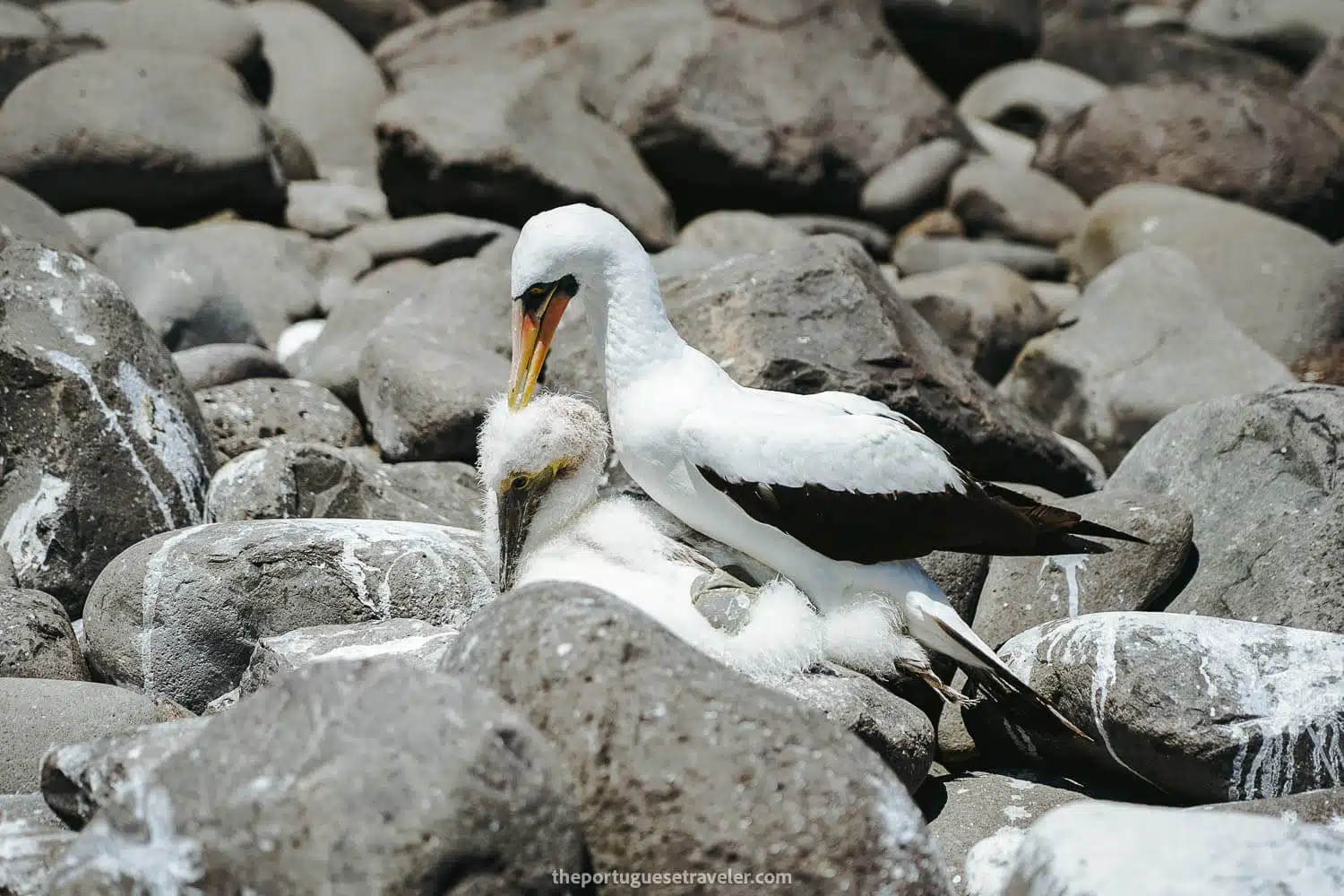
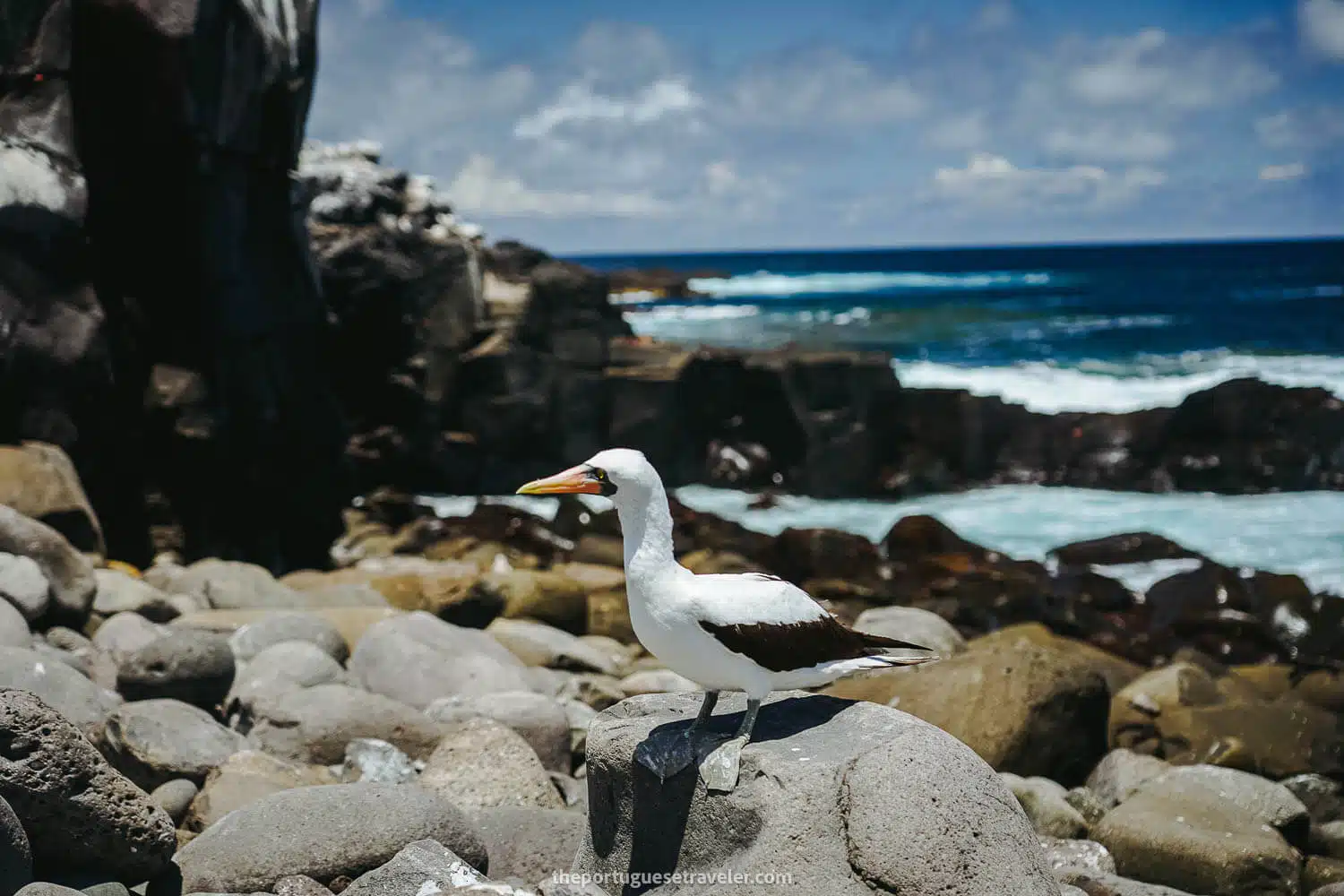
The Nazca booby is a large, white seabird with black tail feathers and an orange-yellow beak in males (females have paler beaks). They forage by plunge-diving for fish in coastal waters. Nazca boobies are known for obligate siblicide, where the larger chick dominates and the smaller often dies. They lay two eggs per clutch, and breeding occurs primarily on the islands, with nests built on bare ground or low shrubs.
Where to see: Española, Genovesa, Wolf & Darwin.
A Nazca Booby
Nazca Boobies breeding area in Española Island
A Nazca Booby in Española Island
Frigatebirds
Magnificent & Great
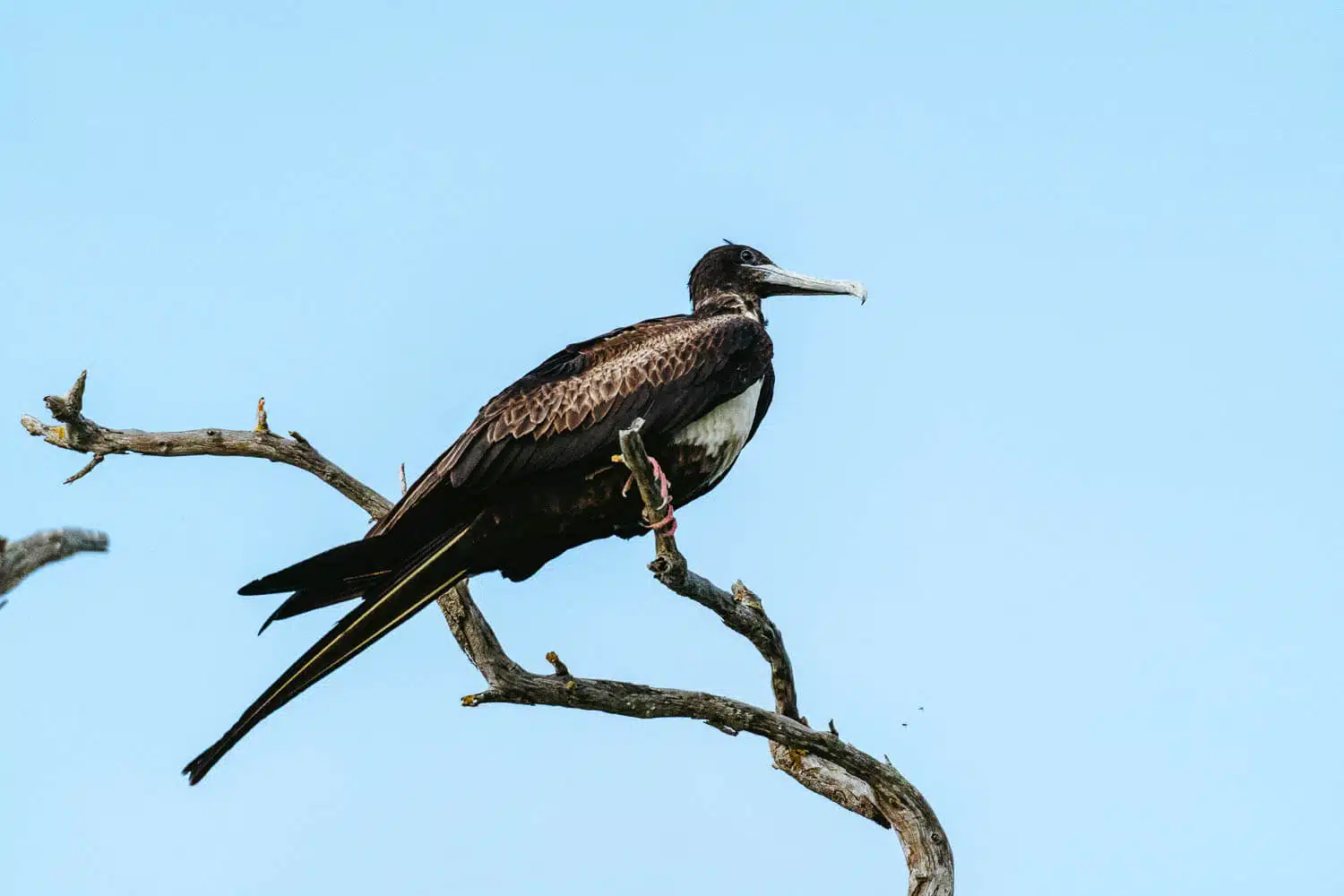
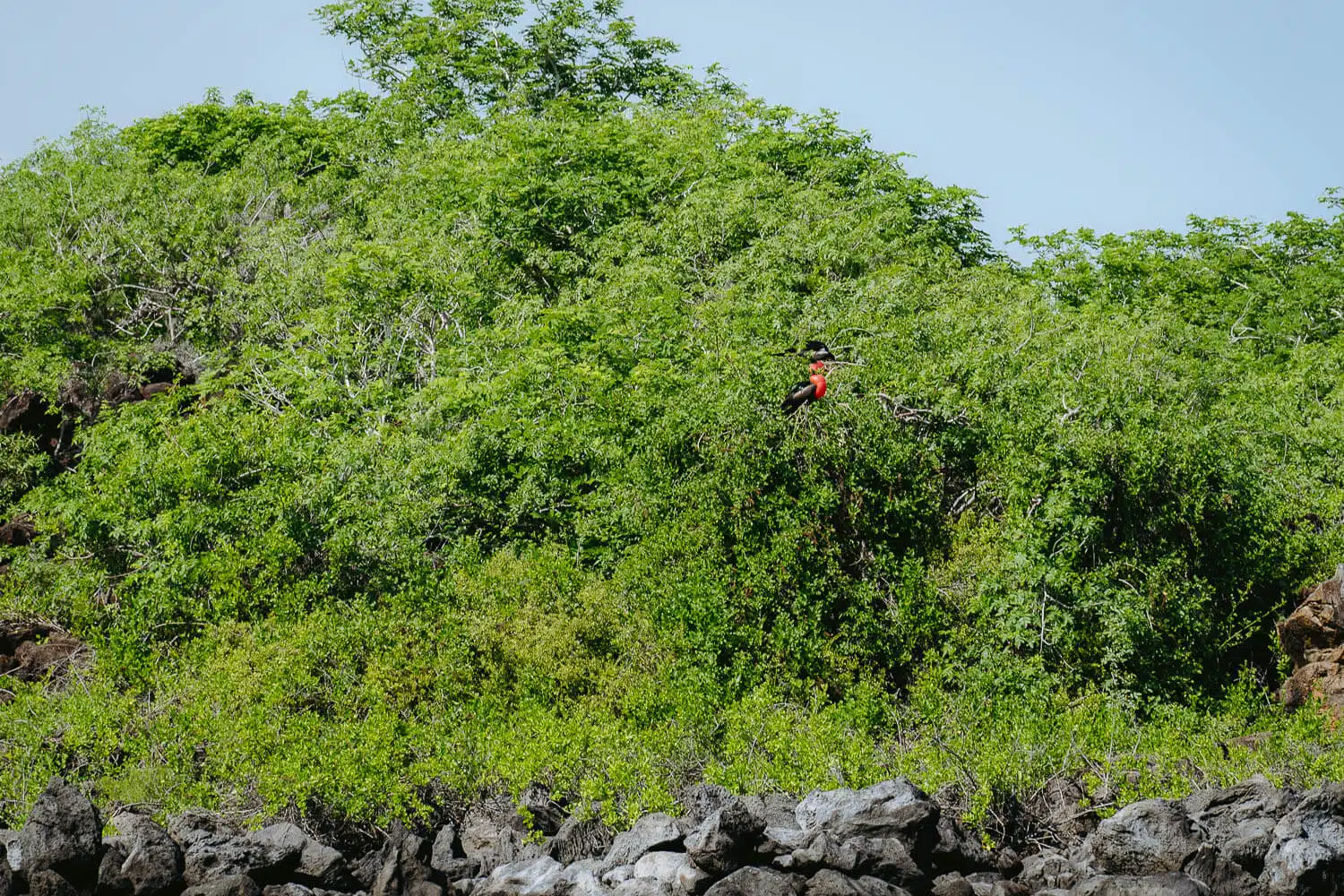
Magnificent frigatebirds have black plumage with a purple sheen on males and a red gular pouch used during courtship displays; females have white breasts. Great frigatebirds are similar but have a green sheen on the back of males. Both species are expert aerial hunters and kleptoparasites, stealing food from other birds. They feed mainly on fish, small crustaceans, and occasionally eggs or chicks of other birds. Nests are built in trees, bushes, or sometimes on the ground, with both parents participating in incubation and chick-rearing.
Where to see: San Cristobal, North Seymour, Genovesa, Wolf & Darwin, Santa Fé.
A Frigate bird chilling on a tree
Frigate birds near Puerto Grande beach
Frigatebird in Kicker Rock
Waved Albatross
Phoebastria irrorata
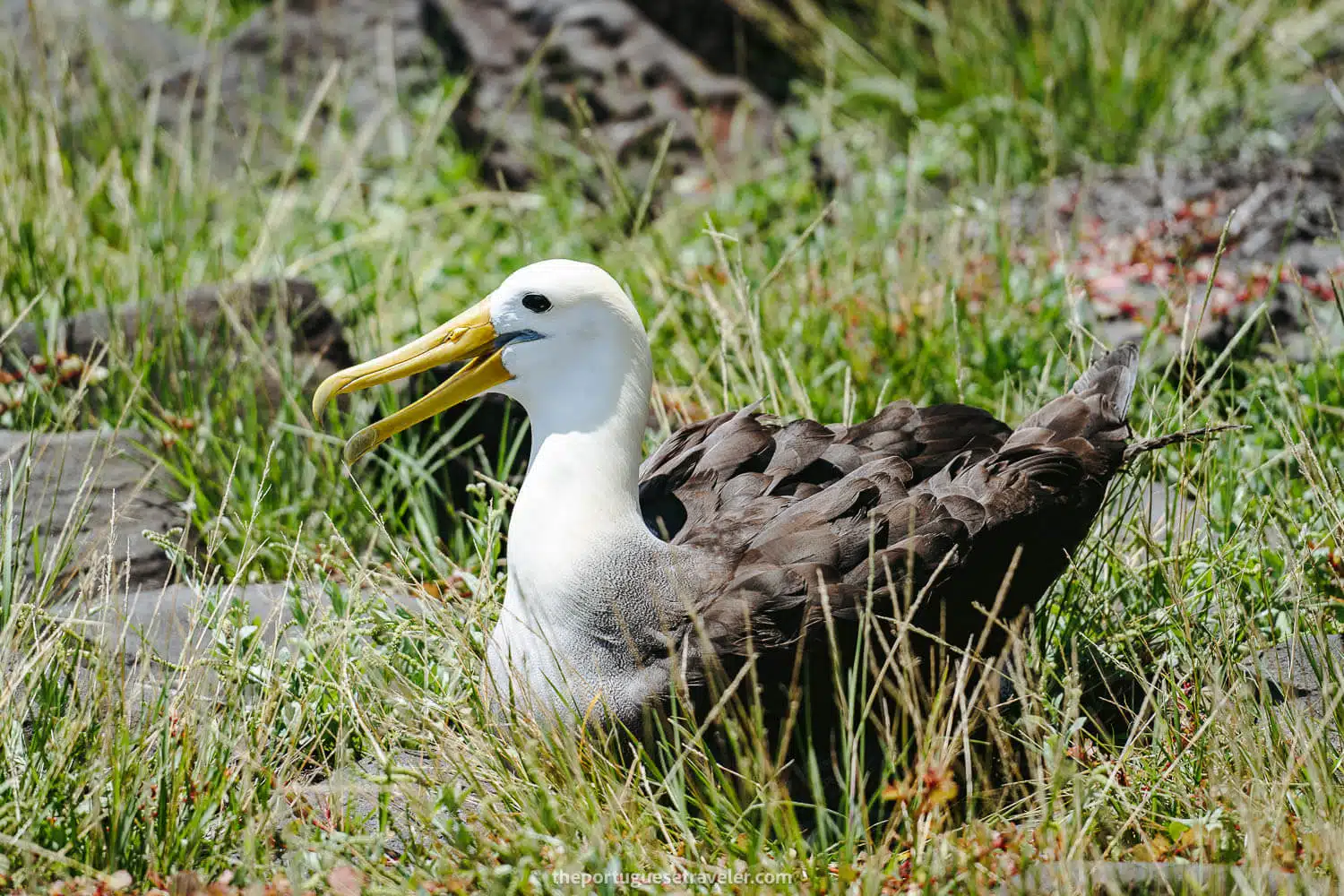
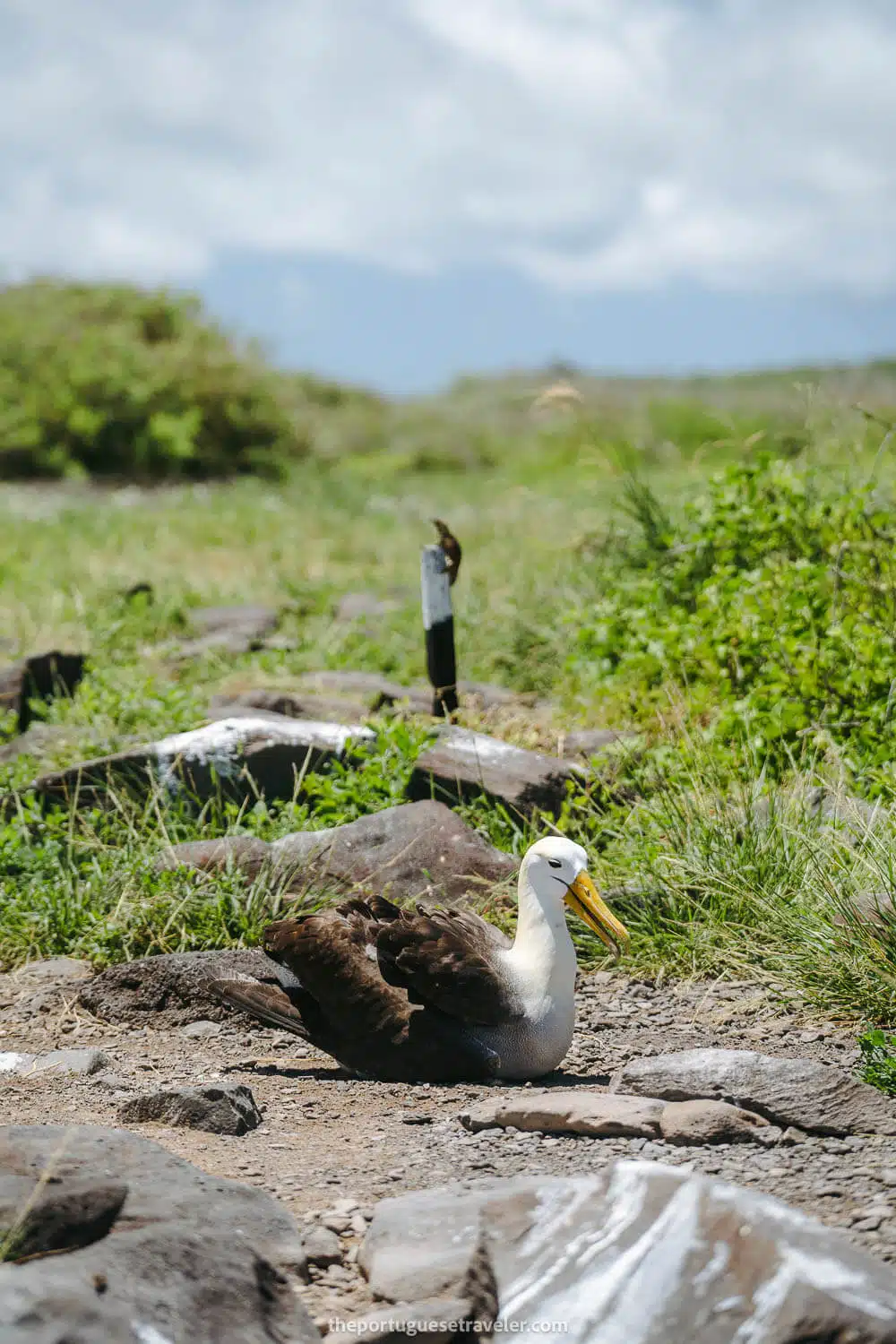
The waved albatross is the largest Galapagos bird, with a wingspan up to 2.5 meters. They are exceptional gliders, spending most of their lives at sea, feeding on fish and squid. Courtship involves elaborate dances including bill circling, clacking, and head nodding. Couples mate for life and lay a single egg per season. Chicks are fed regurgitated pre-digested food until fledging, which occurs around five to six months. Their primary breeding site is Española Island, though small populations exist elsewhere.
Where to see: Española (exclusive nesting site, Apr–Dec).
The Waved Albatross in Punta Suarez
The Waved Albatross with a lava lizard behind
Flightless Cormorant
Phalacrocorax harrisi
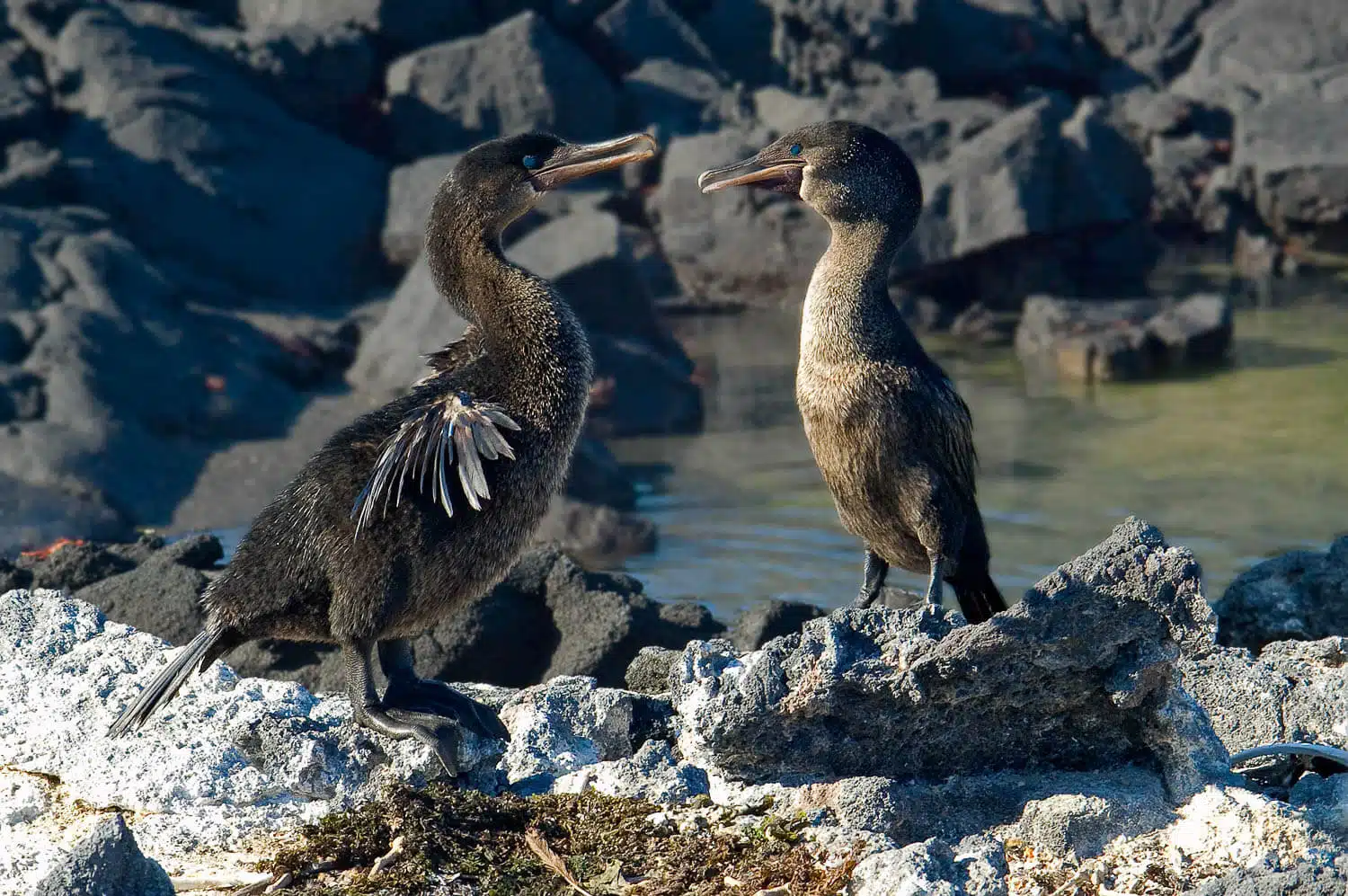
The flightless cormorant is endemic to the Galapagos Islands, primarily found on Fernandina and Isabela. It is notable for its small, vestigial wings, which are incapable of flight, making it the only cormorant species in the world with this adaptation. Its body is dark brown to black, with strong legs and webbed feet, perfectly adapted for diving and swimming. Flightless cormorants hunt in coastal waters, feeding mainly on fish, eels, and small octopuses.
Breeding occurs year-round, with both parents participating in nest building, incubation, and chick feeding. Nests are typically constructed from sticks and seaweed close to the shore. This species’ limited distribution and small population make it vulnerable to environmental changes, human disturbance, and introduced predators.
Where to see: Fernandina, west coast of Isabela.
Flightless Cormorants | Credit: Roger Bates @ https://galapagosconservation.org.uk/
Swallow-tailed Gull
Creagrus furcatus
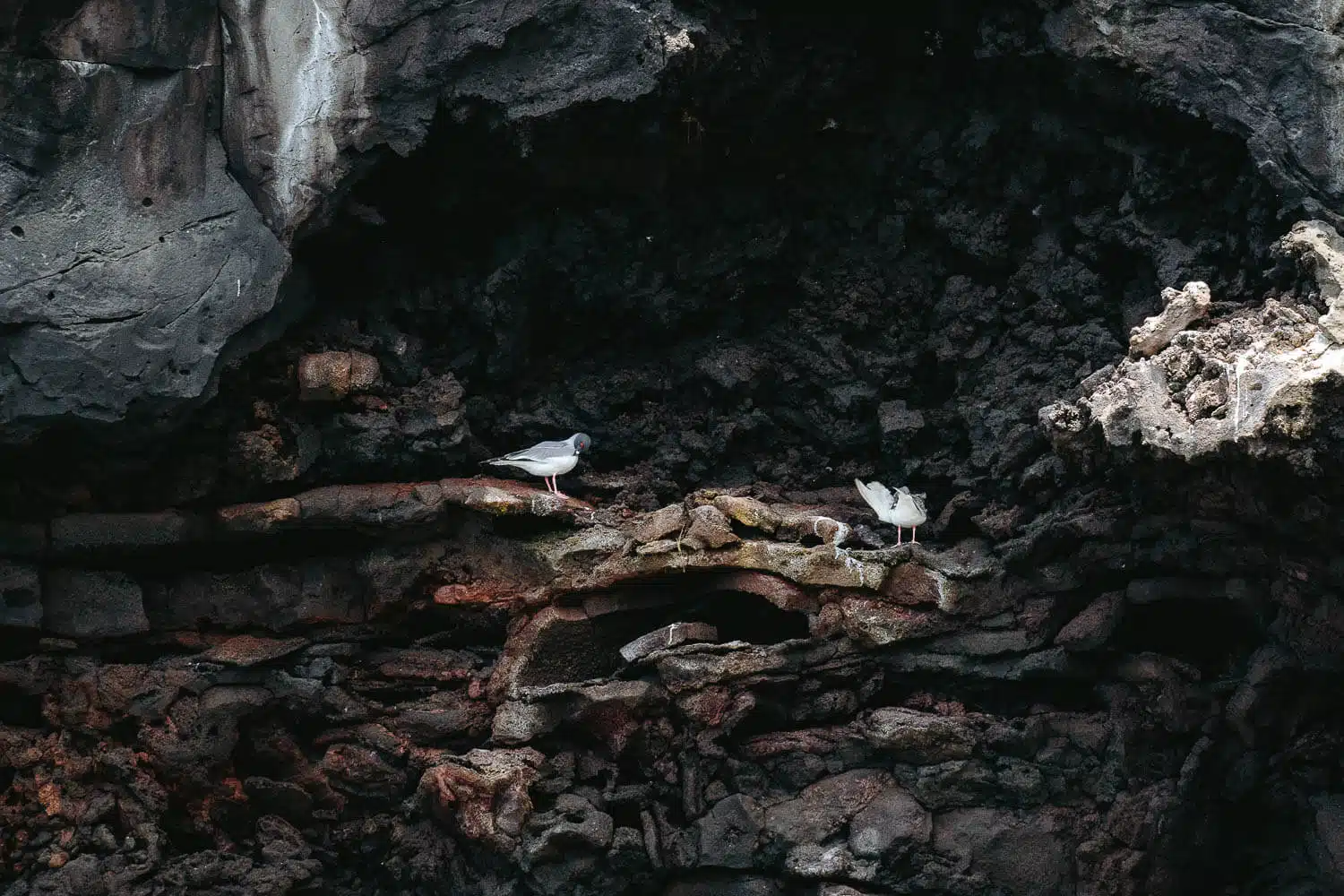
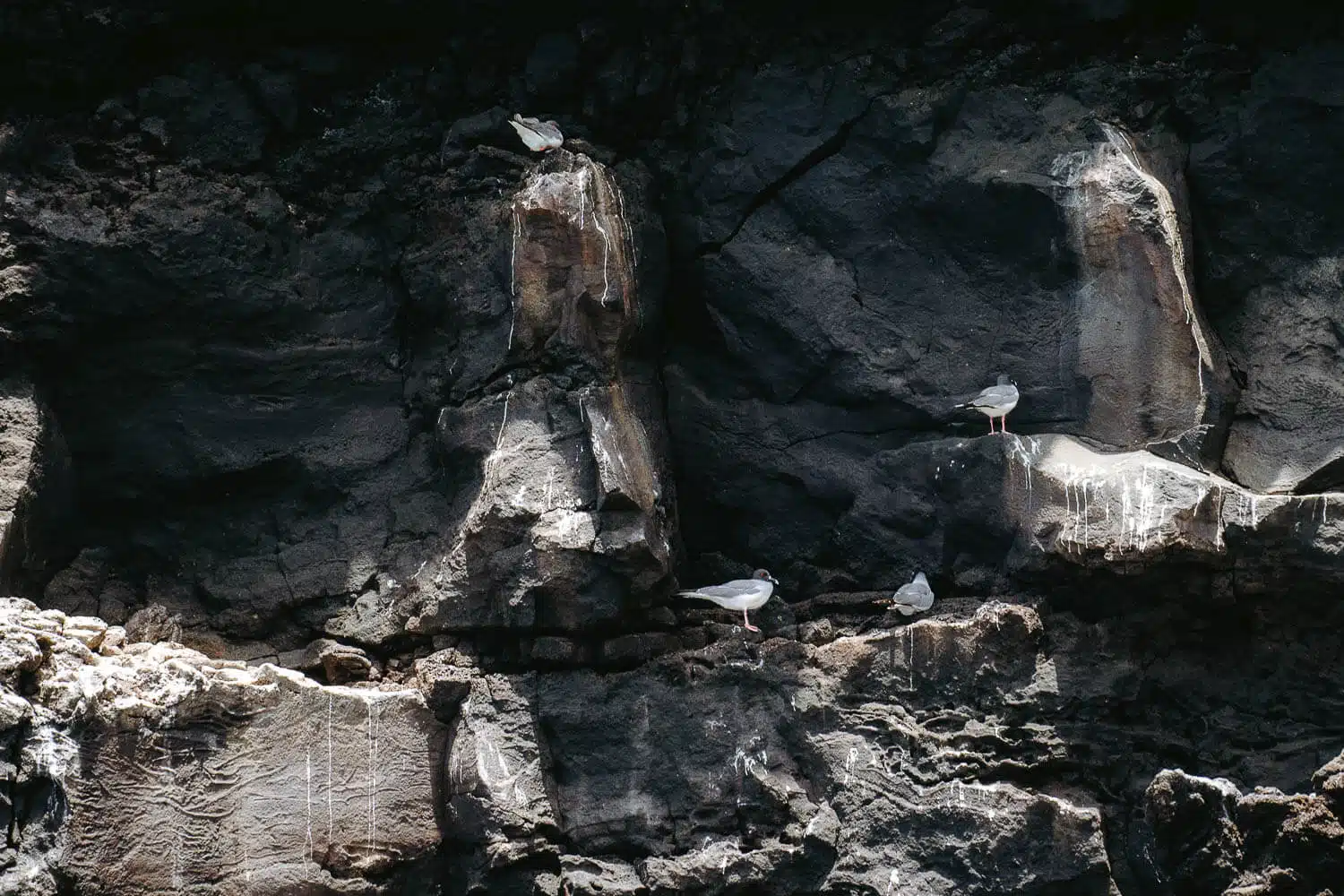
The swallow-tailed gull is the only nocturnal gull in the world, feeding mainly on squid at night. It has specialized eyes for night vision, reflecting light to improve low-light hunting. Adults have grey plumage with black heads and red eye-rings during breeding, while juveniles and non-breeding adults appear paler. Nests are built on rocky slopes or stony beaches, usually consisting of stones or lava fragments. Each female lays a single egg, with both parents caring for the chick for up to three months.
Where to see: Española, Genovesa, North Seymour, Santa Fé.
Swallow-tailed gull in Punta Pitt
Swallow-tailed gull in Punta Pitt
Other Seabirds & Visitors of the Galapagos Wildlife
In addition to the famous seabirds, the islands attract a variety of visitors and less well-known species. Tropicbirds, lava gulls, herons, penguins, and smooth-billed anis either breed locally or use the islands as stopovers. These species add further diversity to the archipelago’s bird communities and highlight its ecological importance for migratory and resident birds alike.
Galapagos Penguin
Spheniscus mendiculus
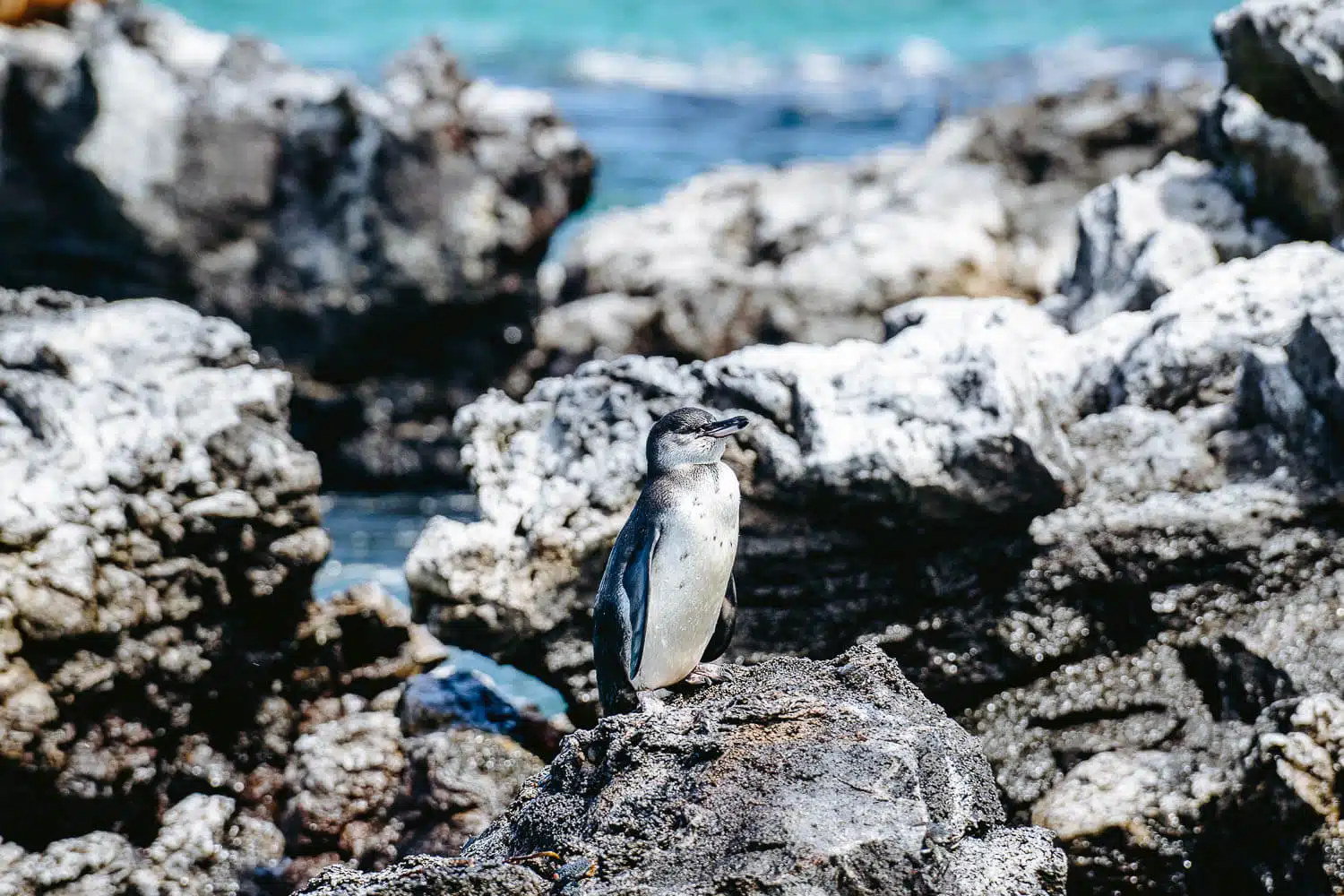
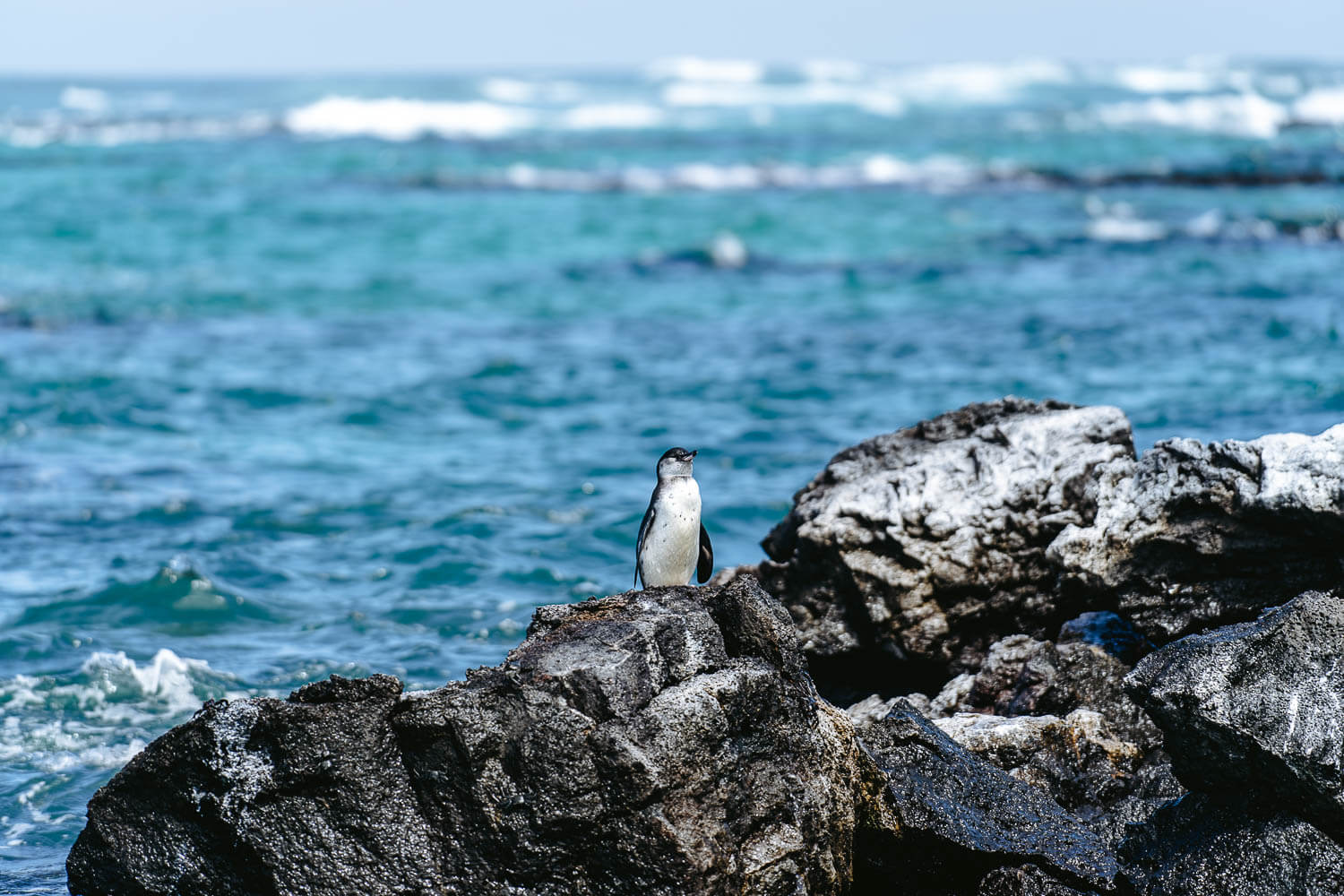
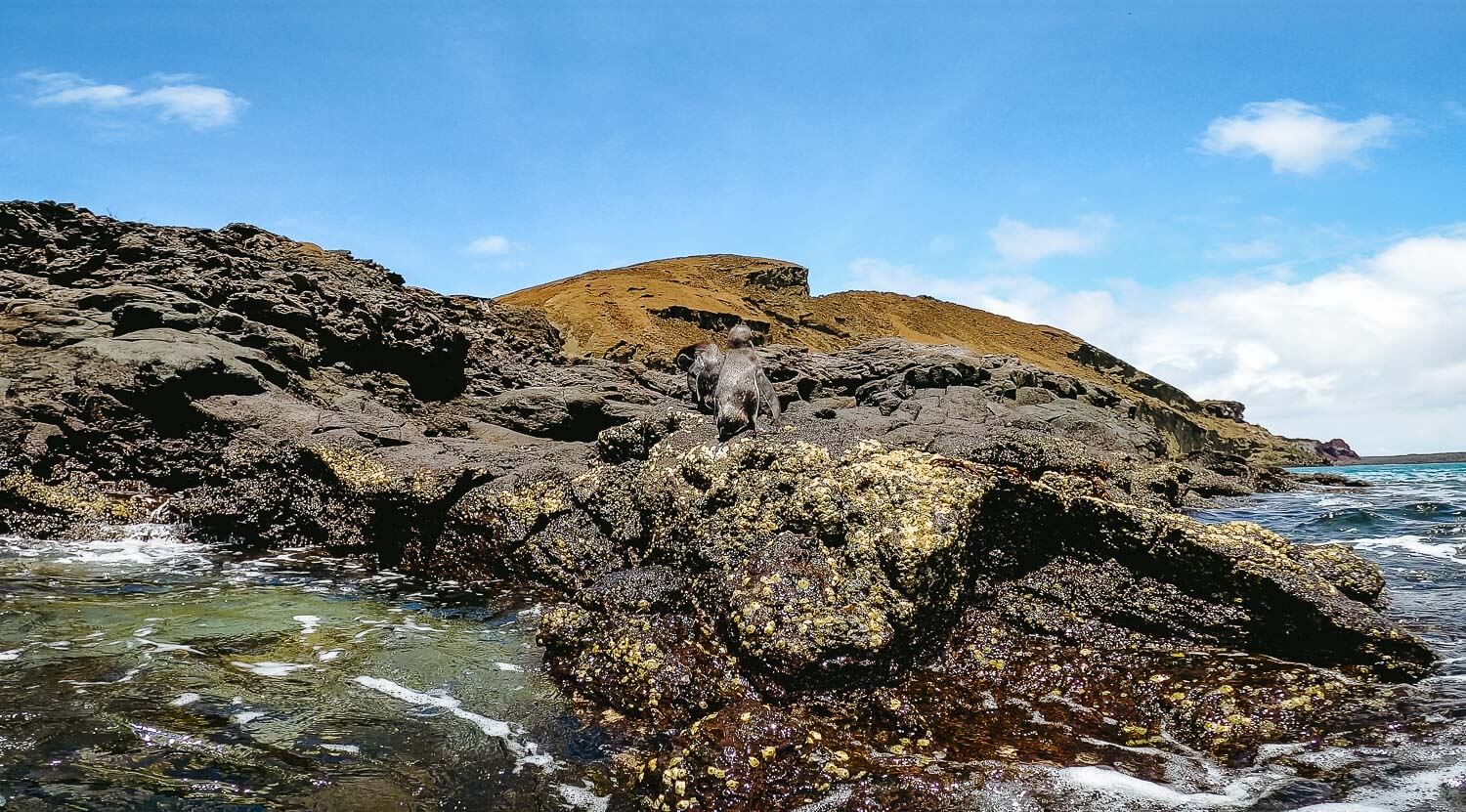
The Galapagos penguin is the only penguin species found north of the equator in the wild. Adults have a black back and white belly, with distinctive black bands across the chest. They feed mainly on small fish and occasionally squid, often hunting in the cool, nutrient-rich waters near the islands. Nests are built in caves or crevices to protect eggs and chicks from heat and predators, with both parents sharing incubation and feeding responsibilities.
Where to see: Isabela (west coast, Punta Vicente Roca), Fernandina, Bartolomé, Floreana (Champion Islet).
The first penguin we spot
A Galápagos penguin
Spotted some penguins chilling on the rocks above water (can you see them?)
Lava Gull
Leucophaeus fuliginosus
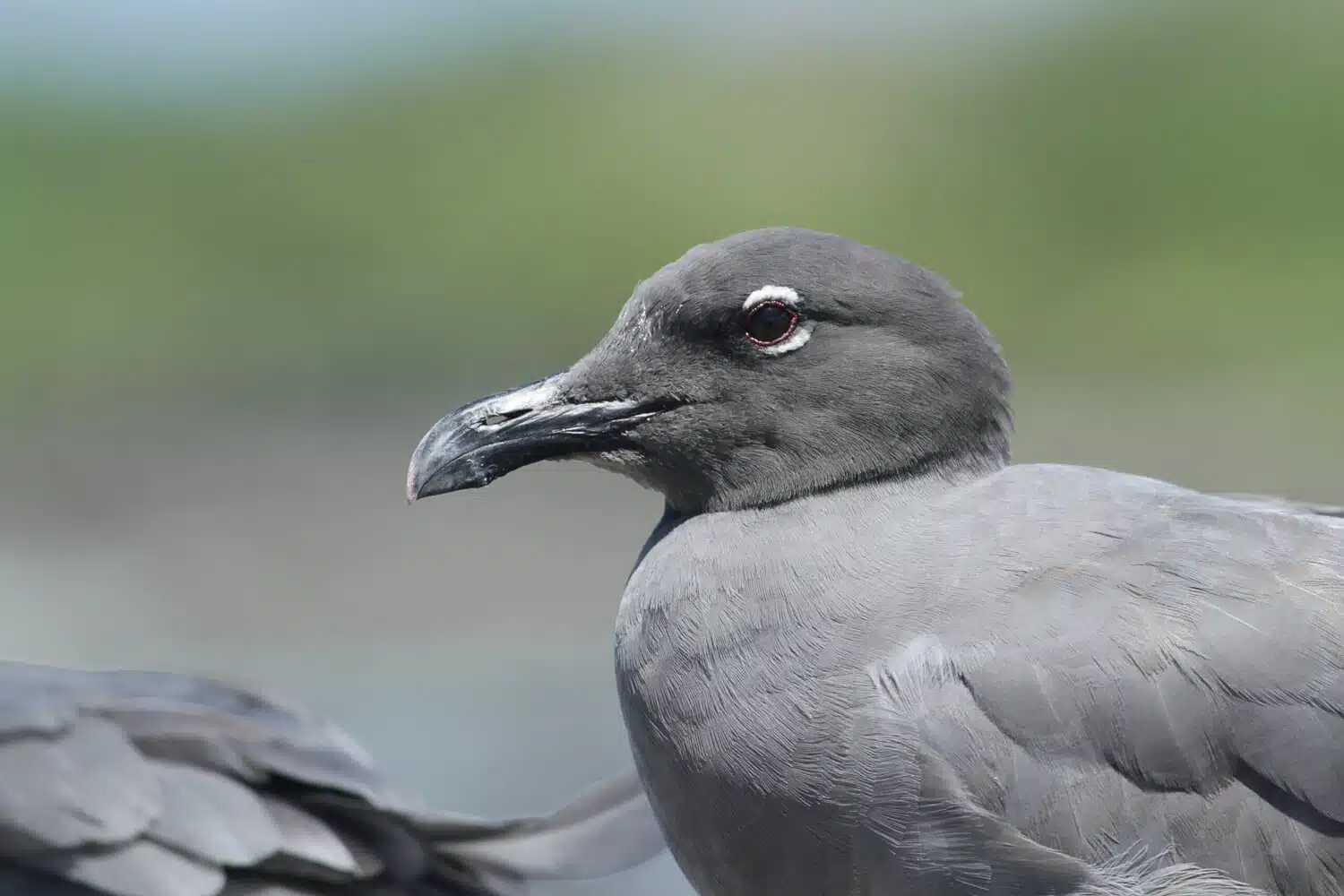
The lava gull is the rarest gull in the world, endemic to the Galapagos, with an estimated population of only a few hundred individuals. It has dark grey to black plumage, a slender red bill, and red legs. Lava gulls are opportunistic feeders, consuming fish, crustaceans, eggs, and carrion. They typically nest on the ground near rocky shores, with both parents involved in incubating the eggs and raising the chicks. Their low population and restricted distribution make them highly vulnerable to environmental changes and introduced predators.
Where to see: Santiago, Genovesa, Española, Santa Cruz (rare, scattered).
Lava Gull | Credit: Luis Ortiz Catedral @ https://galapagosconservation.org.uk/
Red-billed Tropicbird
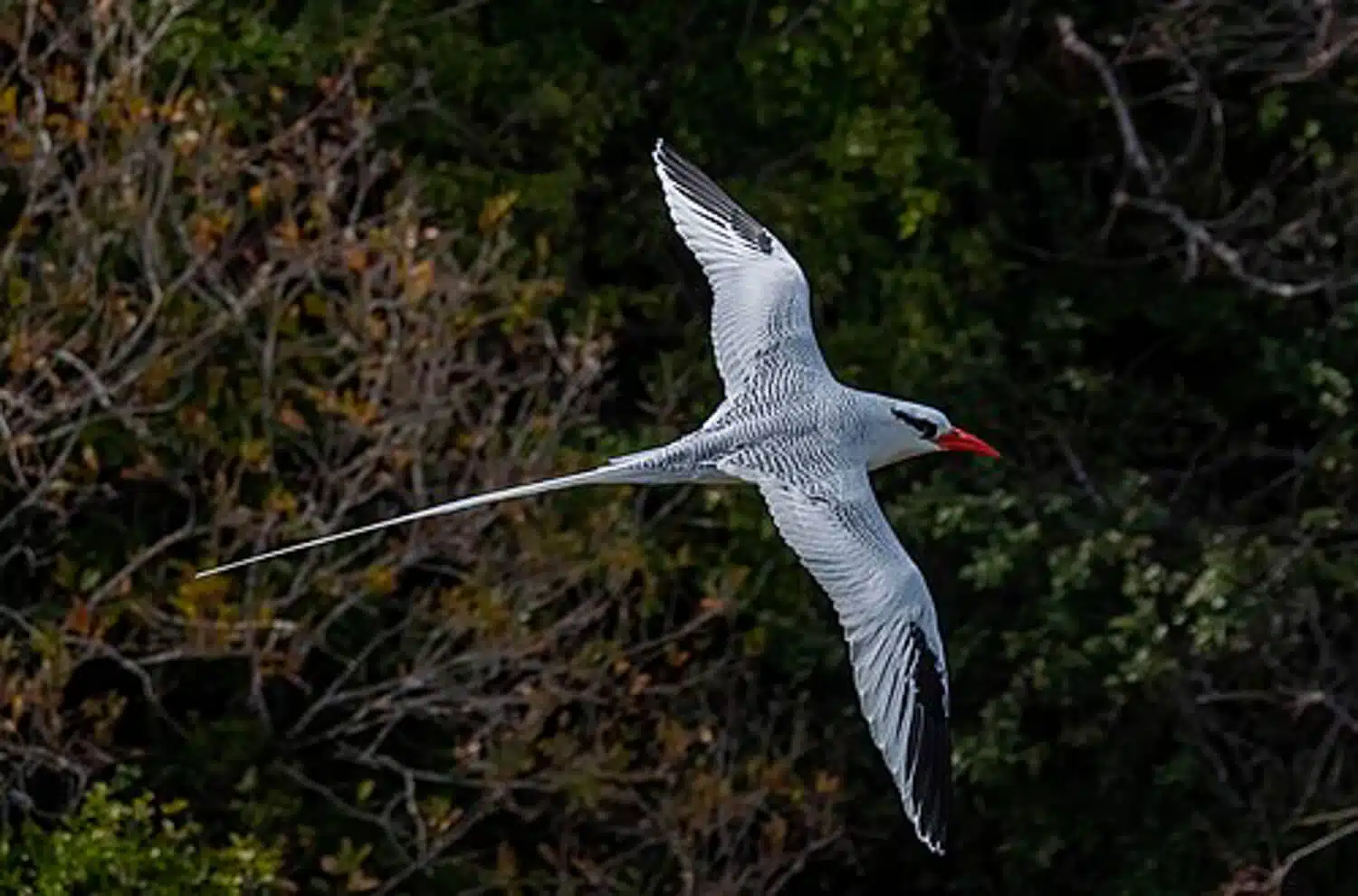
The red-billed tropicbird is a striking seabird with long, slender tail streamers and a bright red bill. They feed primarily on fish and squid, often diving from heights to capture prey. Tropicbirds nest in crevices, cliffs, or rocky outcrops, laying a single egg per breeding attempt. Both parents share incubation and chick-rearing duties, with chicks fledging after about two months.
Where to see: Cliffs of Española, Genovesa, South Plaza.
Similar in behavior to the red-billed tropicbird, the white-tailed tropicbird has a white body with black markings on wings and long tail streamers. It feeds on fish and squid, capturing prey by plunge-diving. Nests are built in rocky crevices or cliff edges, and both parents care for the single chick until it fledges.
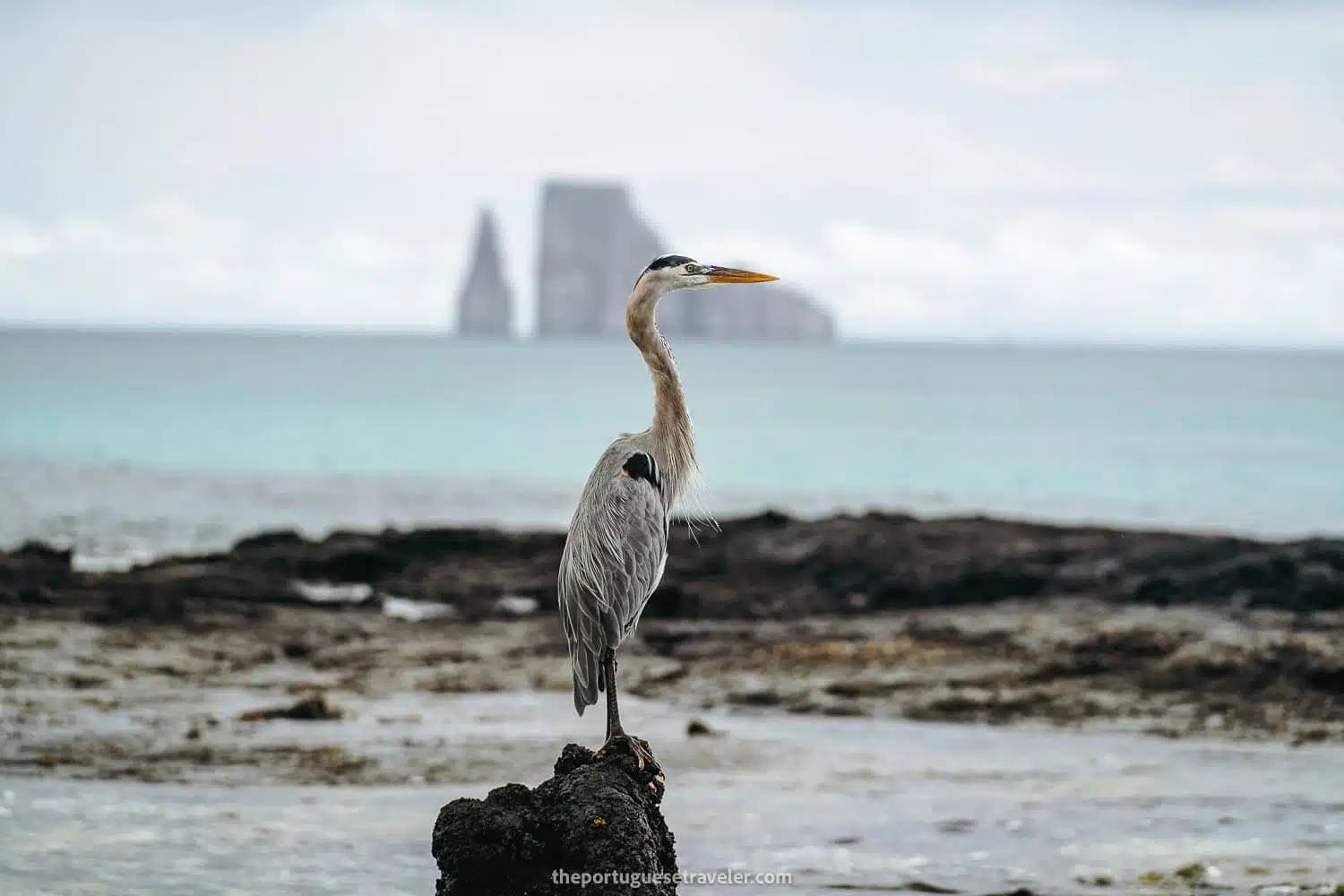
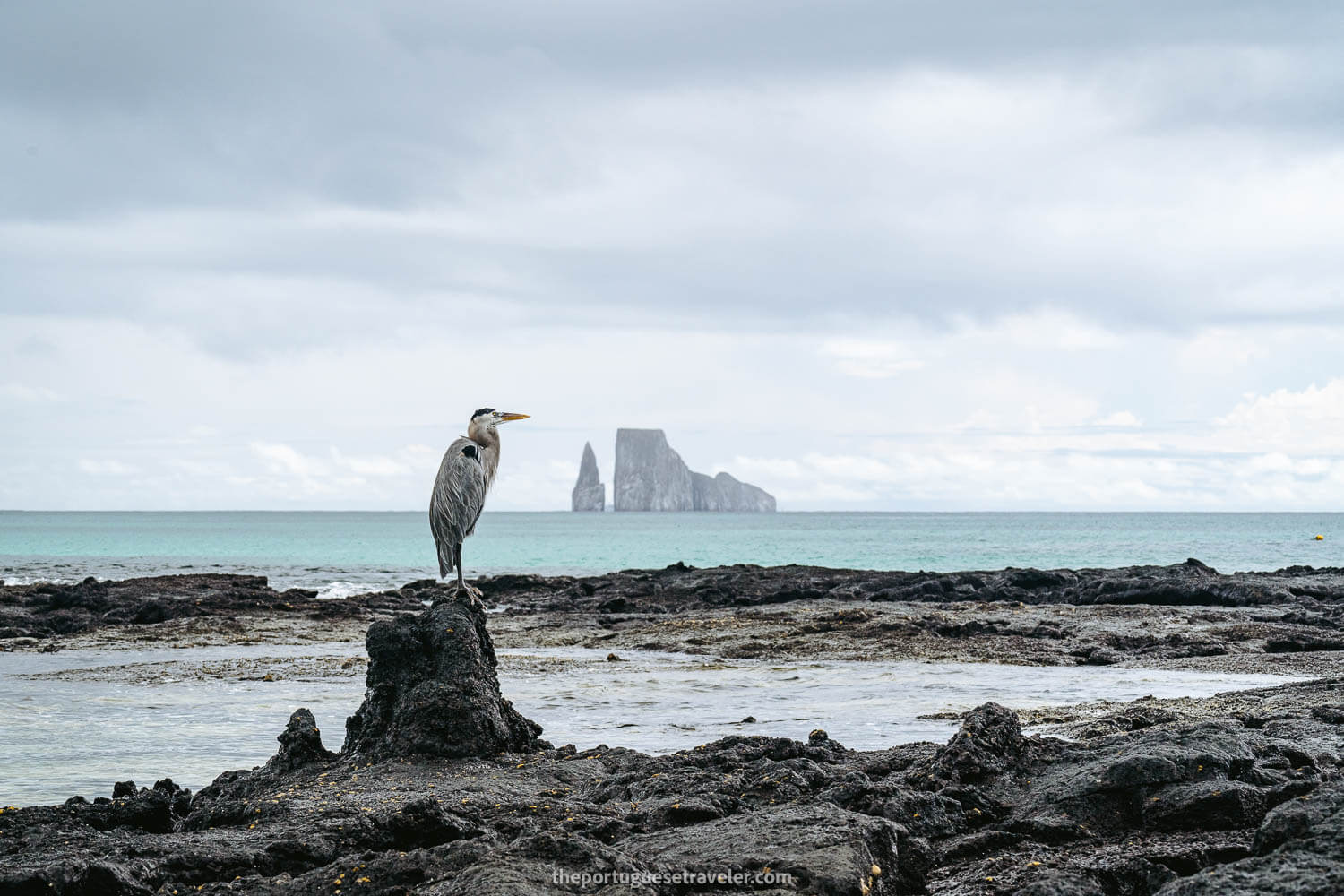
Where to see: Lava herons (Isabela, Santiago), other herons widely across islands.
The Grey Heron and Kicker Rock
The Grey Heron and Kicker Rock
Yellow Warbler
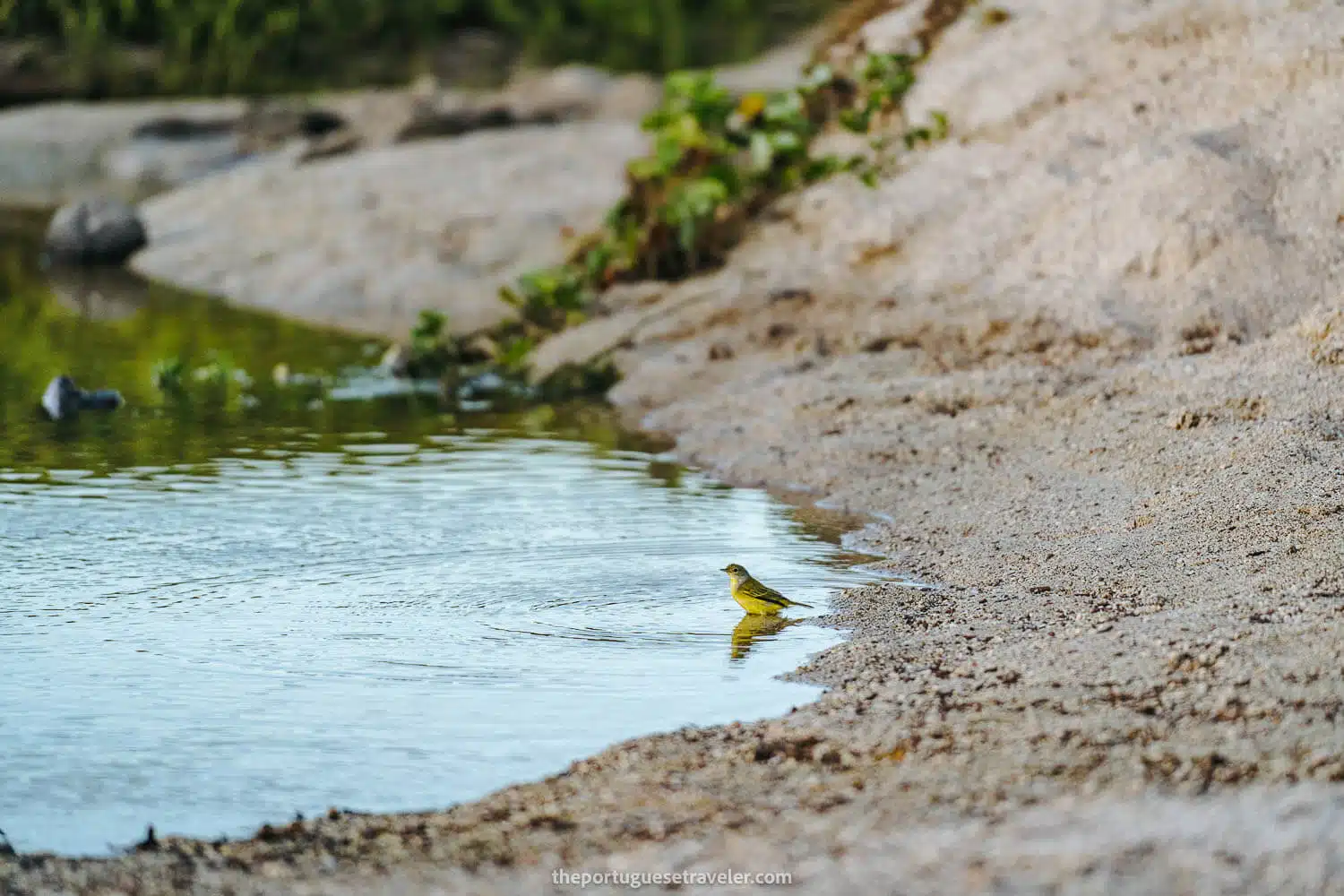
The yellow warbler is a bright yellow bird found in the Galapagos Islands, considered a subspecies of Setophaga petechia. Males display red caps and chest streaks during the breeding season, while females and juveniles are paler. These monogamous birds build small cup-shaped nests in trees, where females incubate 2–5 eggs for about ten days. Yellow warblers feed on insects, catching them in short flights or foraging in trees and on the ground.
Where to see: Common on all main islands.
A yellow warbler in San Cristobal
Little Vermilion Flycatcher
Pyrocephalus nanus
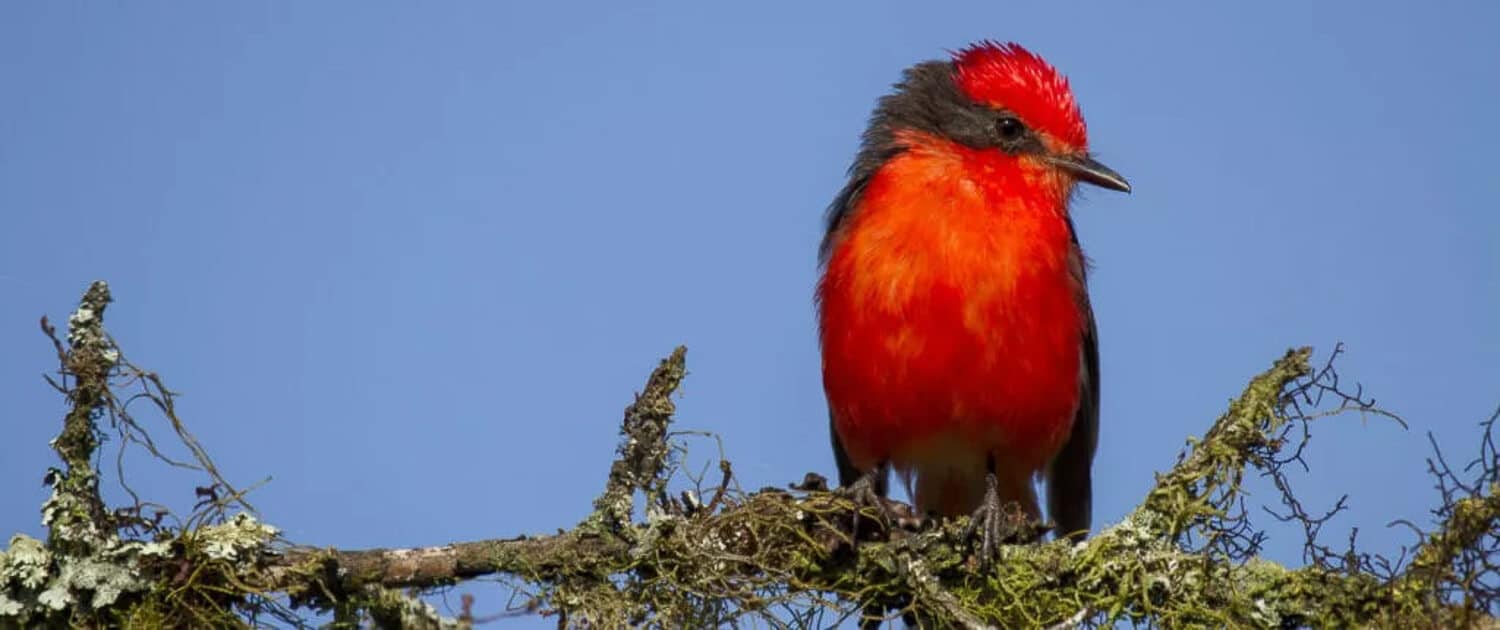
The little vermilion flycatcher is an endemic Galapagos wildlife species. Males are bright red with black wings, while females are duller with grey and peach tones, making males the only truly vivid land birds on the islands.
They feed on insects, often catching them in midair, and live in remaining forest patches. Monogamous and territorial, they breed during the warm season, building cup-shaped nests in trees and laying three eggs. Once thought to have two subspecies, only P. r. nanus now survives.
Where to see: Highlands of Santa Cruz, Floreana, Isabela.
Little Vermilion Flycatcher | Credit: Rob Jansen @ https://galapagosconservation.org.uk/
Galapagos Dove
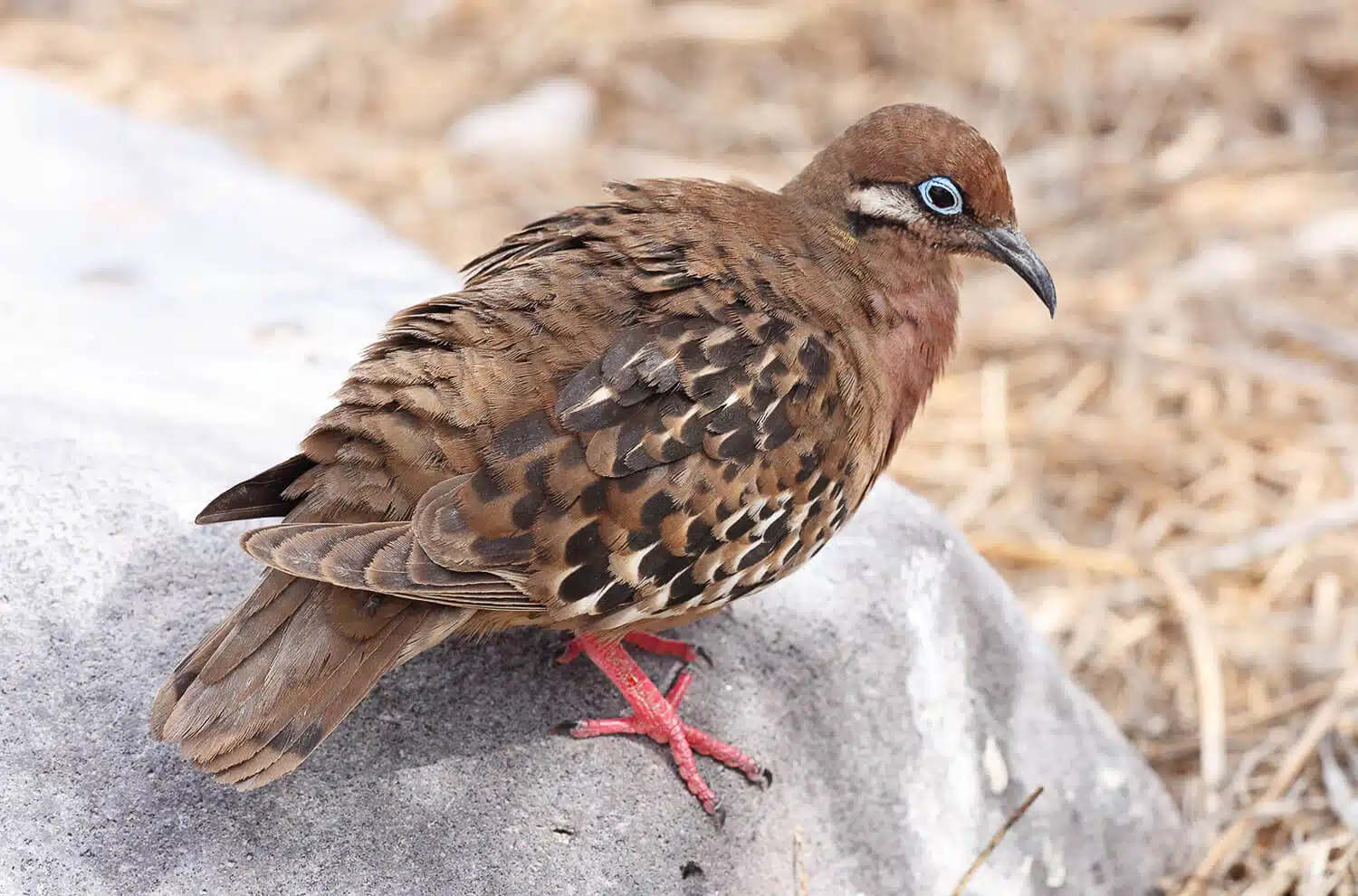
The Galapagos Dove is a small, endemic bird found on most islands. Recognizable by its soft brown plumage and iridescent patches, it forages on seeds, fruits, and insects, often seen walking along the ground or resting in low shrubs.
Where to see: Santa Cruz, Floreana, Española, Genovesa.
Galapagos Dove | Credit: Benjamint444 @ https://wikipedia.com/
Galapagos Rail
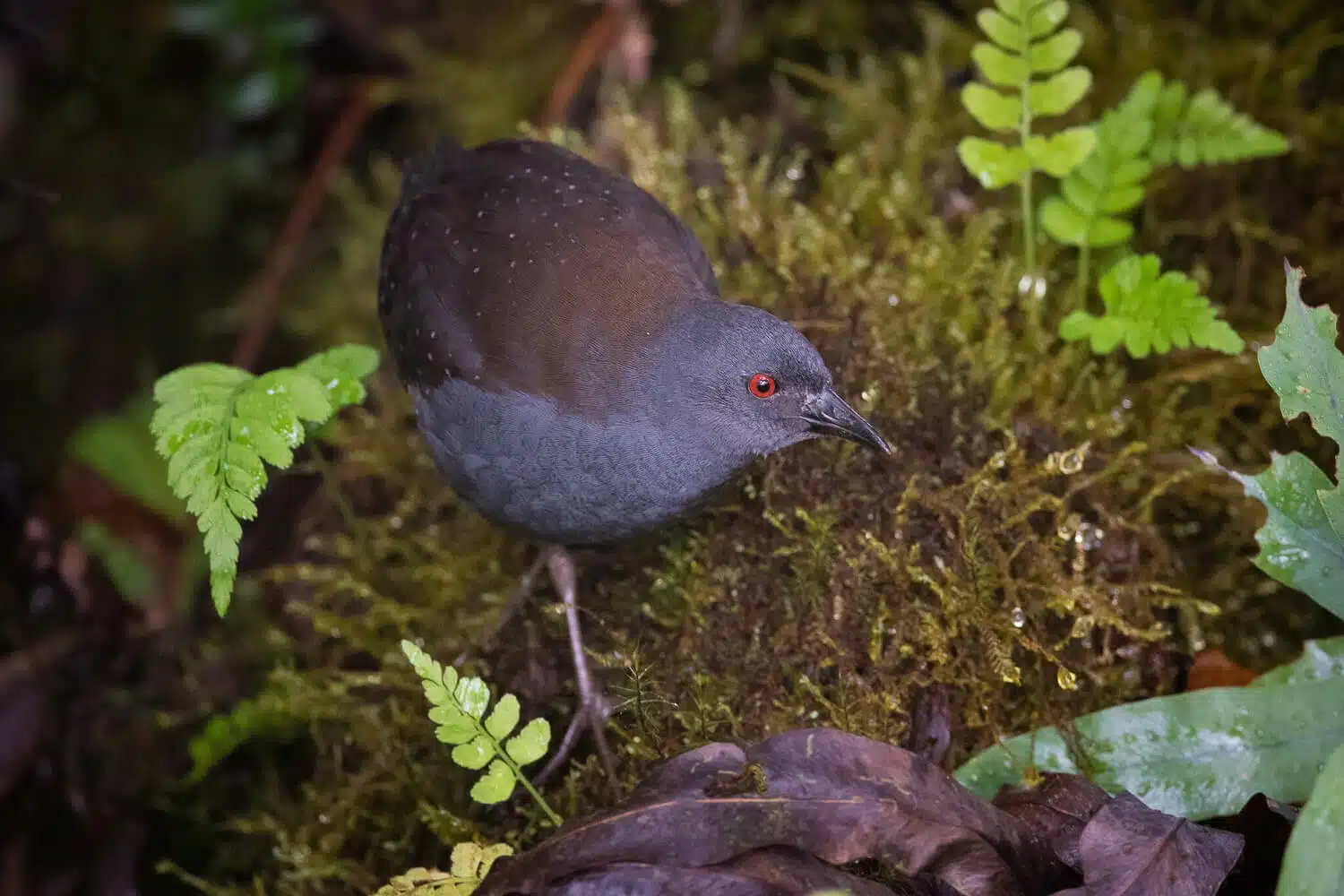
The Galapagos Rail is a secretive, flightless bird native to marshes and wetlands on several islands. With dark plumage and short legs, it feeds on insects and seeds, playing a subtle but important role in the archipelago’s ecosystem.
Where to see: Santa Cruz highlands.
Galapagos Rail | Credit: Adam Jackson @ https://wikipedia.com/
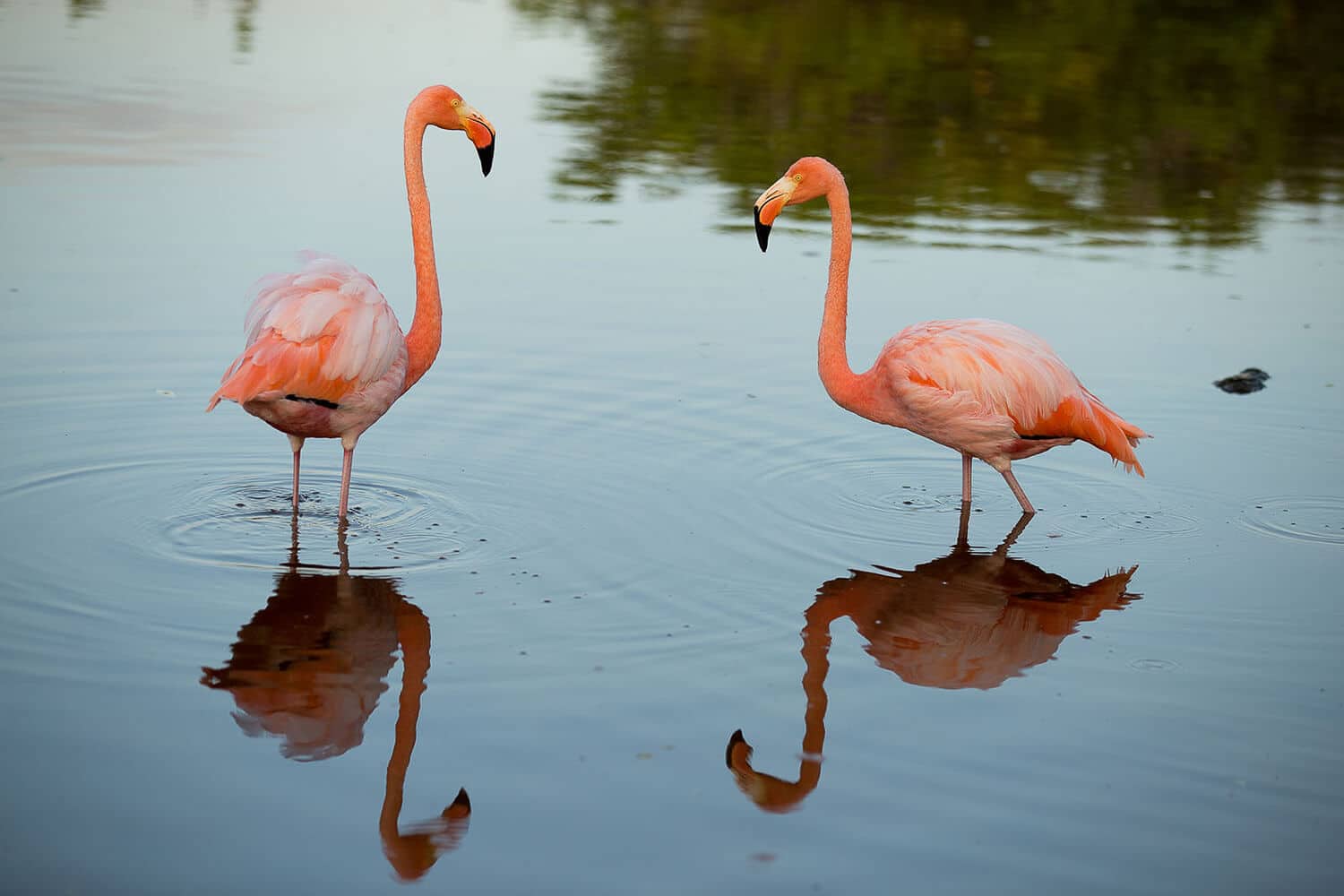
American Flamingo
The American flamingo is a striking wading bird known for its vibrant pink to reddish plumage, long legs, and distinctive curved bill. In the Galapagos, they are primarily found in shallow coastal lagoons and salt flats, where they feed on small crustaceans, algae, and plankton. Their specialized bills filter food from the water, allowing them to extract nutrients from microscopic organisms that give them their pink coloration.
Flamingos in the Galapagos often gather in large flocks, creating impressive, colorful displays. They are social birds that nest in colonies, building mud mound nests for their single egg. While not endemic to the Galapagos, their presence adds to the archipelago’s diversity of birdlife and offers excellent opportunities for wildlife photography, especially at dawn and dusk when their colors appear most vivid.
Where to see: Isabela (lagoons), Floreana (Cerro Laguna), Rábida (seasonal).
American Flamingos | Credit: Lucy Law @ https://galapagosconservation.org.uk/
Flamingo lagoon in Puerto Villamil, Isabela, Galápagos
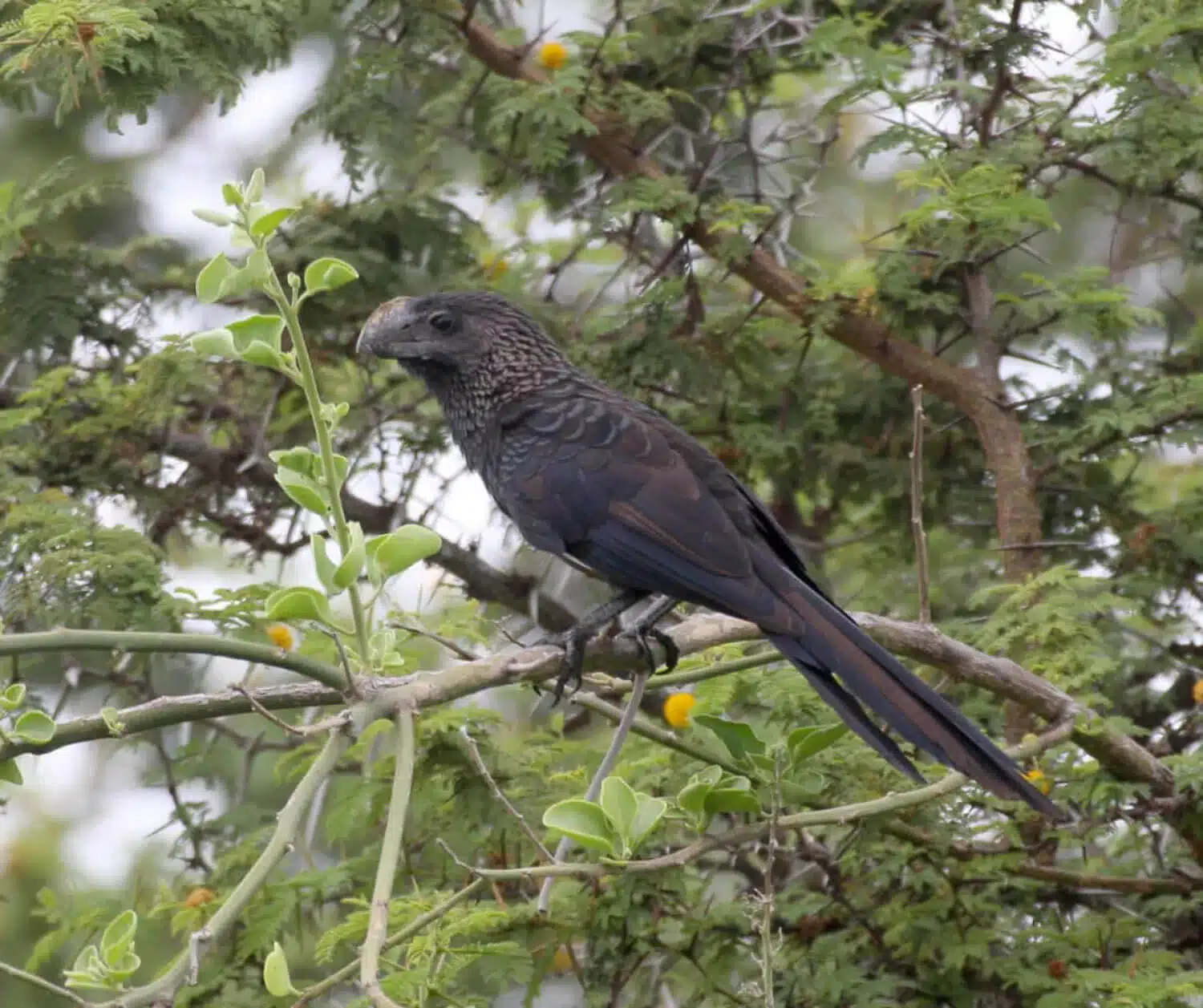
Smooth-billed Ani
Crotophaga ani
The smooth-billed ani is an introduced bird species in the Galapagos, brought to the islands in the 1960s, likely to help control tick infestations on livestock. Since then, it has become invasive, spreading to nearly all major islands except Darwin and reaching an estimated population of around 250,000. Instead of primarily feeding on ticks, anis consume a variety of native wildlife, including endemic finch nestlings, yellow warblers, and mockingbirds.
The species also contributes to the spread of invasive plants, such as the hill raspberry, and acts as a host for the parasitic fly Philornis downsi, which causes high chick mortality in native birds. Their presence poses a significant threat to Galapagos’ delicate ecosystems and endemic species, particularly those already at risk, such as the mangrove finch.
Where to see: Introduced, widespread in humid zones (Santa Cruz, San Cristobal)
Smooth Billed Ani | Credit: Porf W. G. Hale @ https://galapagosconservation.org.uk/
Galapagos Wildlife in Water
The surrounding waters of the Galapagos are rich with marine life, shaped by the convergence of ocean currents. This creates highly productive feeding grounds, supporting a wide range of species from tiny invertebrates to the largest fish and whales. The archipelago is a hotspot for biodiversity, including endemic species and globally threatened marine animals.
Marine Mammals & Cetaceans
Galapagos waters are home to sea lions, fur seals, and various whales and dolphins. These species exhibit fascinating social behaviors and adaptations for hunting, diving, and reproduction. Many play a crucial role in maintaining marine food webs and contribute to the archipelago’s appeal for wildlife enthusiasts and researchers.
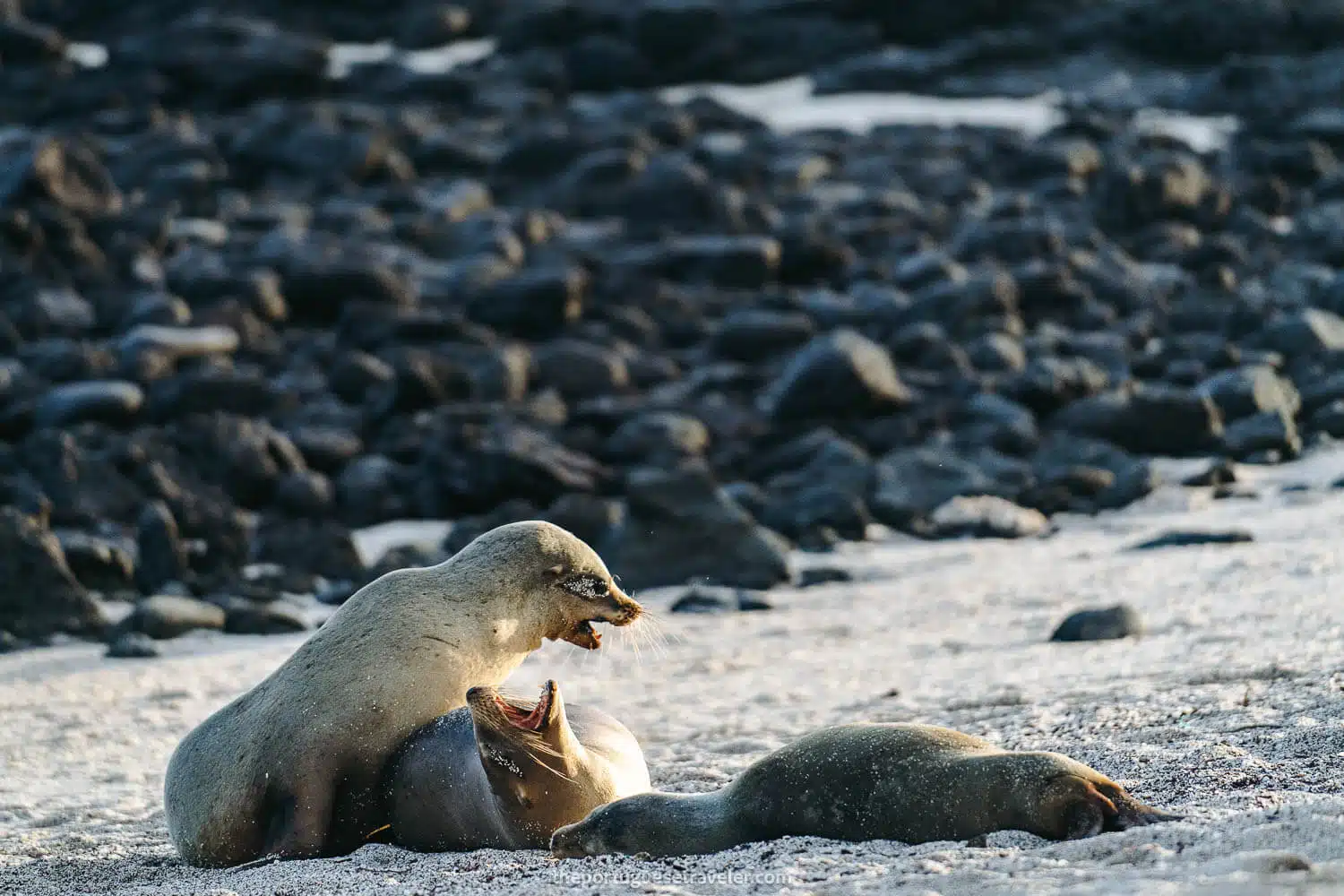
Galapagos Sea Lion
Zalophus wollebaeki
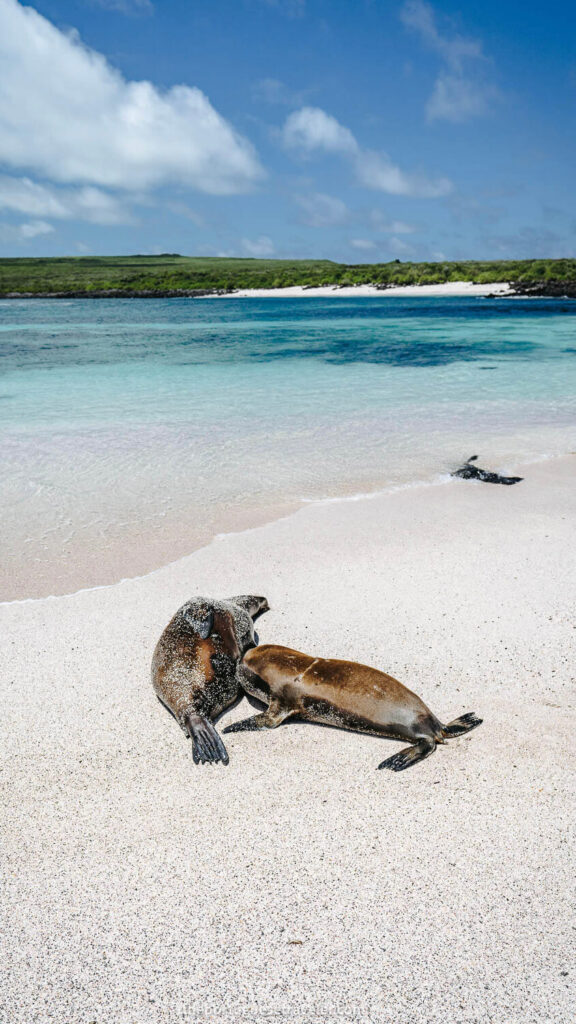
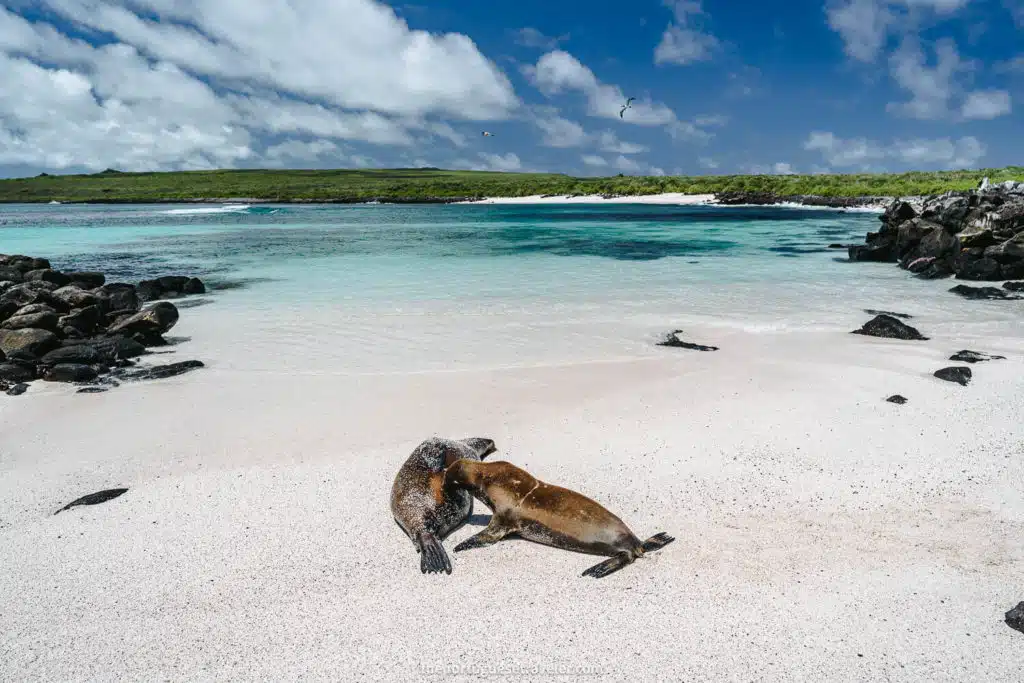
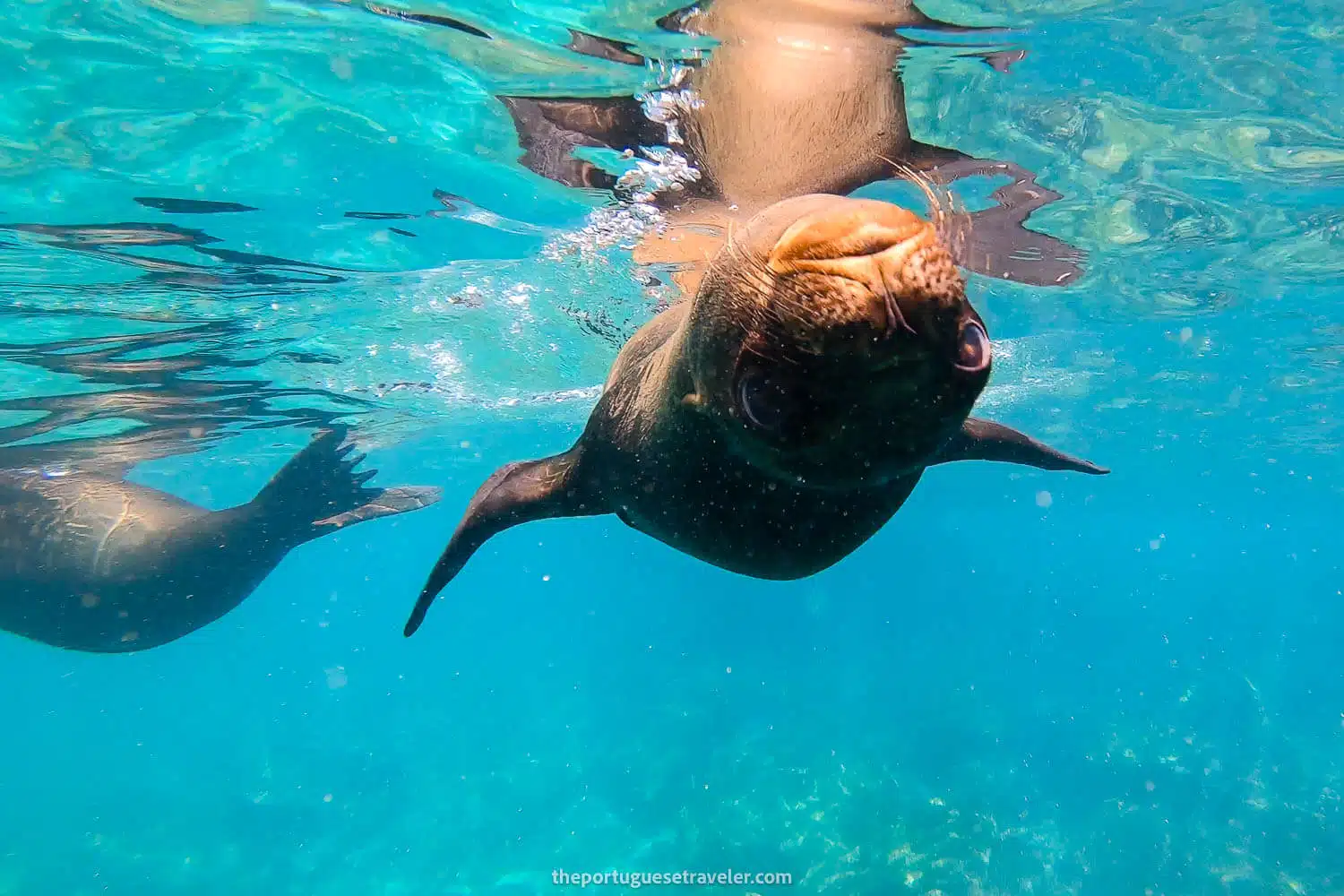
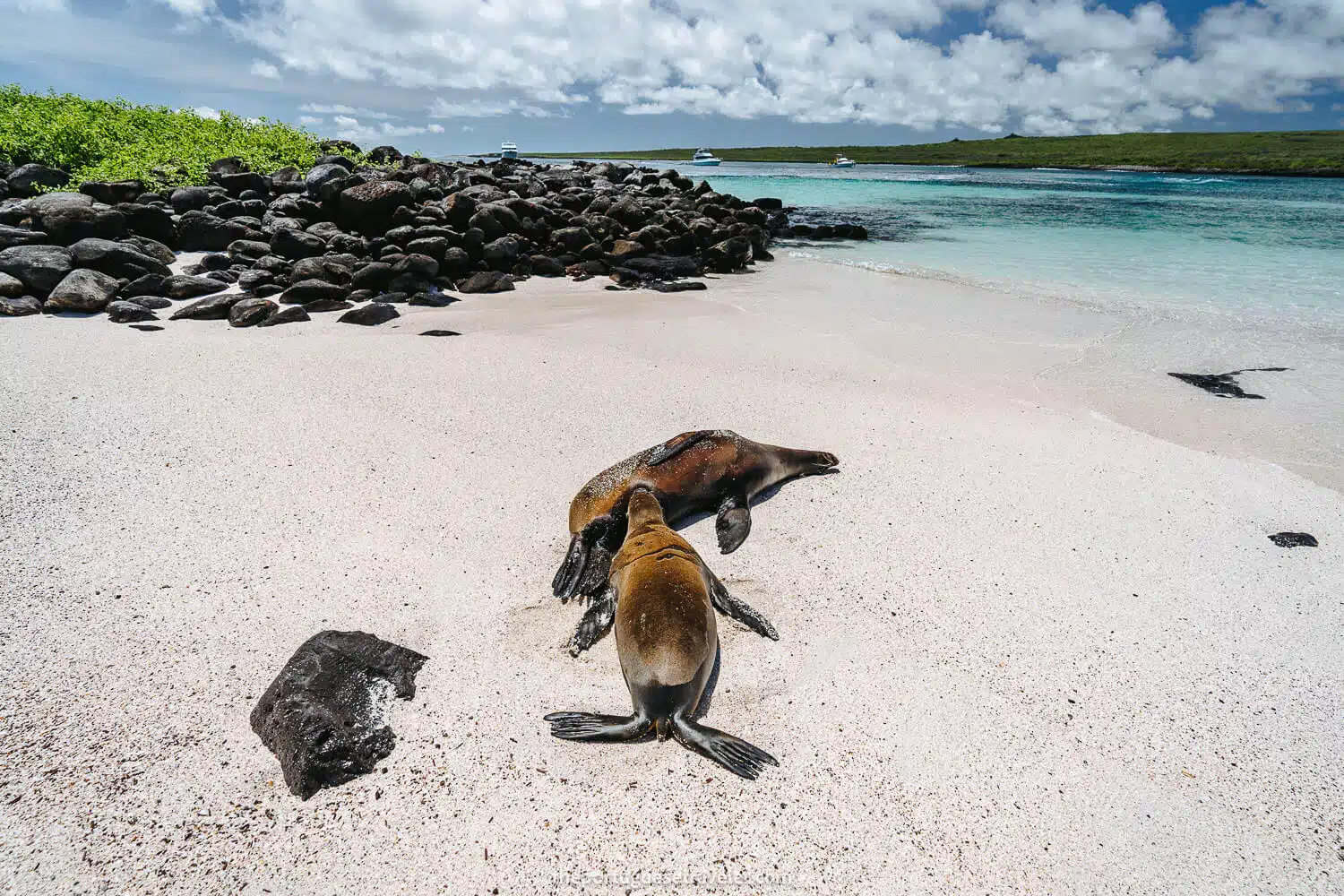
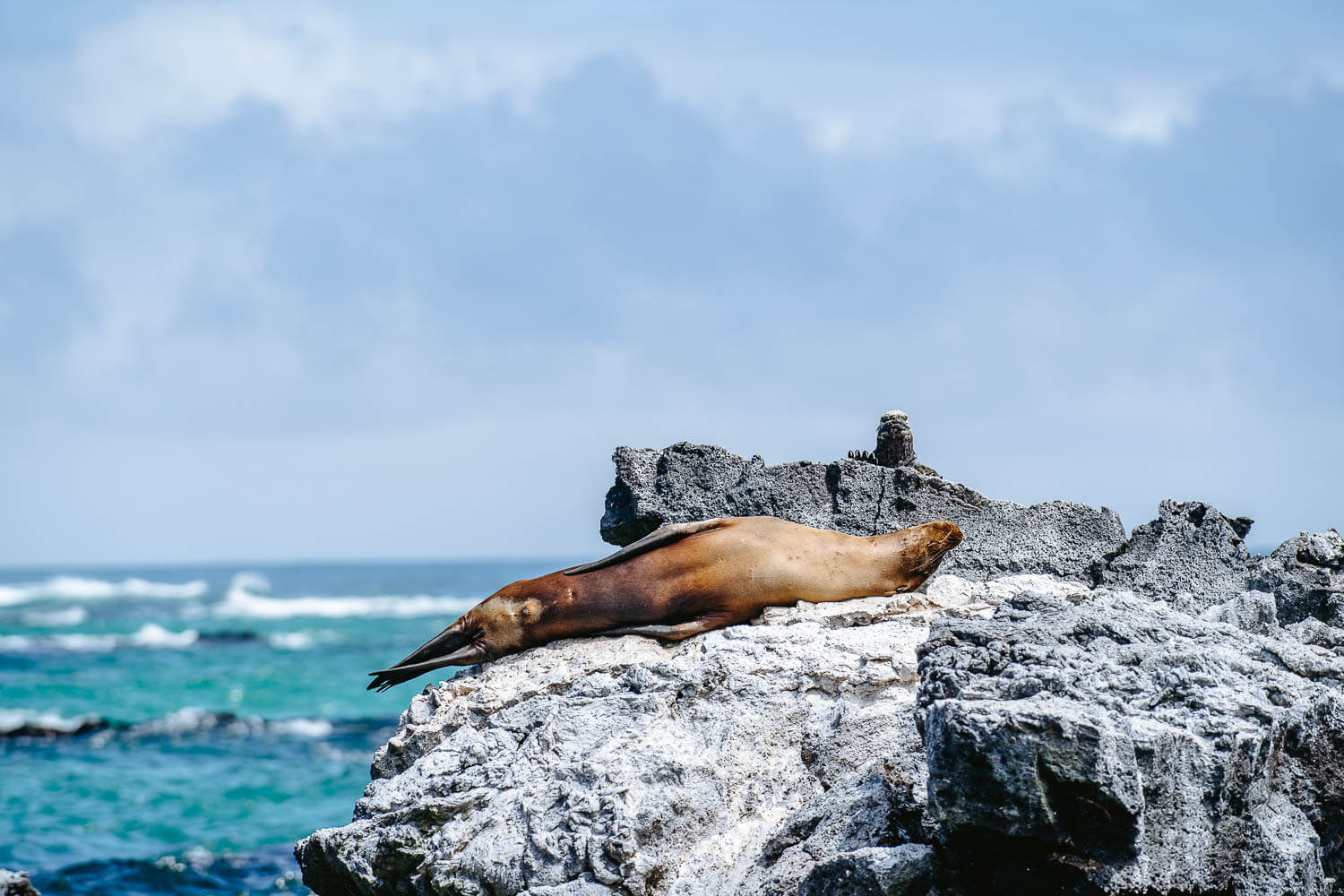
The Galapagos sea lion is endemic to the Galapagos Islands and nearby coastlines. They are highly social, forming large colonies on beaches and rocky shores. Adult males are noticeably larger than females and establish territories known as harems, protecting groups of females during the breeding season. Females give birth to a single pup each year, which they nurse for several months. Sea lions are agile in water, feeding mainly on fish and squid, but are more clumsy on land. Their playful behaviour, curiosity toward humans, and vocalizations make them one of the most iconic Galapagos animals.
Where to see: Widespread, especially San Cristobal, Española (Gardner Bay), Santa Cruz (Puerto Ayora), North Seymour, Bartolomé, Rábida.
Sea Lions playing on the beach
A baby sea lion playing with us at Muelle Tijeretas
The Sea lions feeding on the white sandy beach
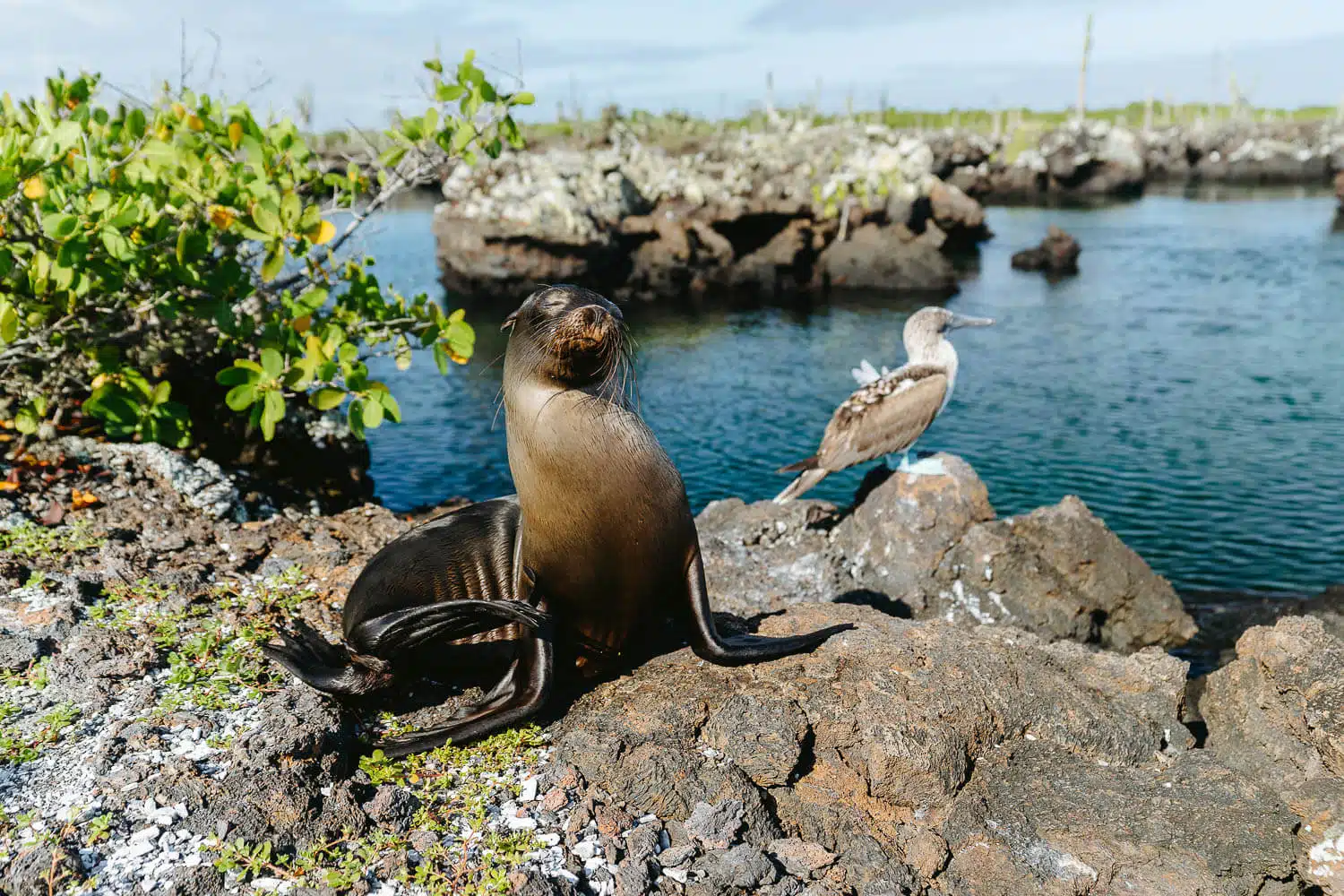
A cute baby sea lion and its friend a blue-footed booby
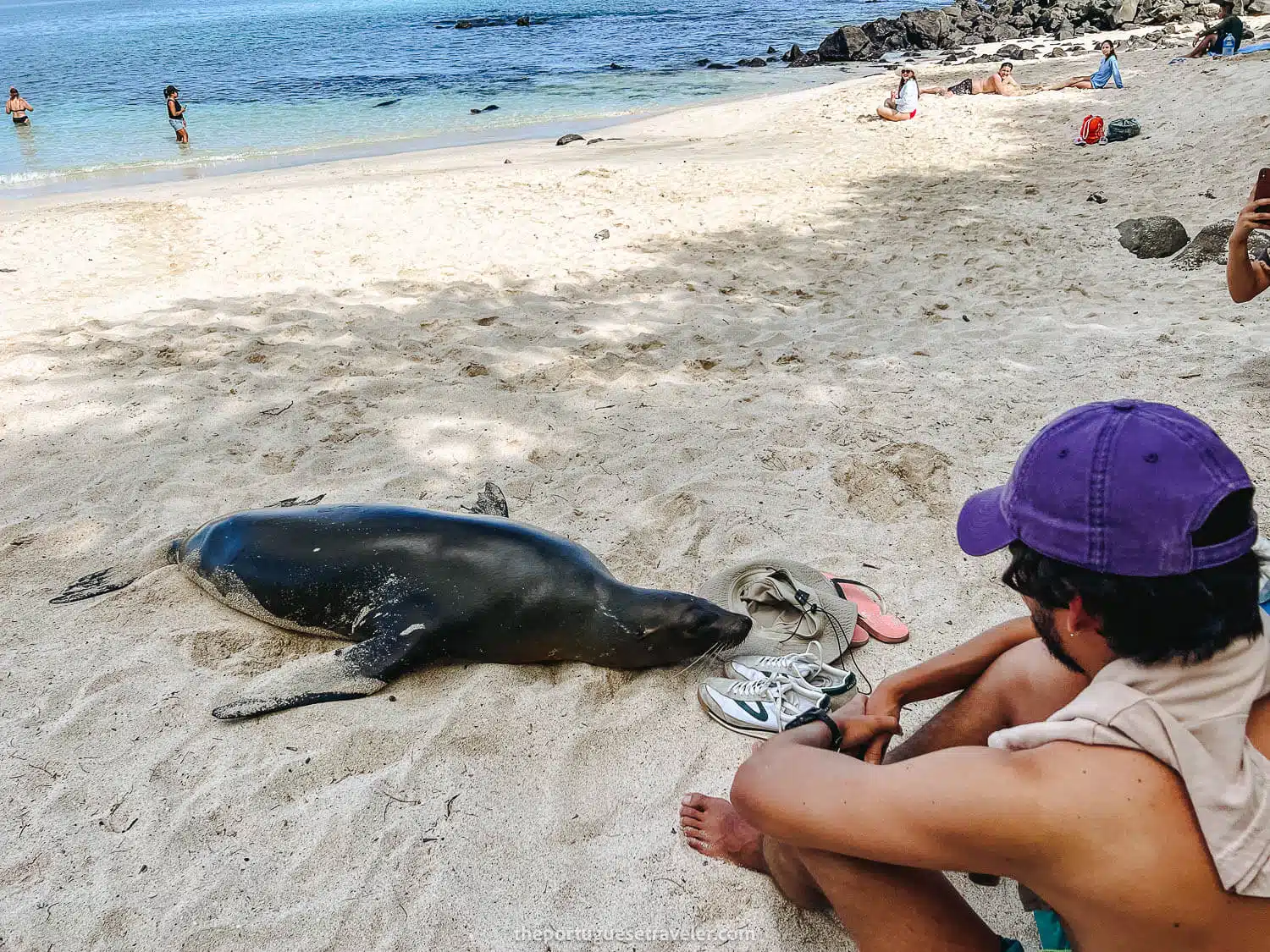
The pup smelling some shoes
Fur Seal
Arctophoca galapagoensis
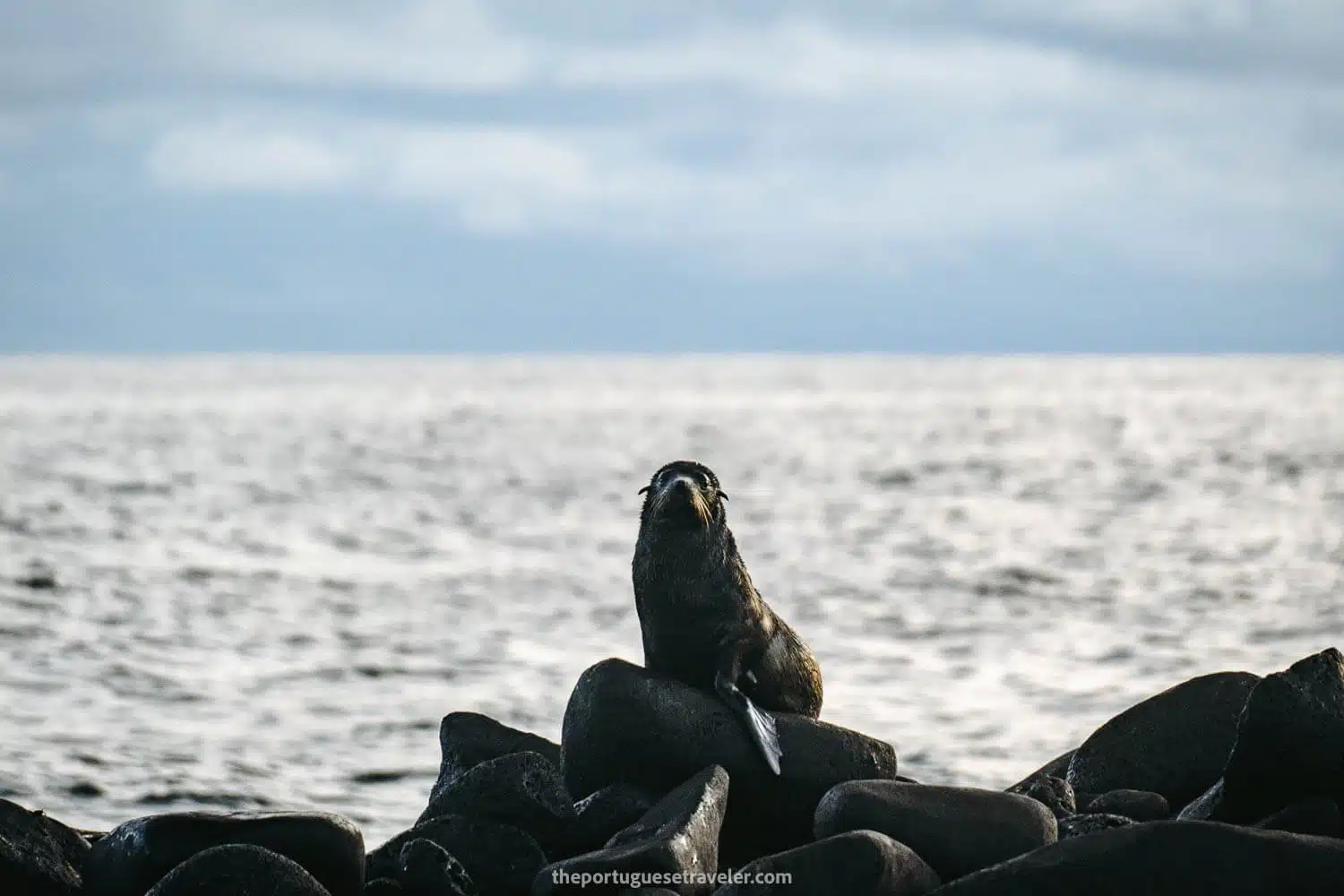
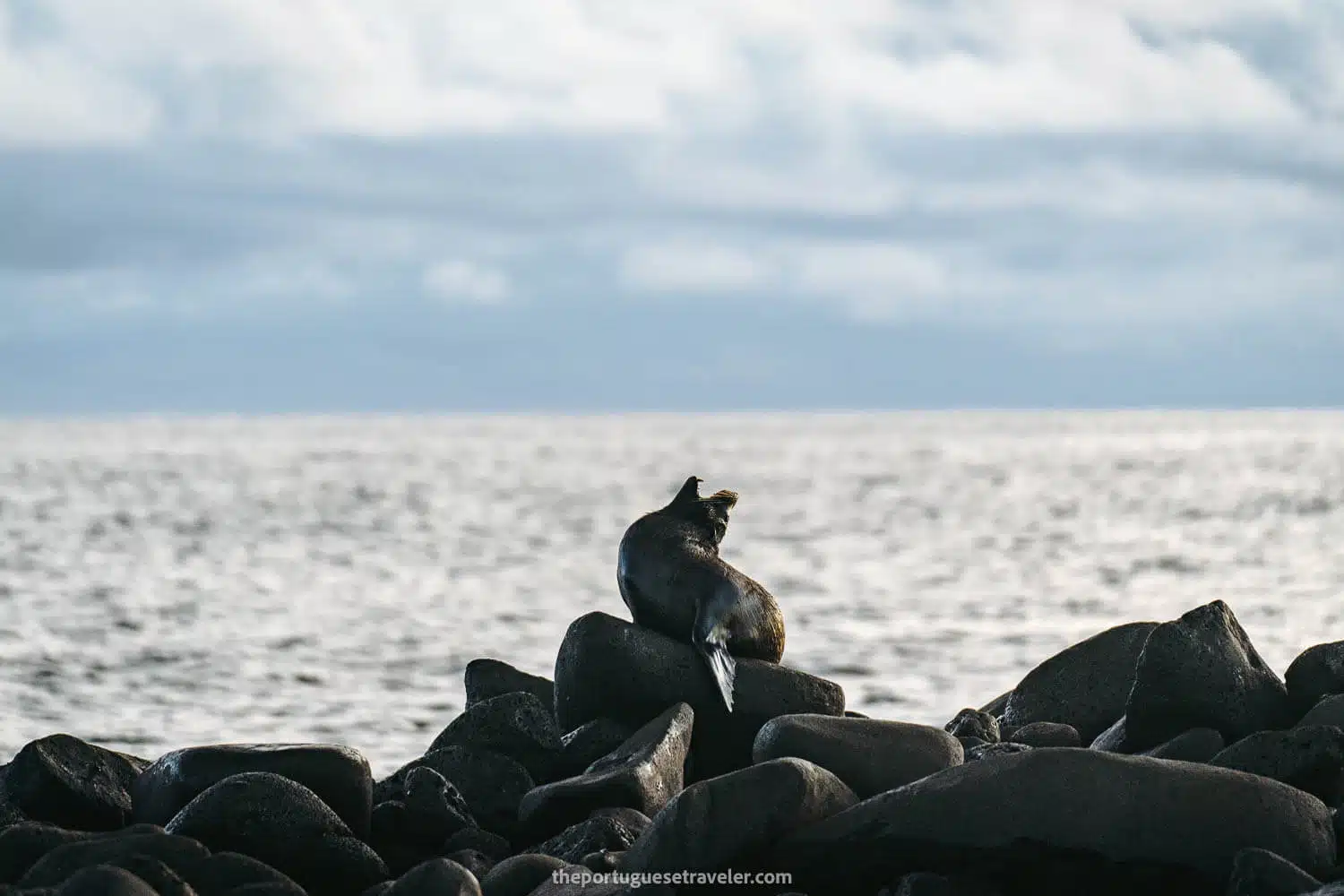
The Galapagos fur seal is the smallest of all fur seal species and eis ndemic to the Galapagos. Unlike sea lions, they are primarily nocturnal hunters, resting in caves or under rocks during the heat of the day. They feed on small fish and squid, diving up to 40 meters. Fur seals have a dense underfur that provides insulation in cooler waters. Though less social than sea lions, they often gather in small groups for resting and are highly territorial during breeding.
Where to see: Fernandina, Santiago (Puerto Egas tide pools), Genovesa.
A fur seal pup on the rocks
A baby fur seal yawning
Whales
Bryde's, Humbpack, Blue, Sei, Sperm, Orca
Galapagos waters are home to several whale species, including Bryde’s, Humpback, Blue, Sei, Sperm, and Orca. These migratory giants visit the islands for feeding and breeding, drawn by the abundance of fish and squid. Many pass through seasonally, while others linger in productive waters, making the Galápagos a key habitat for these magnificent marine mammals.
Where to see: Common around Isabela, Fernandina, and Wolf & Darwin.
Dolphins
Bottlenose, Short-beaked Common
Dolphins, such as bottlenose and short-beaked common dolphins, are highly social and energetic. They often travel in pods, riding waves, foraging together, and interacting playfully with one another. Their acrobatics and close encounters with boats make them some of the most visible and engaging marine species in the Galapagos.
Where to see: Wolf & Darwin, common in channels between main islands.
Reptiles
The Galapagos waters are home to two remarkable reptiles. The marine iguana (Amblyrhynchus cristatus) is the only lizard in the world that forages in the sea, feeding on algae along the rocky coastline. The Green Sea Turtle (Chelonia mydas) grazes on seagrass and algae, nesting on sandy beaches and playing a crucial role in maintaining healthy marine ecosystems. Both species are iconic representatives of the islands’ unique aquatic life.
Green Sea Turtle
Chelonia mydas agassizii
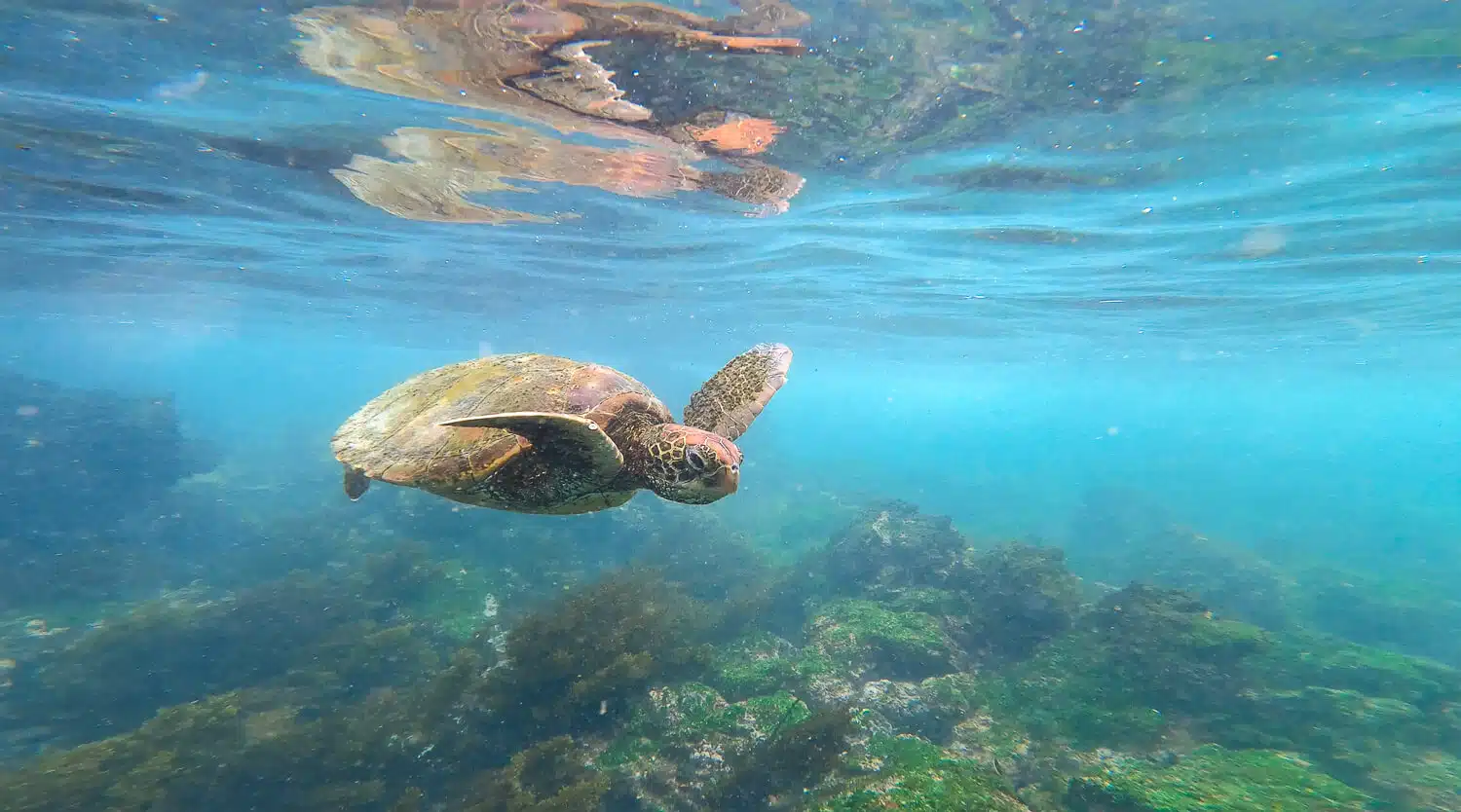
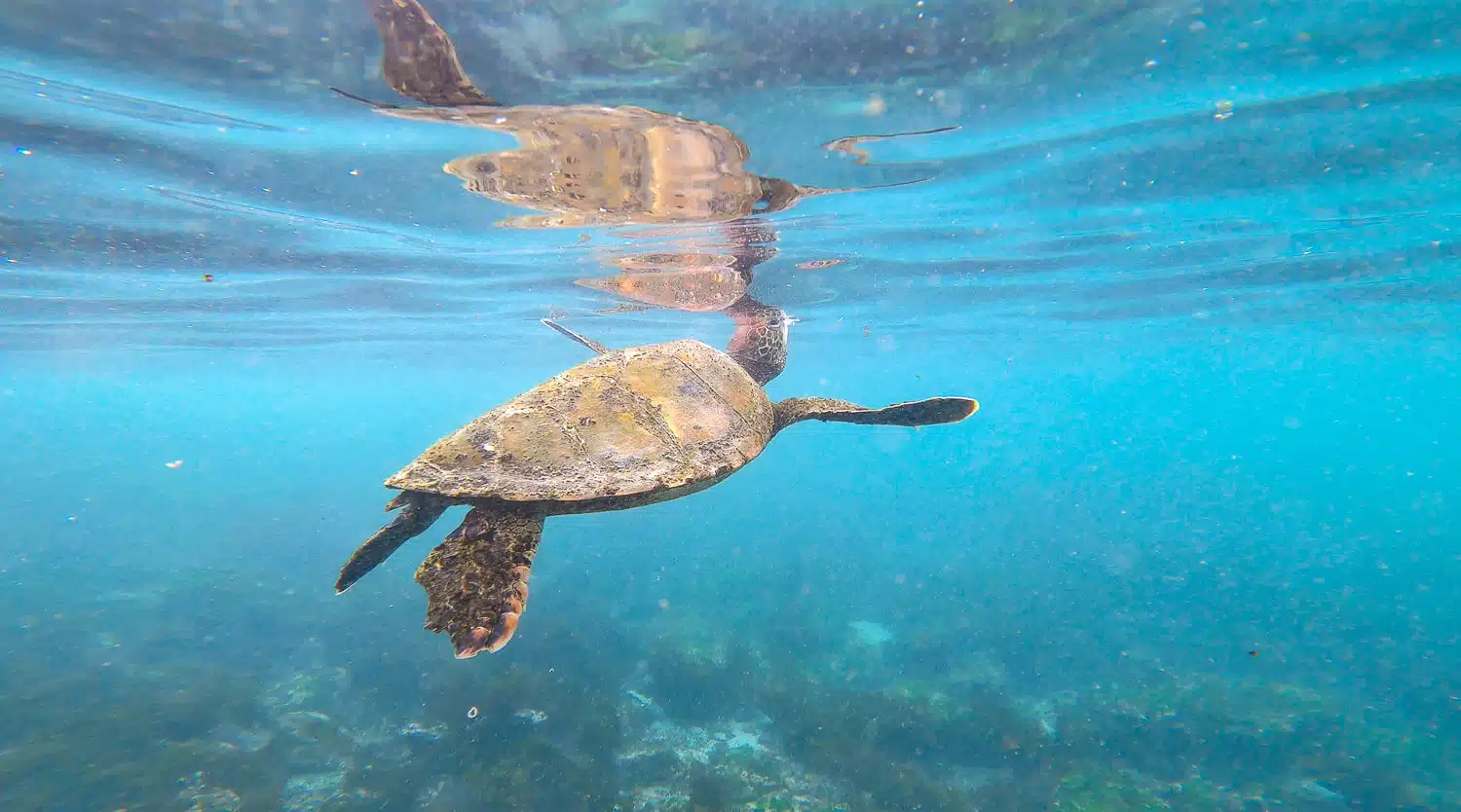
The Galapagos are home to several marine turtle species, especially the green sea turtle. They mainly eat seagrass and algae and play a key role in keeping marine ecosystems healthy. Females return to sandy beaches to nest, laying multiple clutches of eggs, and hatchlings face predators and other hazards. Occasionally, hawksbill and olive ridley turtles are also seen. Conservation is vital to protect these vulnerable reptiles.
Where to see: Widespread; Kicker Rock, Punta Vicente Roca, Española, Floreana, Bartolomé.
A cute turtle while snorkeling at Loberia beach
A Turtle at the Loberia beach in Floreana Island
Sharks & Rays
Sharks and rays are key predators in Galapagos wildlife and marine ecosystems. From reef specialists like the whitetip and blacktip reef sharks to migratory giants such as whale sharks, these species help regulate prey populations and maintain the health of coral reefs and open-ocean habitats. Rays, including manta and stingrays, also add diversity to the shallow and deeper waters around the islands.
Galapagos Shark
Carcharhinus galapagensis
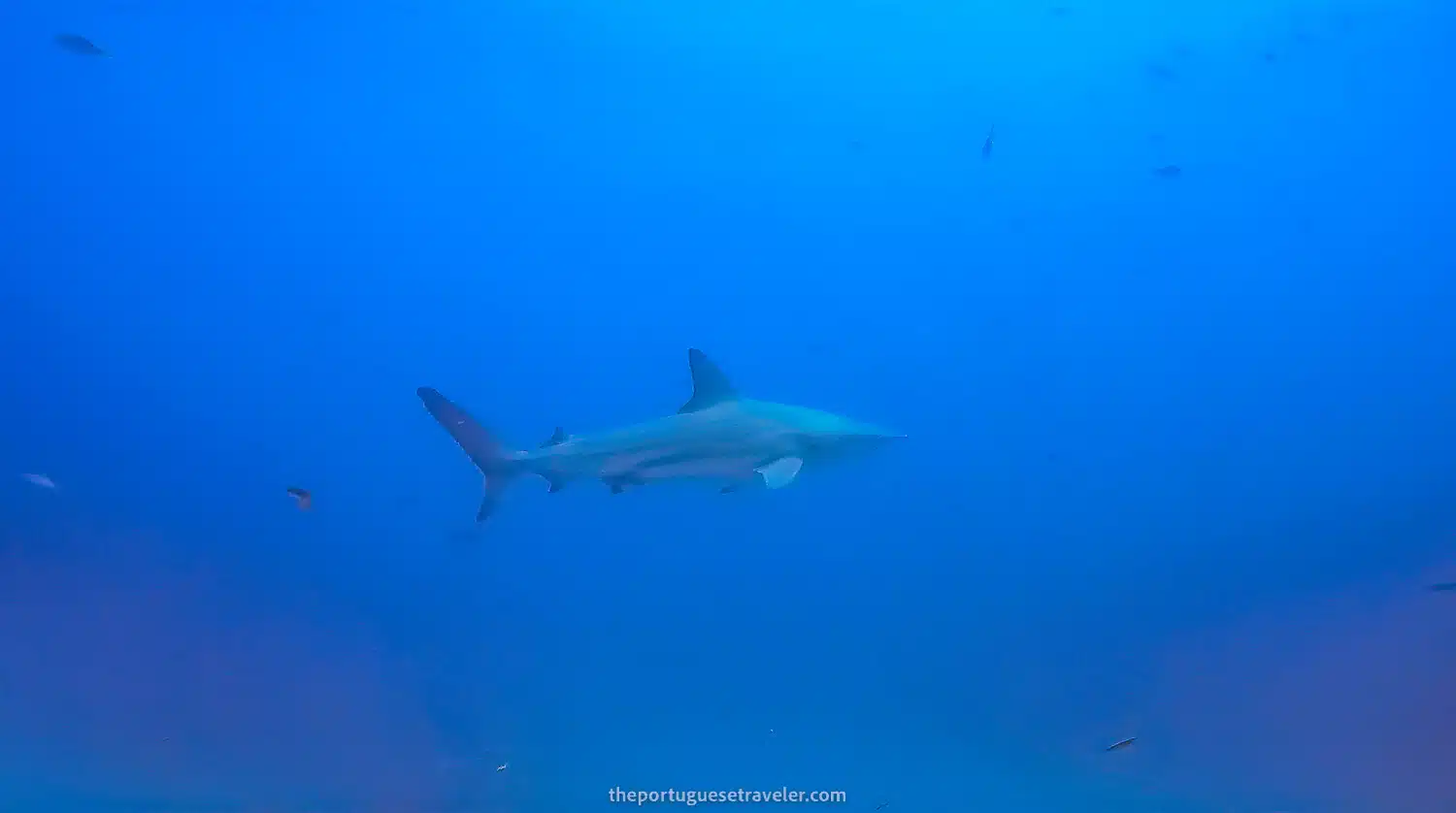
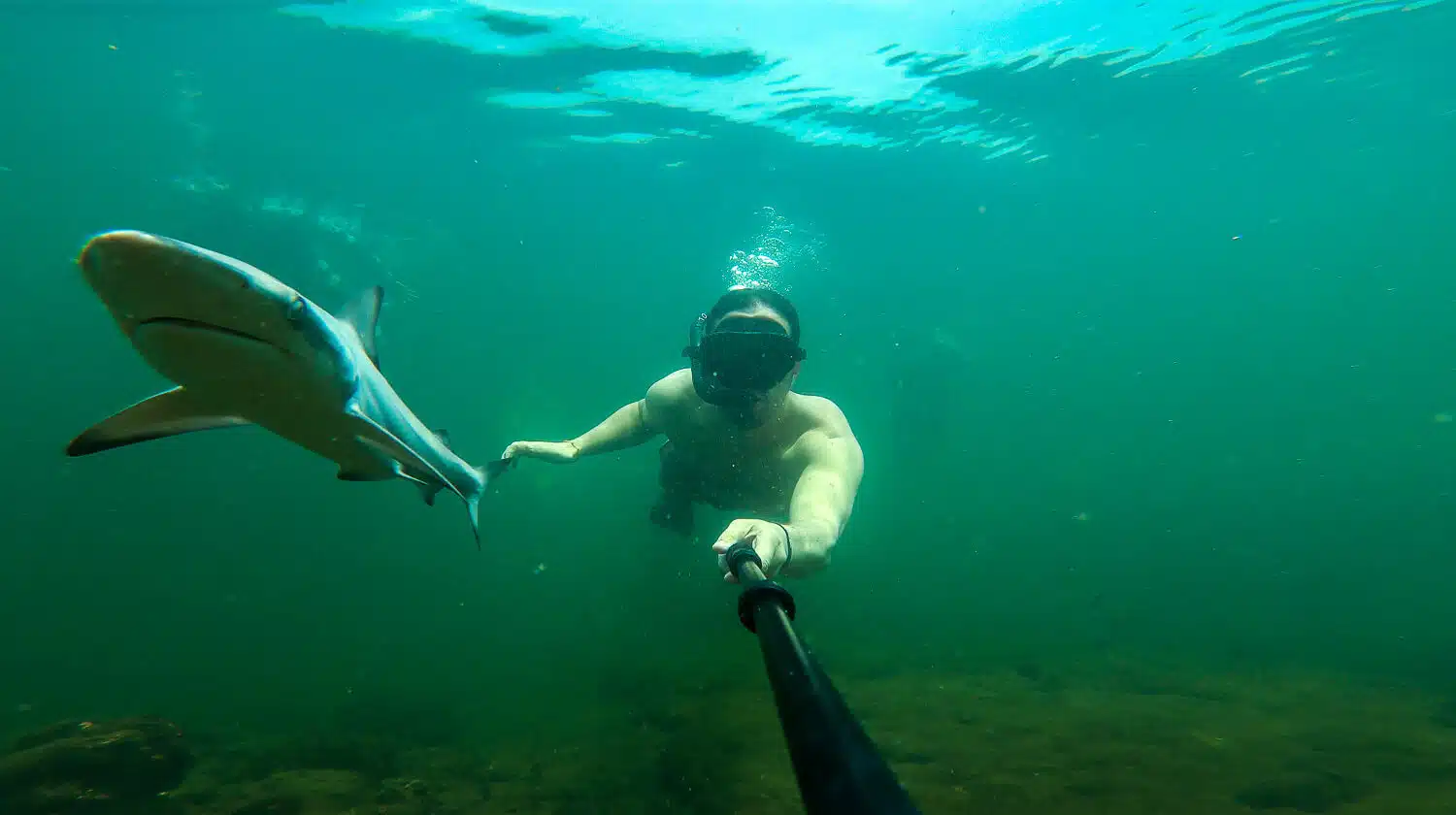
The Galapagos shark is a large requiem shark found in warm waters globally, though first identified near the Galapagos Islands. They have a slender, streamlined body and 14 rows of serrated teeth. They primarily feed on benthic bony fish, but in the Galapagos, they also hunt fur seals and sea lions. Young pups stay in shallow waters to avoid adult cannibalism. Adults are inquisitive and can show aggression toward humans or boats, but they feel threatened in the presence of divers or other sharks.
Where to see: Kicker Rock (San Cristobal), Wolf & Darwin.
A Galápagos Shark on the Gordon Rocks dive site
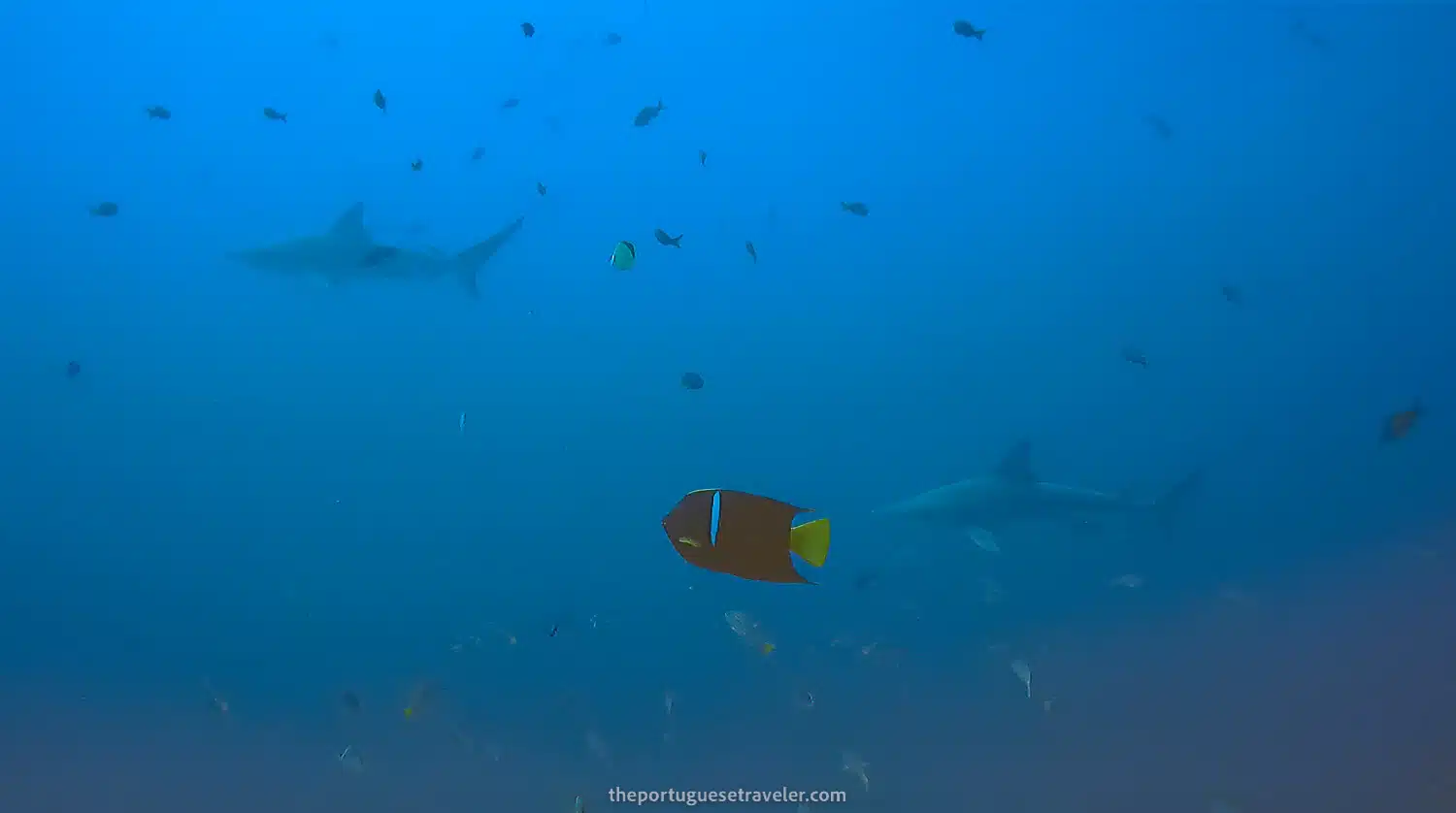
Galapagos Sharks
Blacktip & Whitetip Reef Sharks
Triaenodon obesus
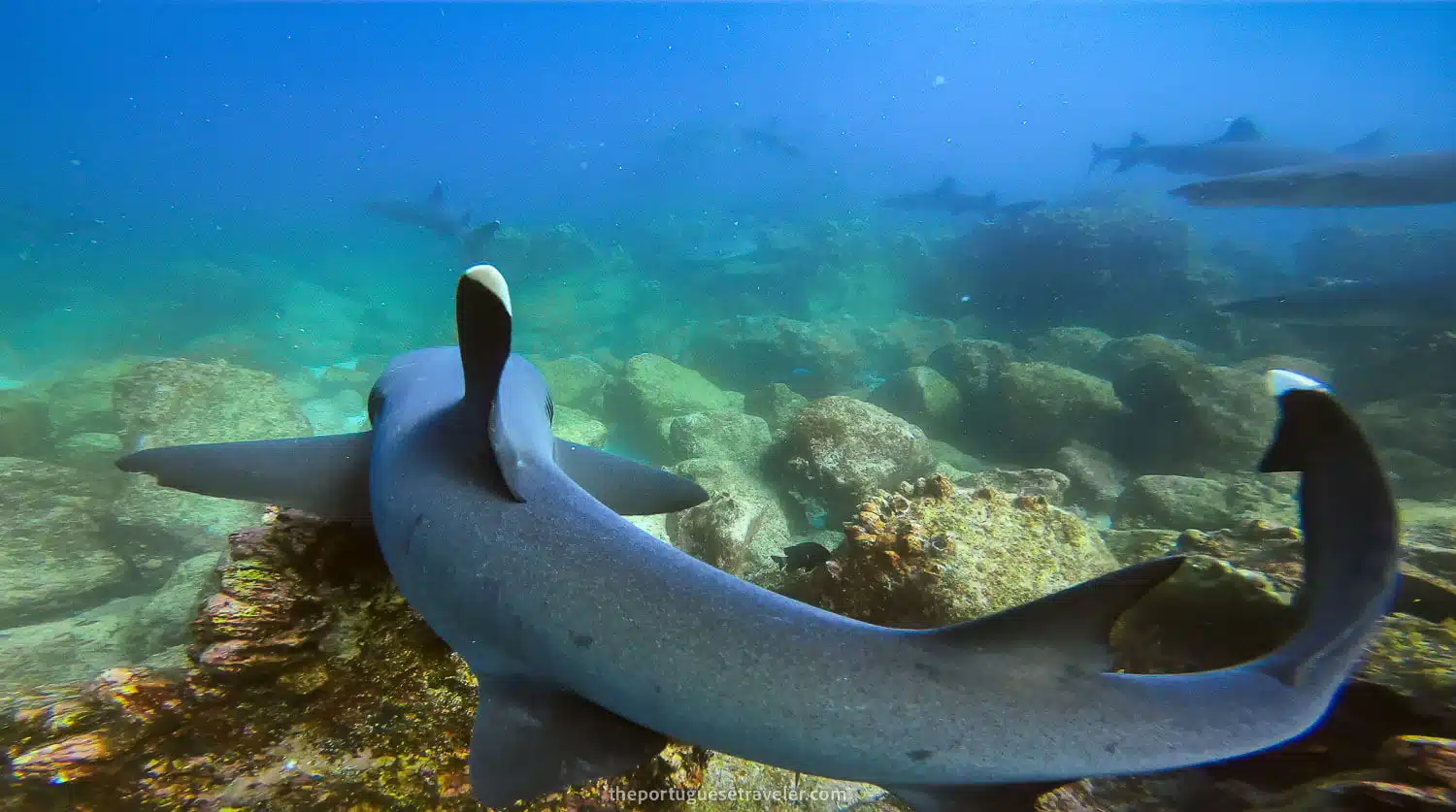
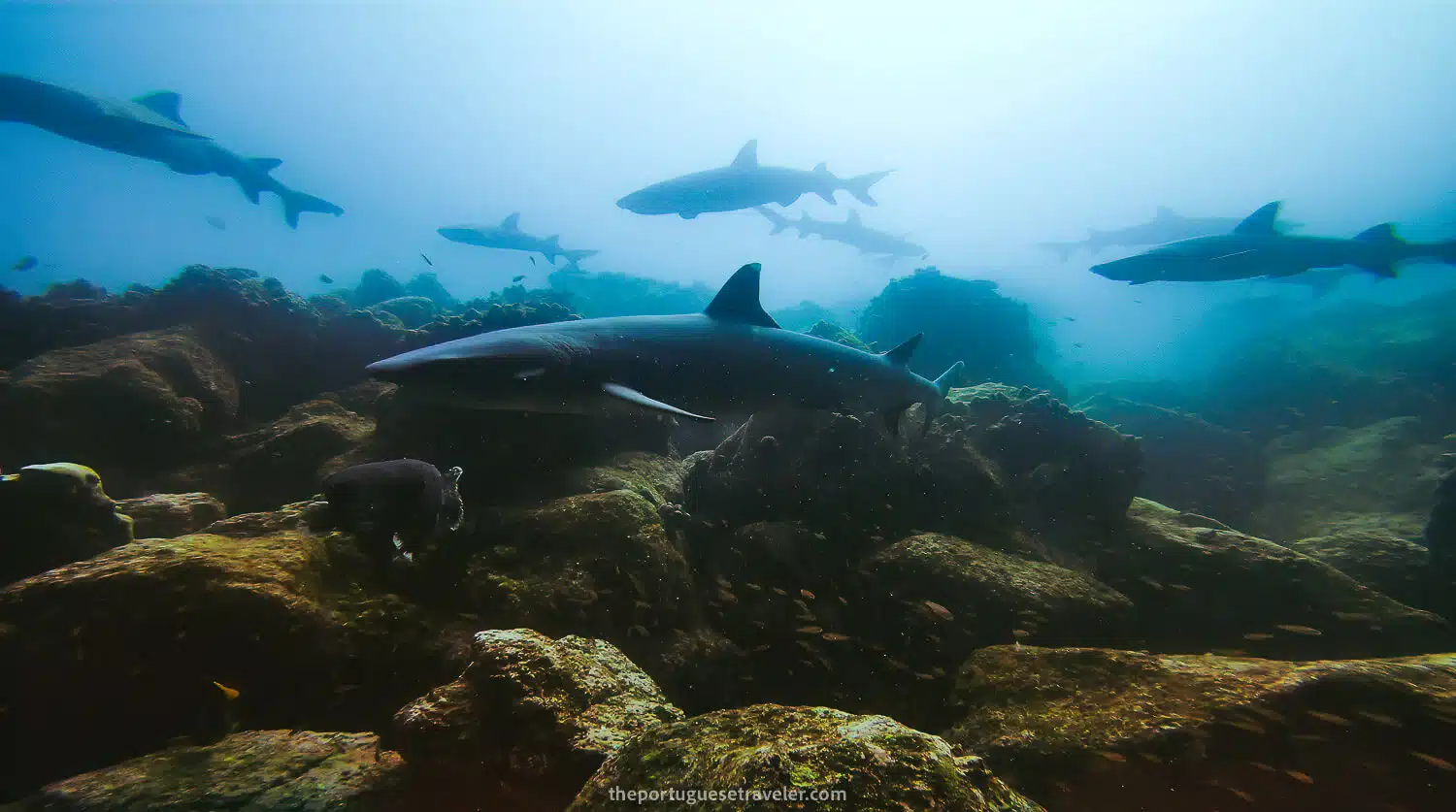
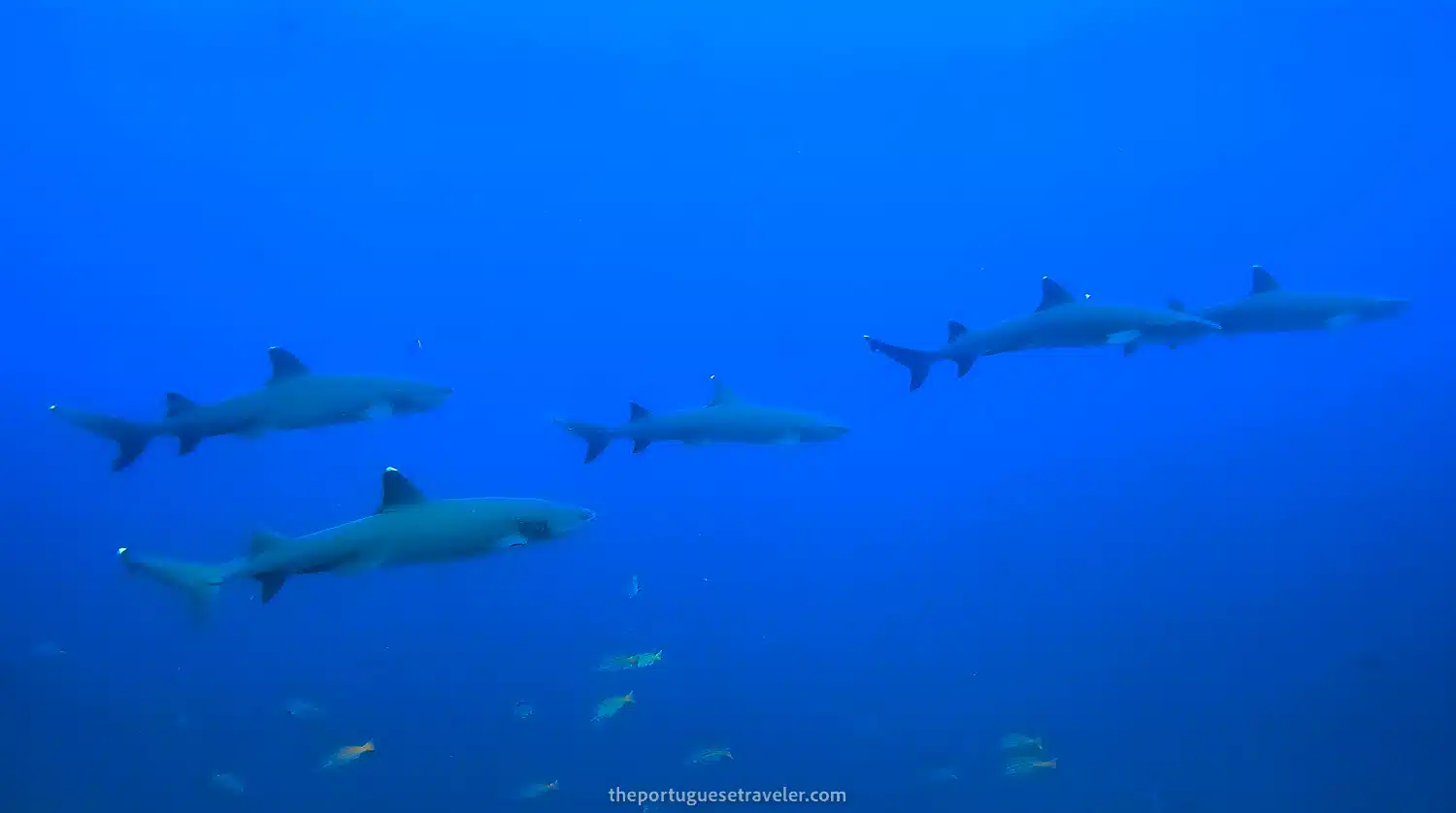
The whitetip reef shark is a small to medium-sized reef predator, slender-bodied with a grey-brown upper side and white underbelly. They are relatively sluggish, resting in caves during the day and hunting at night. Whitetips reproduce in shallow waters, giving birth to 1–5 pups fully capable of surviving independently. Blacktip reef sharks, while not detailed in the info, generally share similar reef habitats and feed on small fish.
Where to see: Widespread, Isabela, Gordon Rocks (Santa Cruz), Devil’s Crown (Floreana), Bartolomé, Española.
A very close white-tip reef shark
White-tip reef sharks cleaning station in Mosquera dive site
A school of white tip reef sharks
A sharkie
Hammerhead Sharks (Scalloped)
Sphyrna lewini
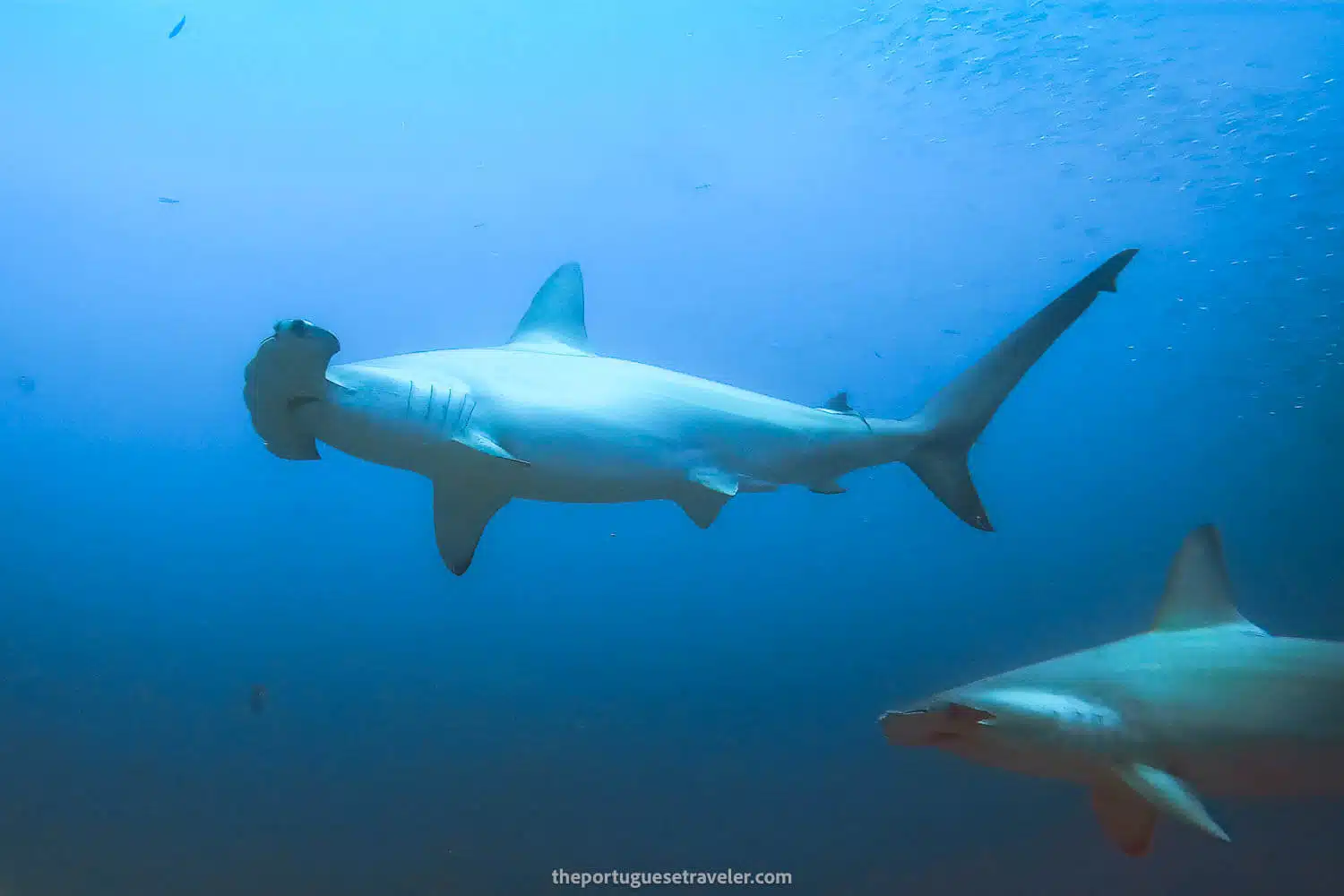
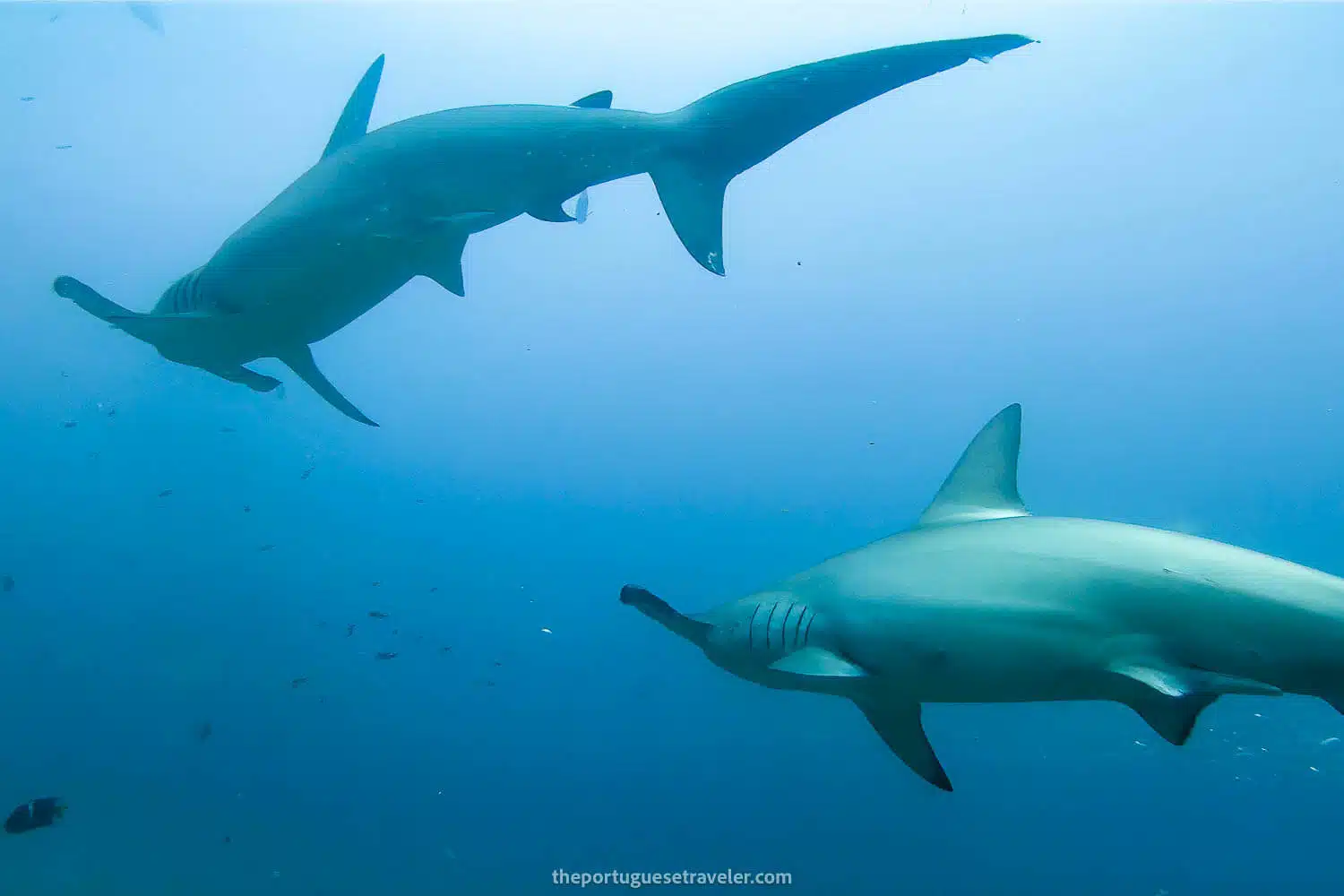
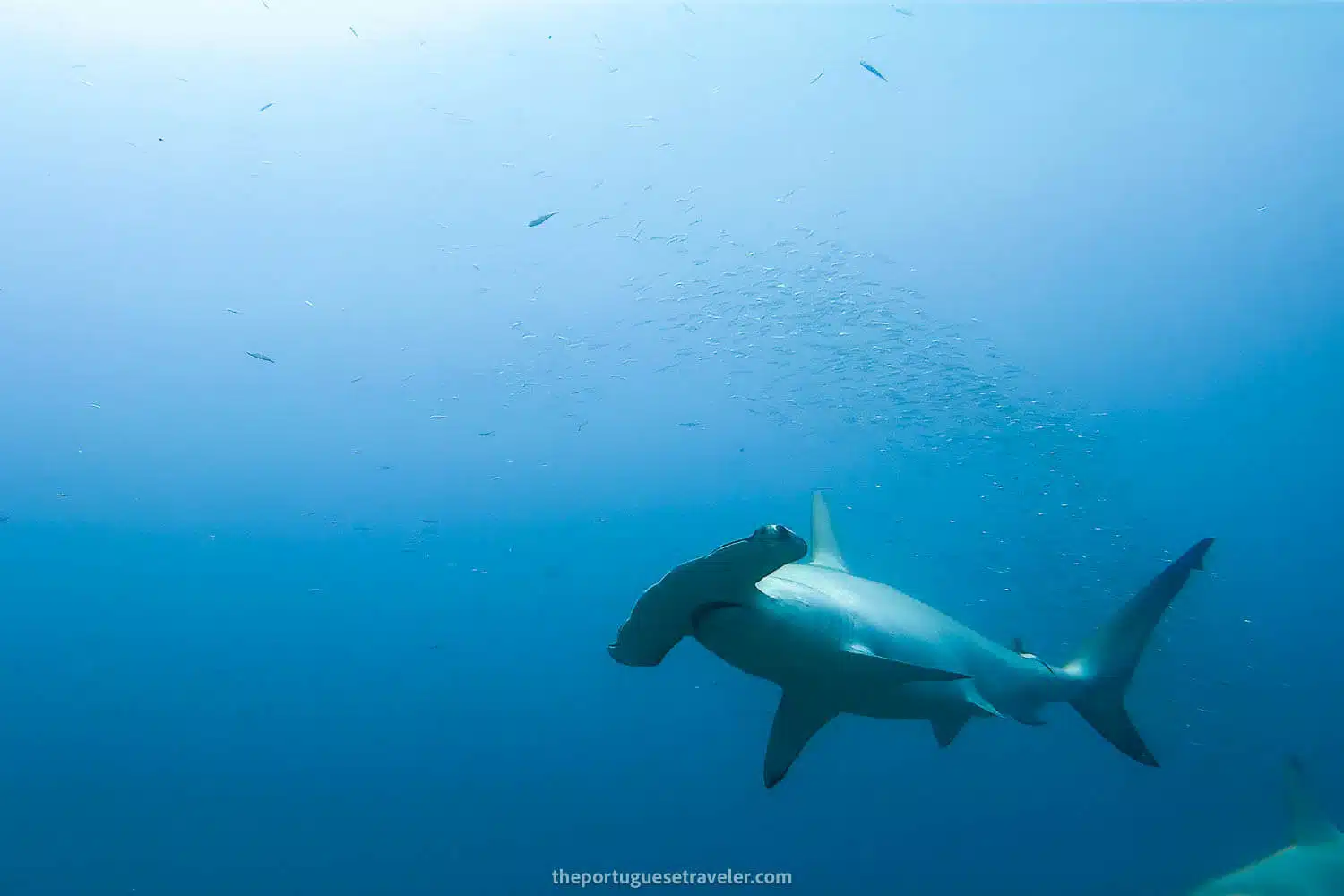
Scalloped hammerheads are migratory sharks easily recognized by the scalloped front edge of their hammer-shaped heads. They are viviparous, giving birth to 12–40 pups after a 9–12 month gestation. In the Galapagos Marine Reserve, large schools of hammerheads gather, a phenomenon still not fully understood. Their diet includes schooling fish, stingrays, squid, and crustaceans.
Where to see: Kicker Rock, Gordon Rocks, Wolf & Darwin.
Hammerhead Sharks at Kicker Rock
The groups of Hammerhead sharks that passed by us at Kicker Rock
A beautiful hammerhead at Kicker Rock
Whale Shark
Rhincodon typus
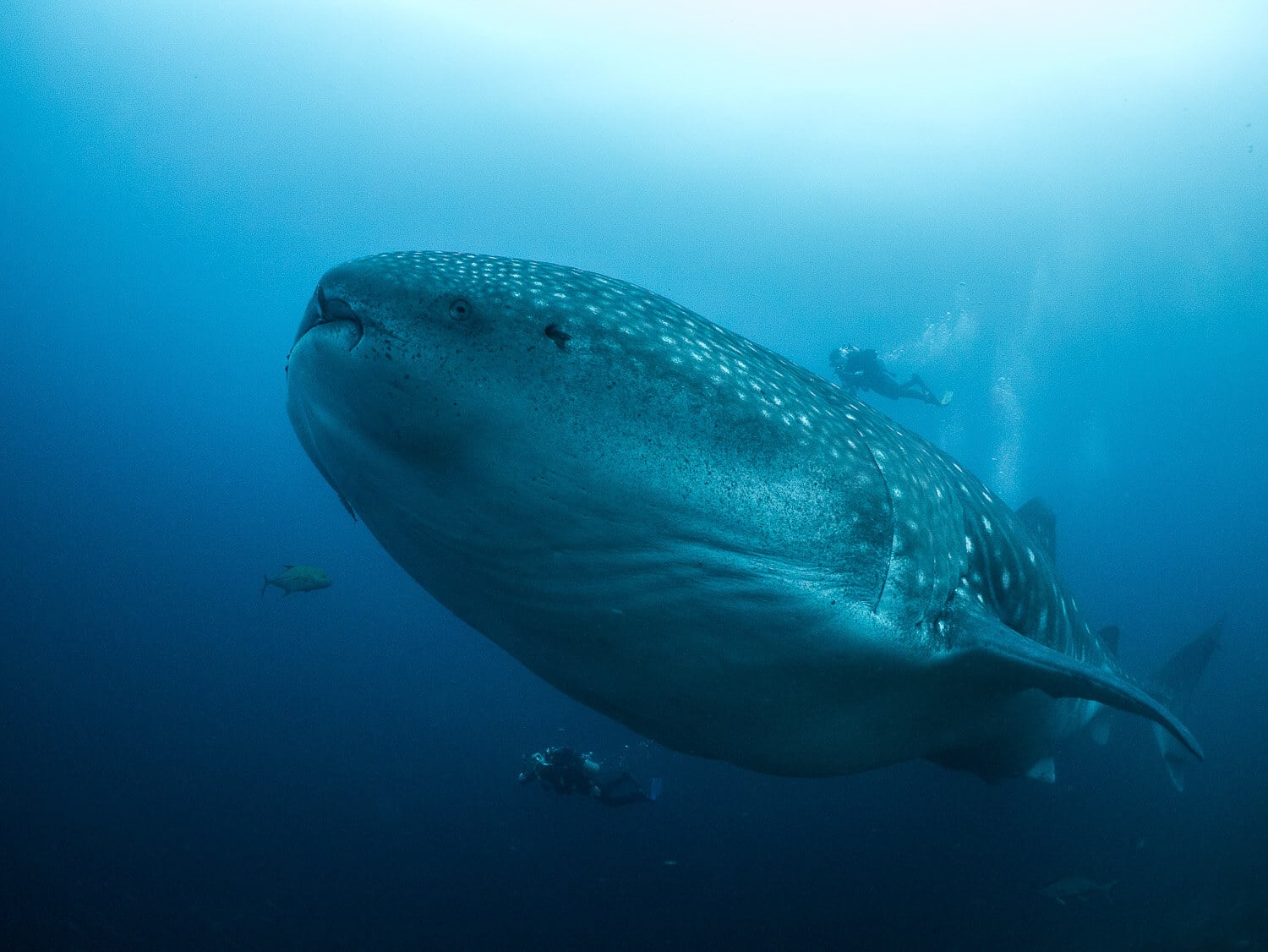
The whale shark is the largest fish in the world, with individuals reaching up to 20 meters and 30 tonnes. They are migratory filter feeders, consuming plankton and occasionally small fish through ram filtration. Whale sharks in Galapagos are mostly pregnant females, though the reasons for this are still being studied. They are slow-moving, gentle giants with distinctive grey-blue patterned skin.
Where to see: Wolf & Darwin (best June–Nov).
Whale Shark | Credit: Simon Pierce @ https://galapagosconservation.org.uk/
Galapagos Bullhead Shark
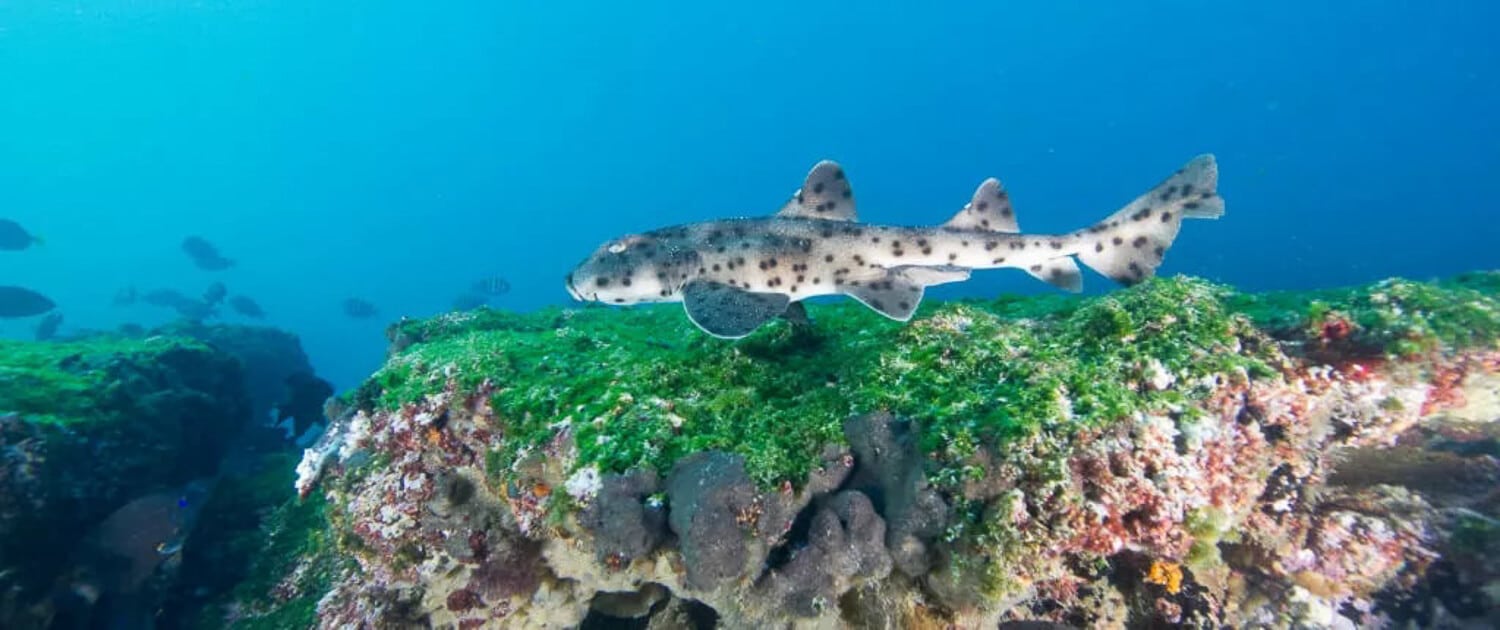
Information on the Galapagos bullhead shark wasn’t detailed in the sources, but bullhead sharks are generally small, bottom-dwelling sharks with broad, flattened heads, feeding on benthic invertebrates and fish.
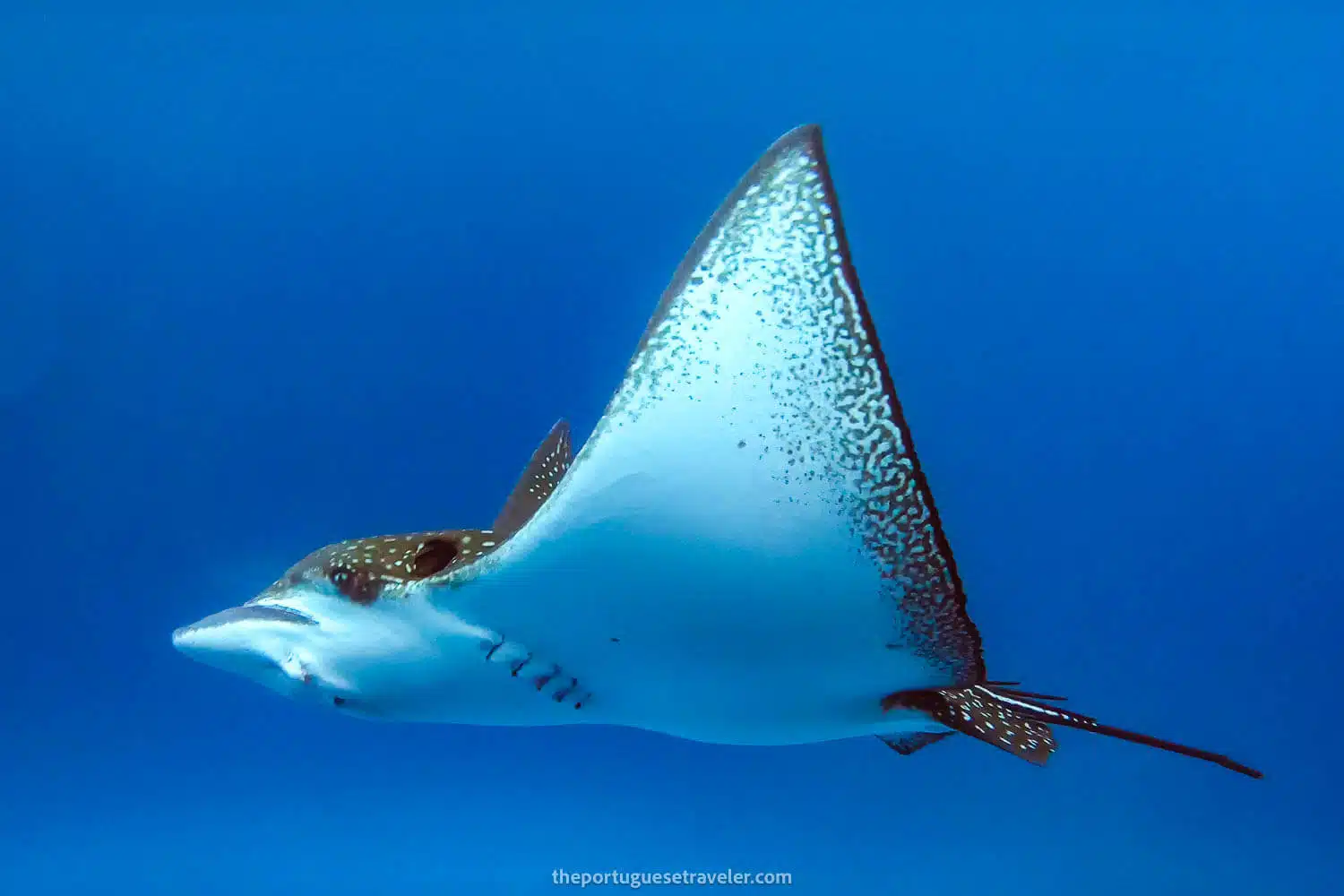
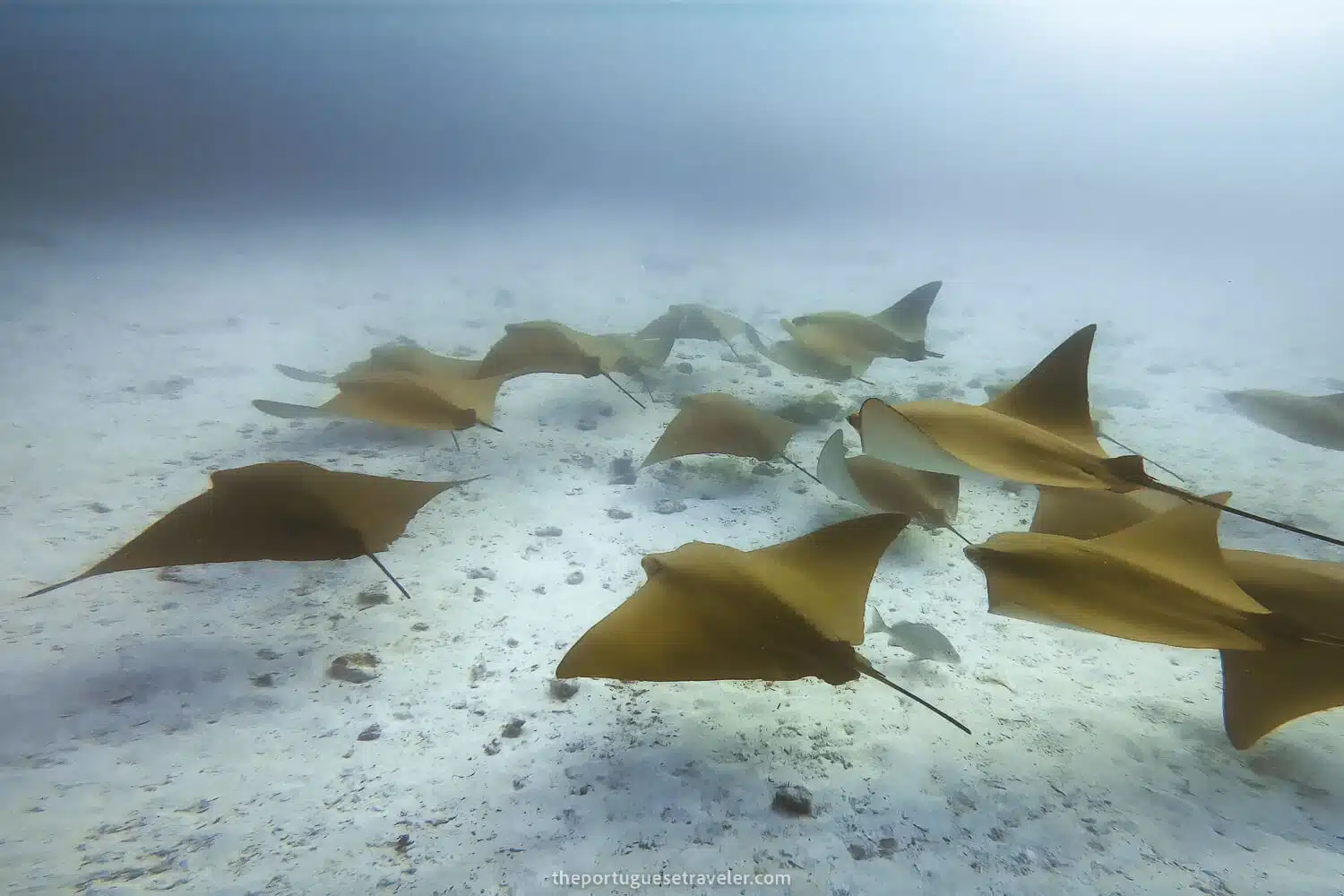
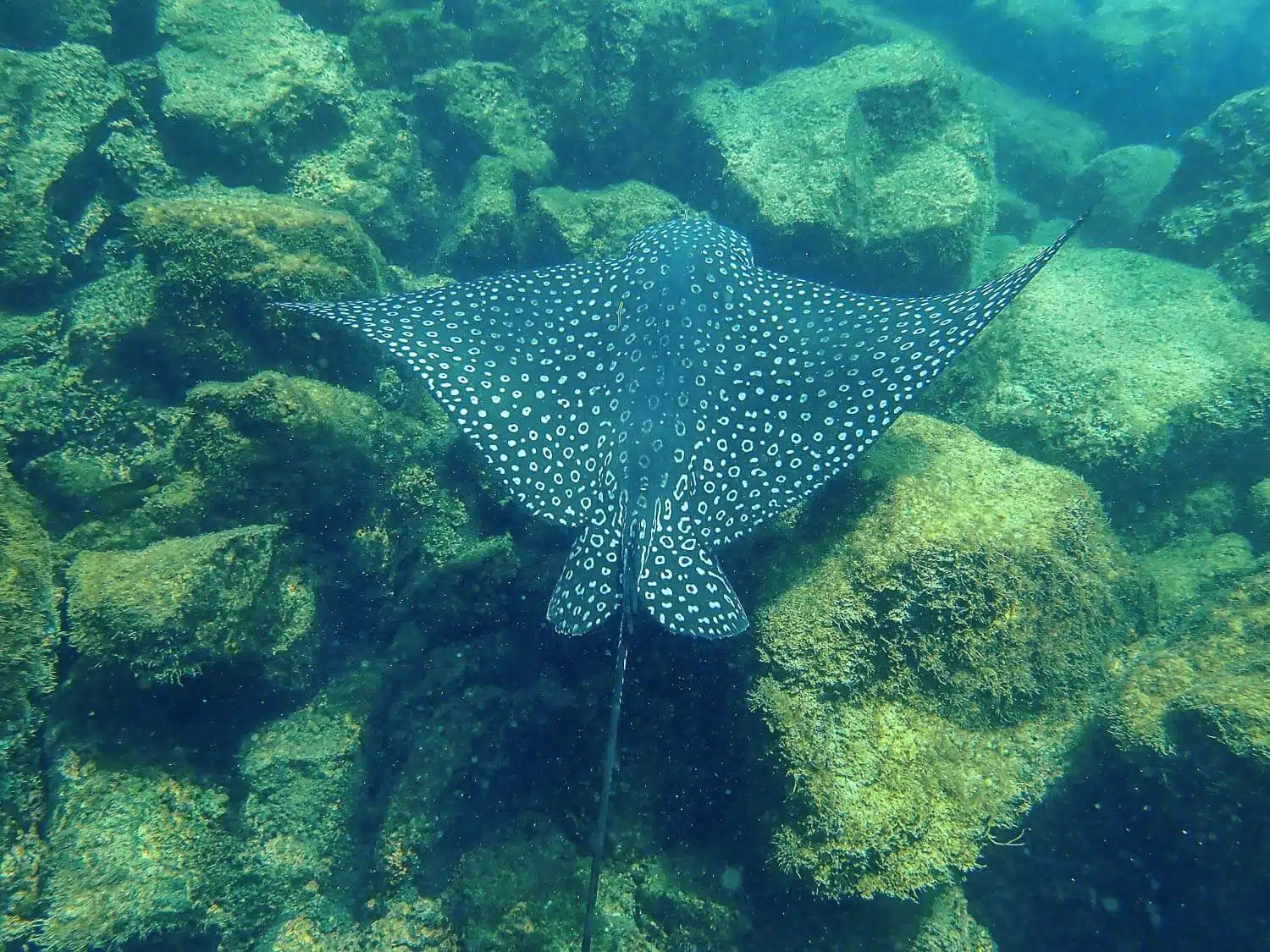
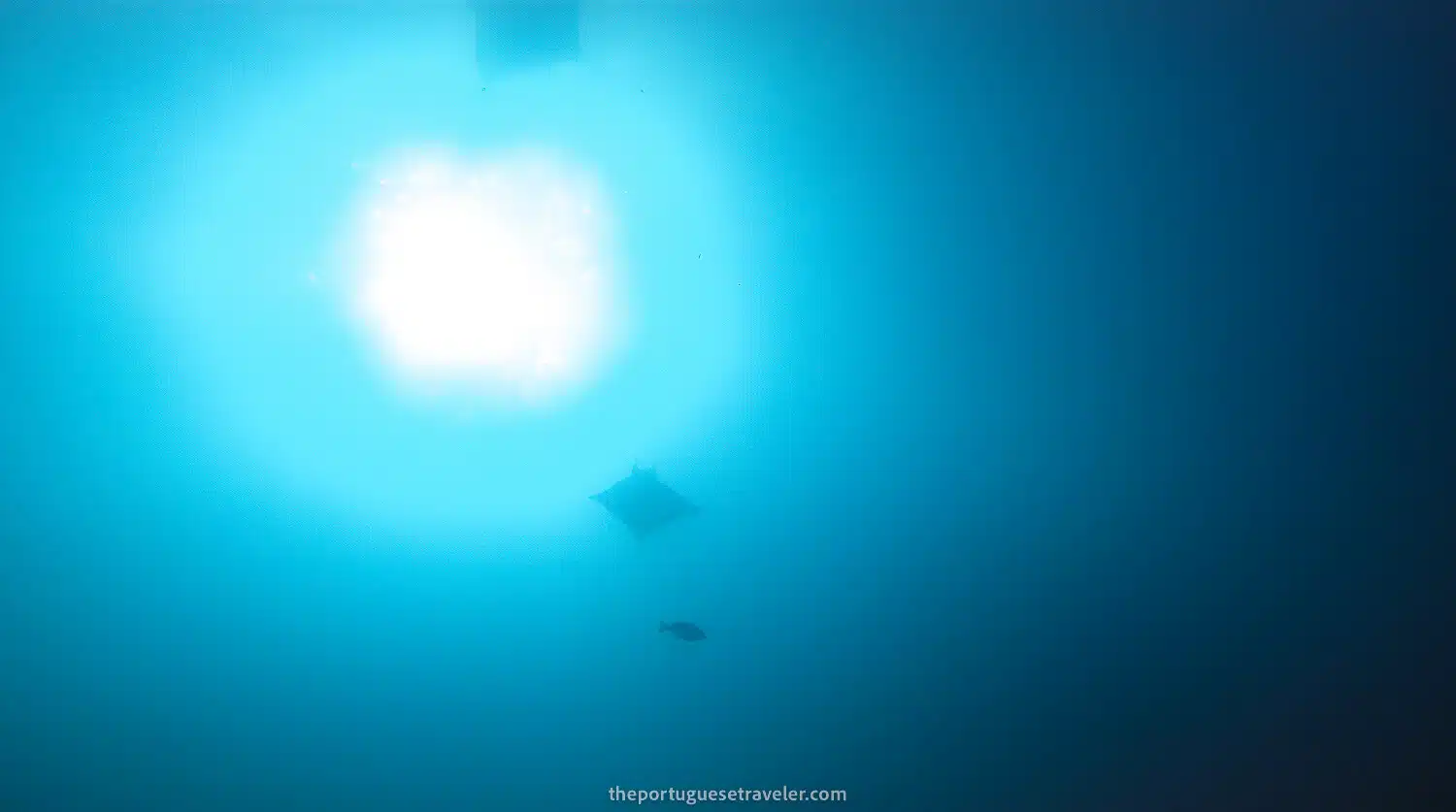
Galapagos waters host various rays, including manta rays, golden rays and stingrays. Rays are flat, cartilaginous fish with large, wing-like fins for graceful swimming. Manta rays feed on plankton using filter feeding, while stingrays often hide beneath sand to ambush prey. Some rays, like manta rays, exhibit playful behaviors such as leaping out of the water, possibly to remove parasites or for other unknown reasons.
Where to see: Cape Marshall (Isabela), Gordon Rocks (Santa Cruz), Española, Floreana.
A really close eagle ray at Kicker Rock
Mosquera Island
A gorgeous eagle ray
Two manta rays swimming over us
Fish of the Galapagos Wildlife
The Galapagos boasts a rich diversity of reef and pelagic fish. Species range from small reef herbivores like surgeonfish and parrotfish to large predators like groupers and snappers. Each plays a critical role in the food web, shaping the structure and health of coral reefs and marine ecosystems.
Pacific Seahorse
Hippocampus ingens
Seahorses are small, delicate fish found in the shallow coastal waters of the Galapagos. They anchor themselves to seagrass, algae, or coral using their
prehensile tails and feed on tiny crustaceans and plankton. Remarkably, male seahorses carry and give birth to the young, making them a unique example of parental care in the marine world. Their slow movements and camouflaging ability help them avoid predators, but they remain vulnerable to habitat changes and pollution.
Where to see: Cousin’s Rock (Santiago), Isabela.
A beautiful seahorse in Los Tuneles
Mola Mola (Ocean Sunfish)
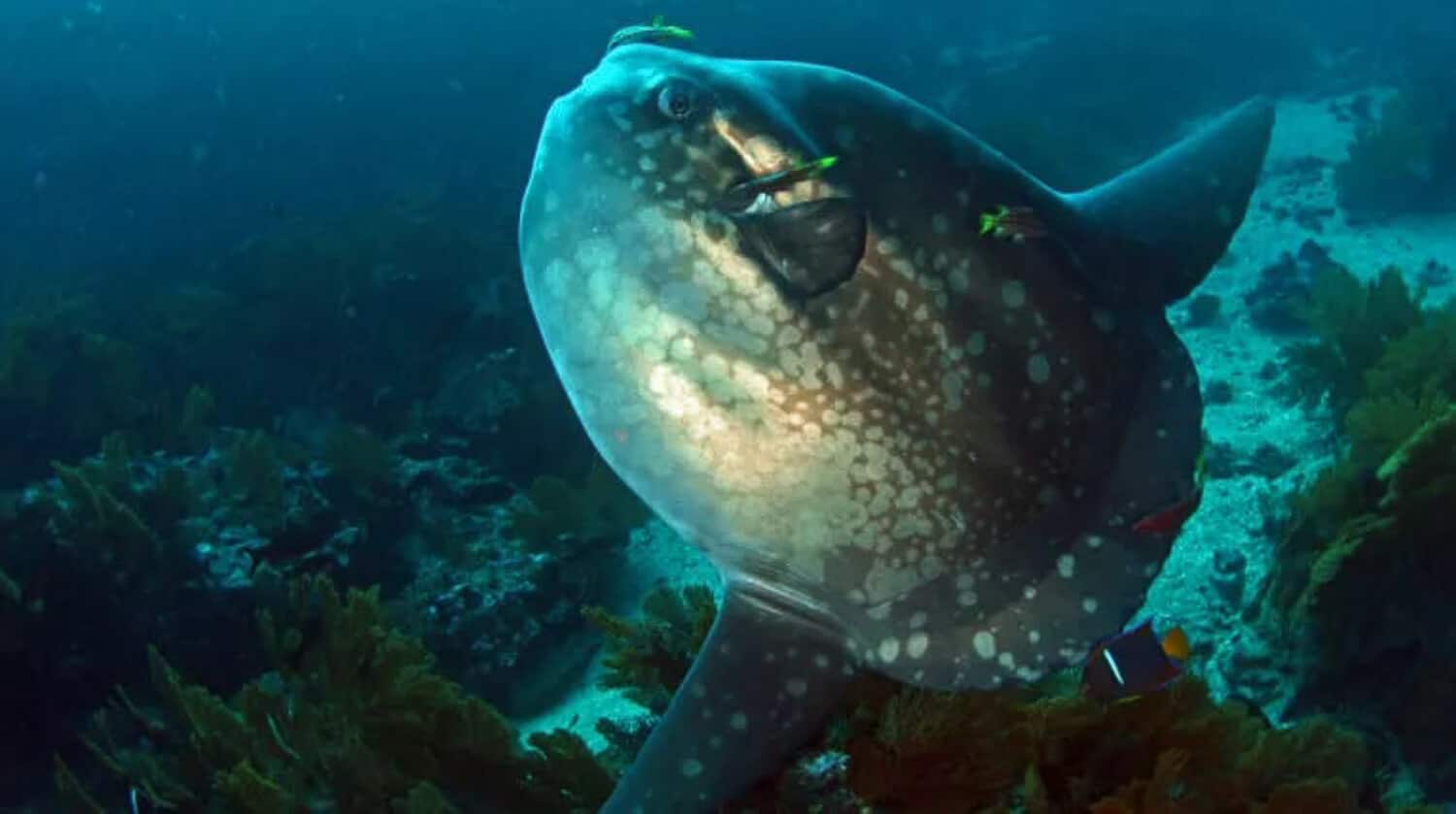
Two species of sunfish are found in the Galapagos: Mola mola (ocean sunfish) and Mola ramsayi (southern sunfish). These massive, rounded fish have no real tail and move using large dorsal and anal fins. They bask near the surface, which helps regulate their body temperature after deep dives. Sunfish feed on jellyfish, squid, crustaceans, and small fish, crushing food with fused beak-like teeth. Females produce enormous clutches, with one documented carrying 300 million eggs.
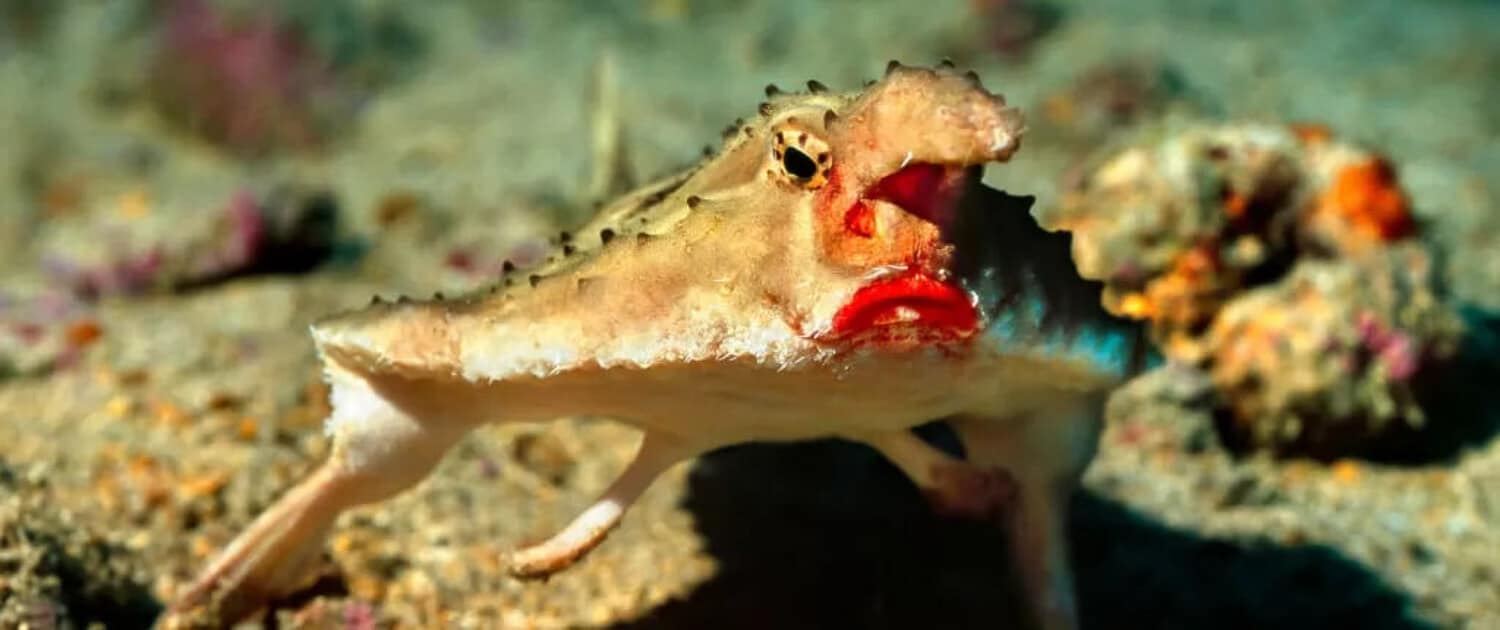
The red-lipped batfish is a bizarre-looking benthic fish, notable for its bright red lips and “walking” ability using its modified pectoral fins. Native to Galapagos, it inhabits sandy bottoms and hunts small invertebrates. Its unusual appearance is mostly for mating displays rather than feeding.
Where to see: Deeper waters off Santa Cruz and San Cristobal.
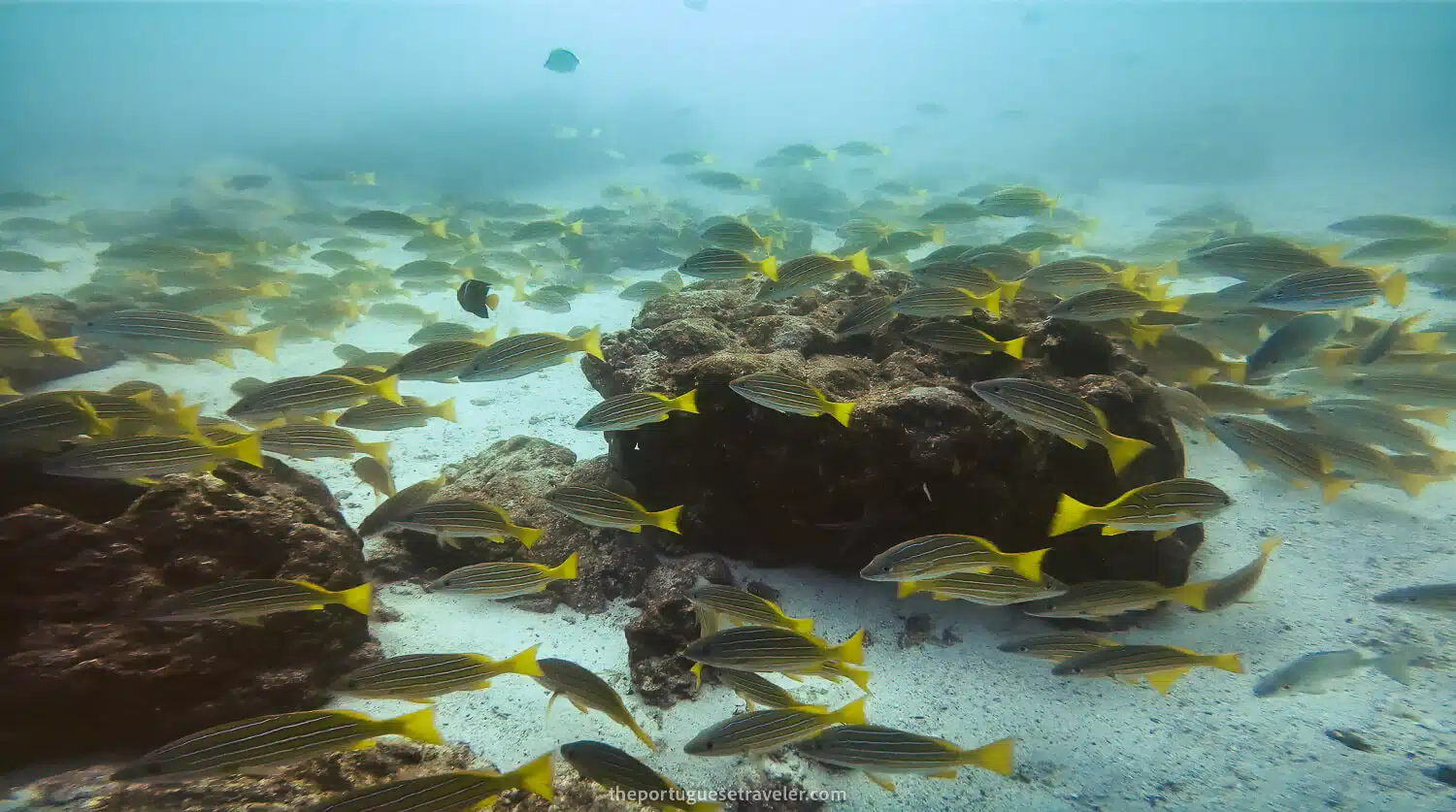
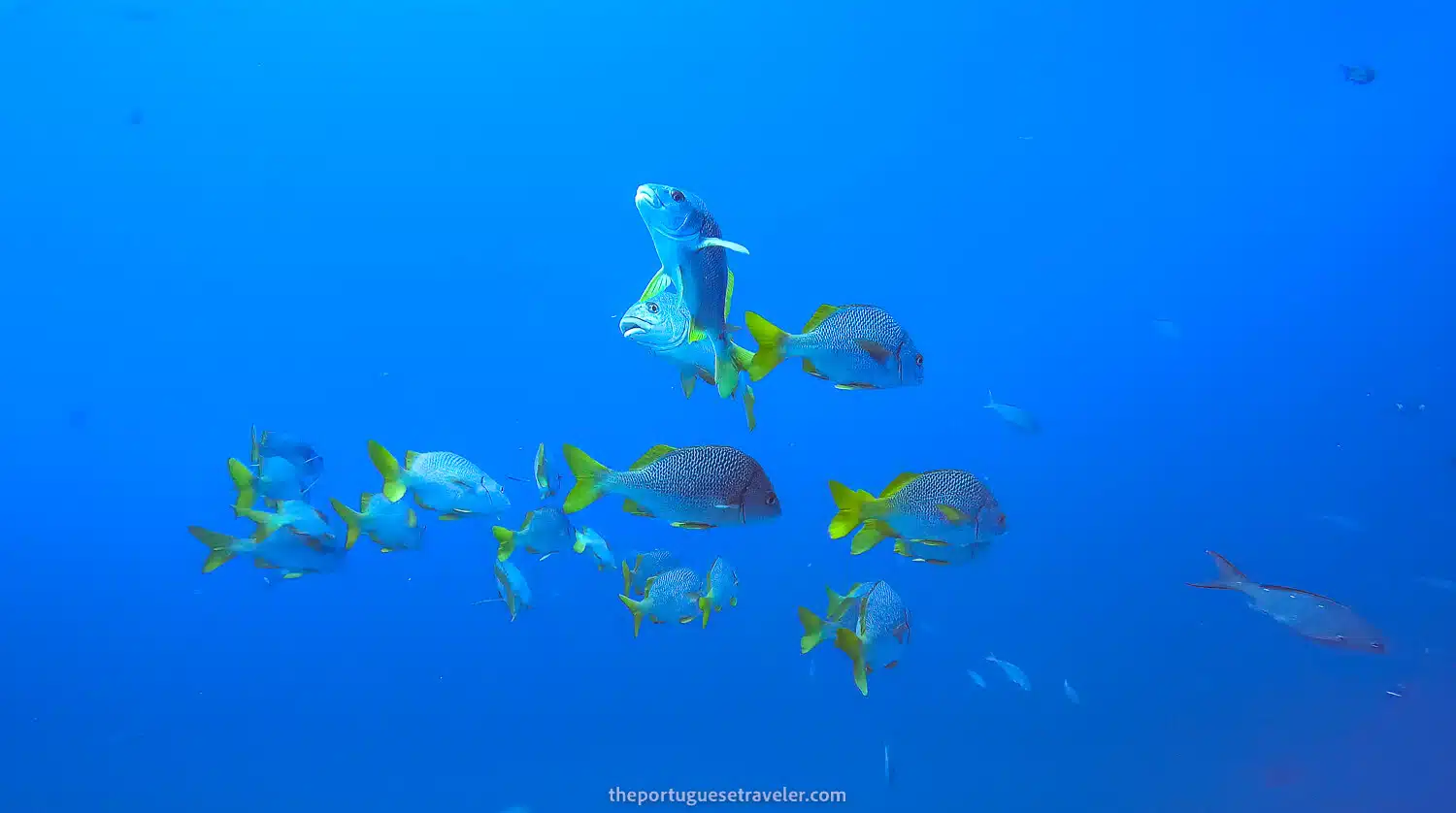
Groupers and snappers are common reef predators in Galapagos waters. Groupers are large, stocky fish feeding on smaller fish and crustaceans. Snappers are fast, schooling predators feeding on fish and invertebrates. Both play important roles in controlling reef populations.
Where to see: Common throughout rocky reefs.
Blue Gold Snappers in Mosquera Dive Site
Yellowtail Surgeonfish, Parrotfish, Angelfish
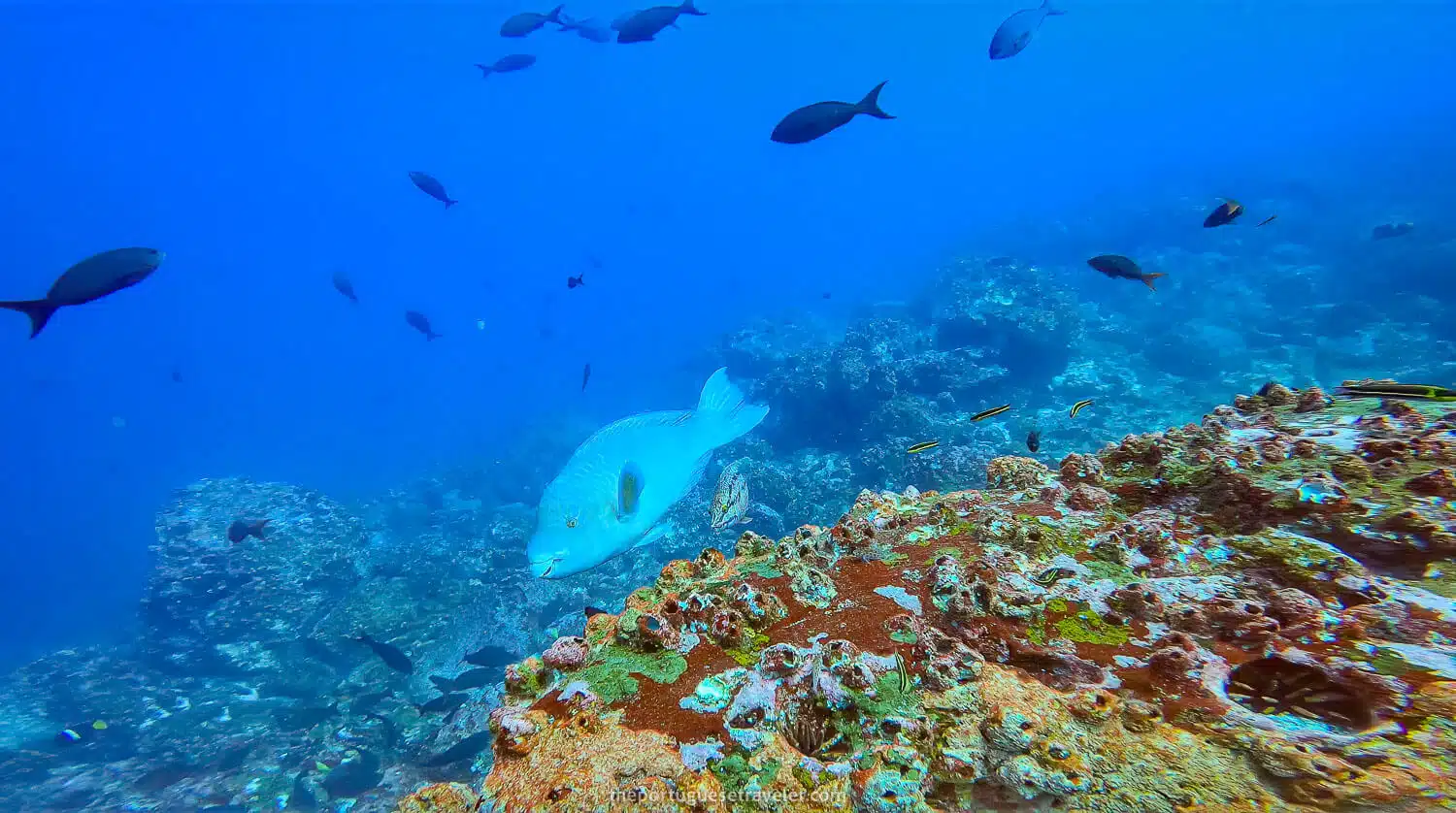
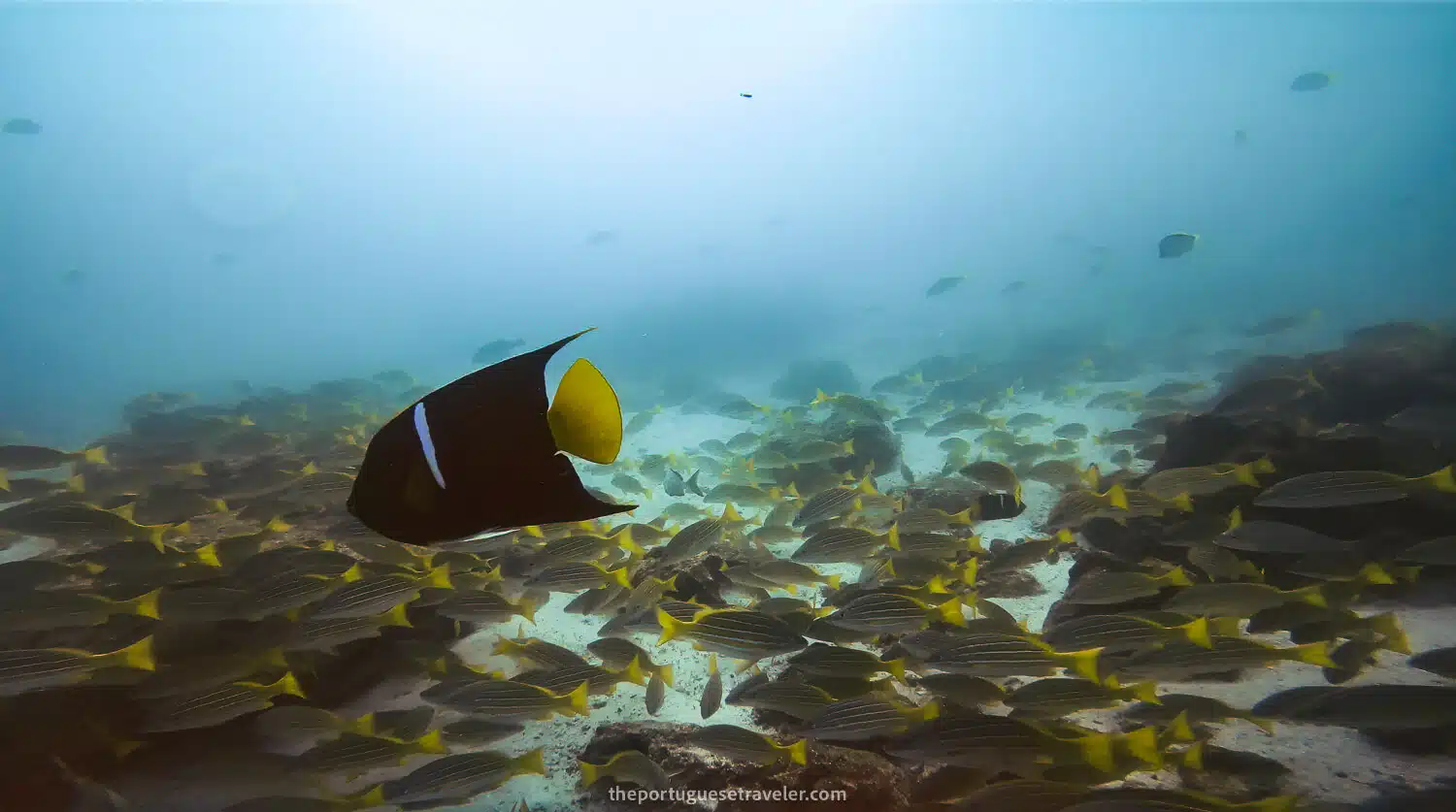
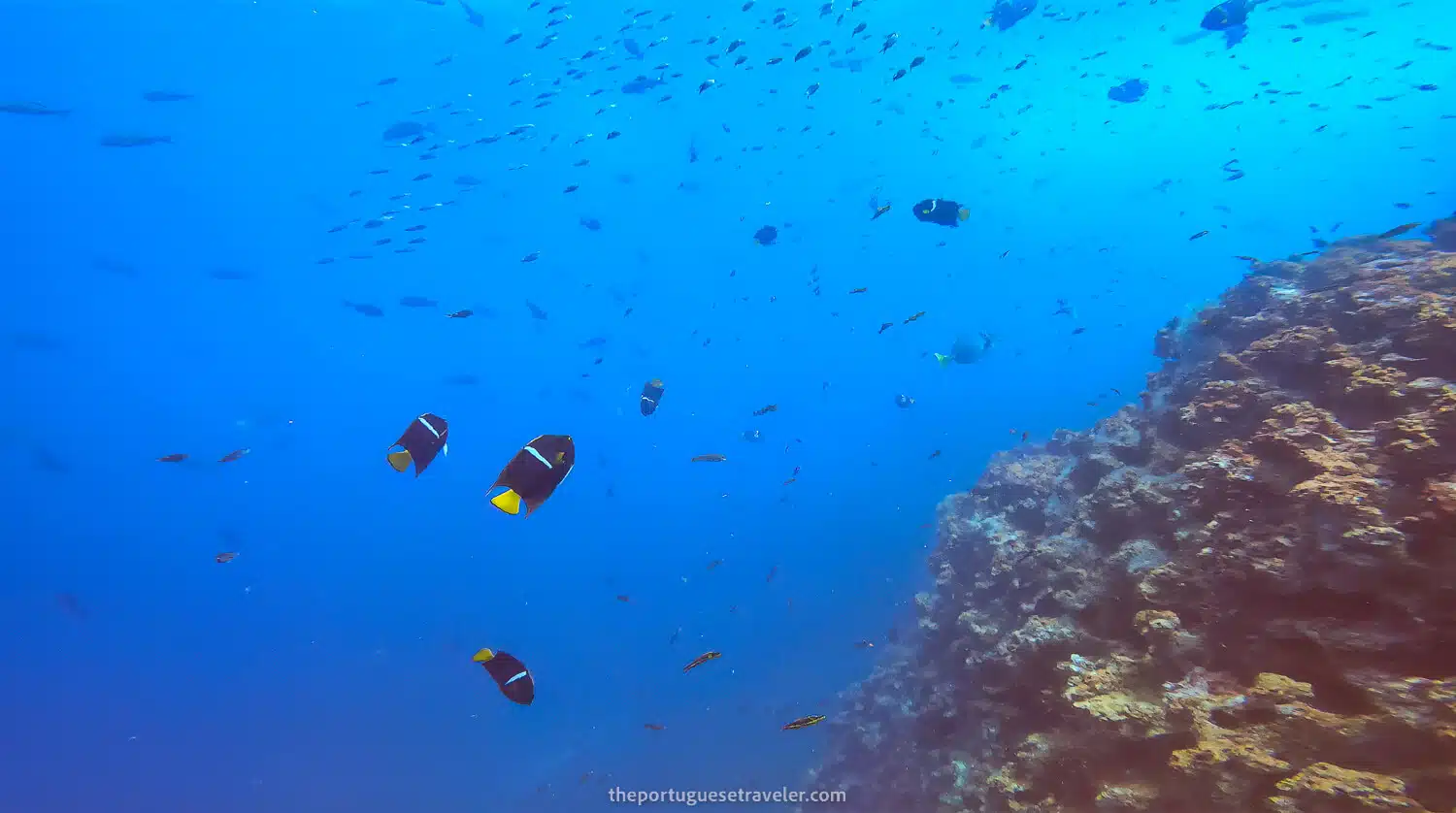
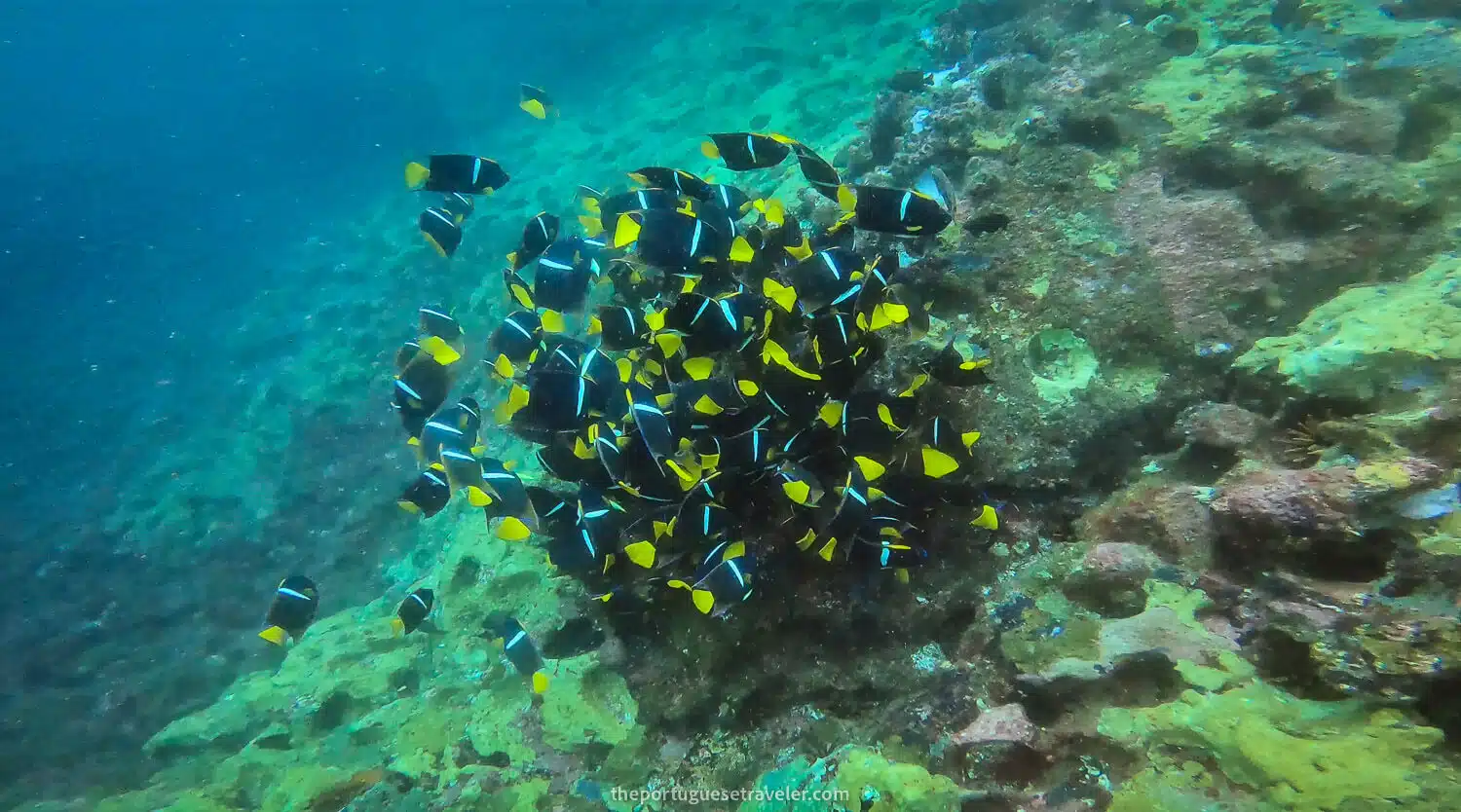
Reef herbivores include yellowtail surgeonfish, parrotfish, and angelfish. Parrotfish feed on algae and coral polyps, often shaping the reef structure with their beak-like mouths. Surgeonfish graze algae, maintaining balance on the reef, while angelfish feed on sponges and small invertebrates, adding diversity to the ecosystem.
Where to see: Coral and rocky reefs near all main islands.
A school of Yellowtail Grunt
A Parrot Fish next to some beautiful corals
A king angelfish between many blue and gold snappers
King Angelfish and a halocline
A school of King Angelfish next to Kicker Rock
Crustaceans & Marine Invertebrates
Crustaceans and other invertebrates are abundant along Galapagos shores and reefs. Sally Lightfoot crabs, hermit crabs, ghost crabs, sea cucumbers, starfish, and sea urchins perform vital ecological roles, from grazing algae to recycling nutrients. These species are essential to the stability and productivity of both intertidal and subtidal zones.
Sally Lightfoot Crab
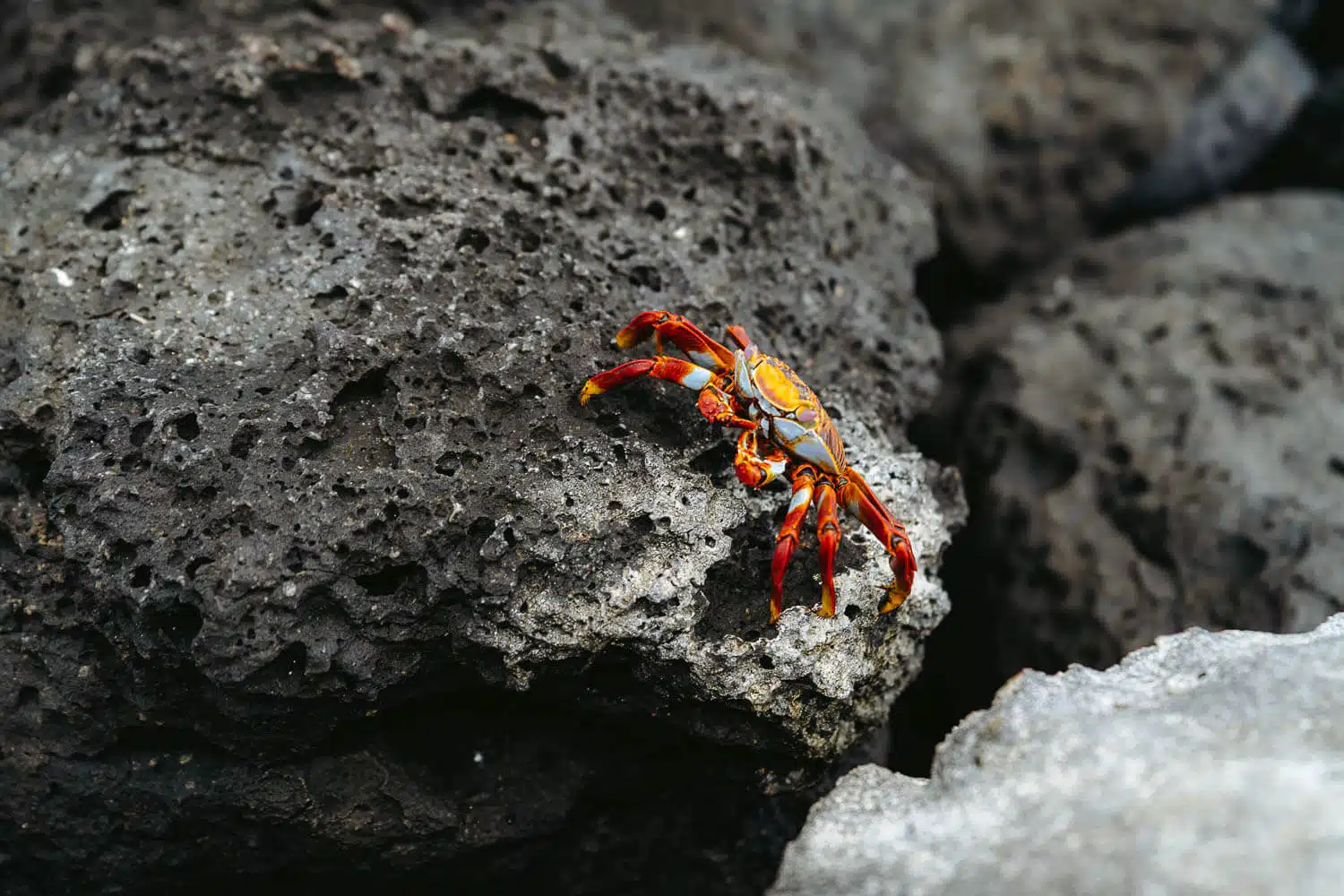
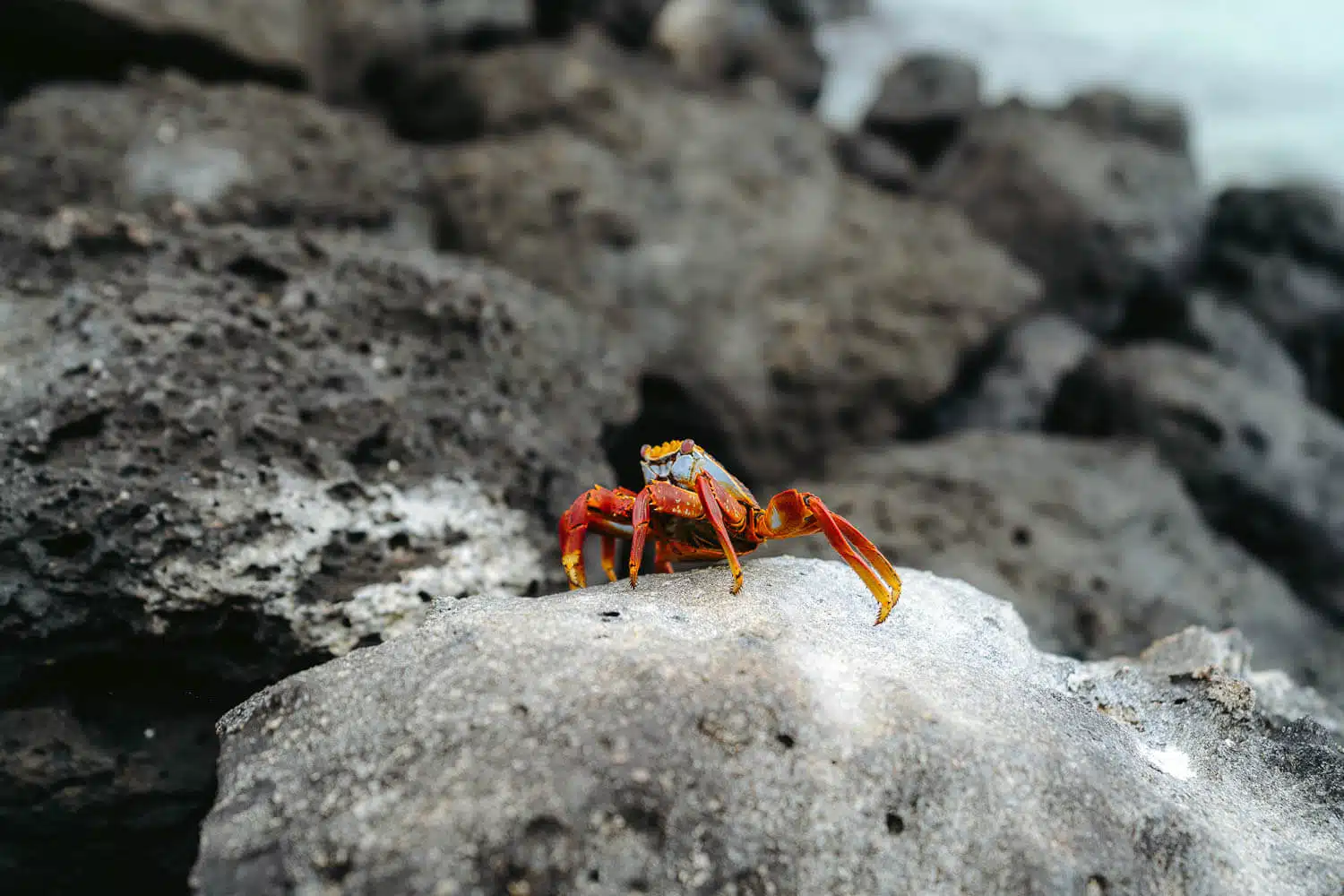
The Sally Lightfoot crab (Grapsus grapsus) is a bright, agile crab commonly seen on Galapagos lava rocks. It feeds on algae, detritus, and occasionally scavenges from dead animals. Its vivid red and orange coloration makes it iconic on the islands’ coastlines.
Where to see: Widespread, especially Santiago, Fernandina, Bartolomé, Santa Cruz.
Grapsus Grapsus Crab in Santa Cruz
Grapsus Grapsus crap in the Galápagos
Hermit Crabs & Ghost Crabs
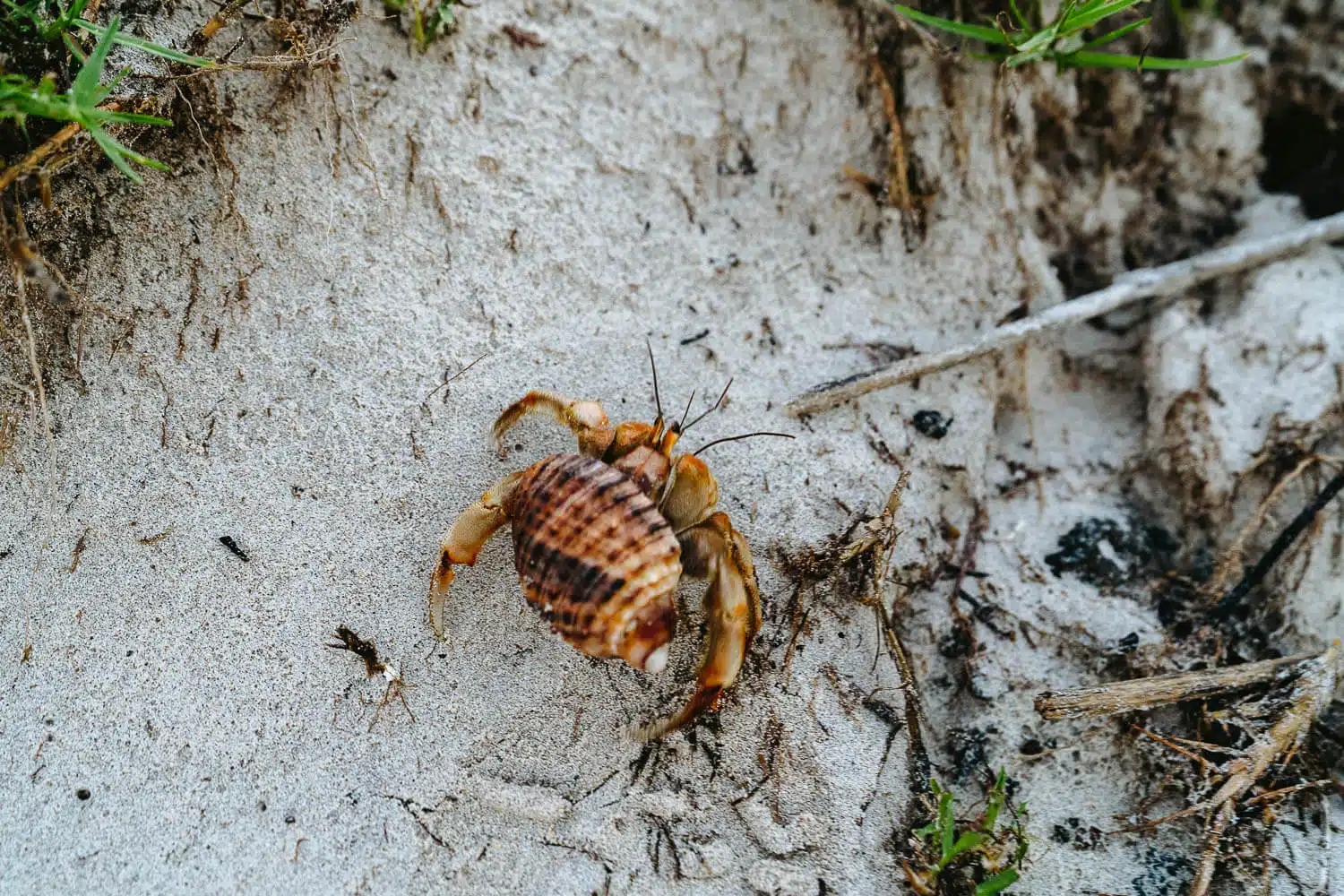
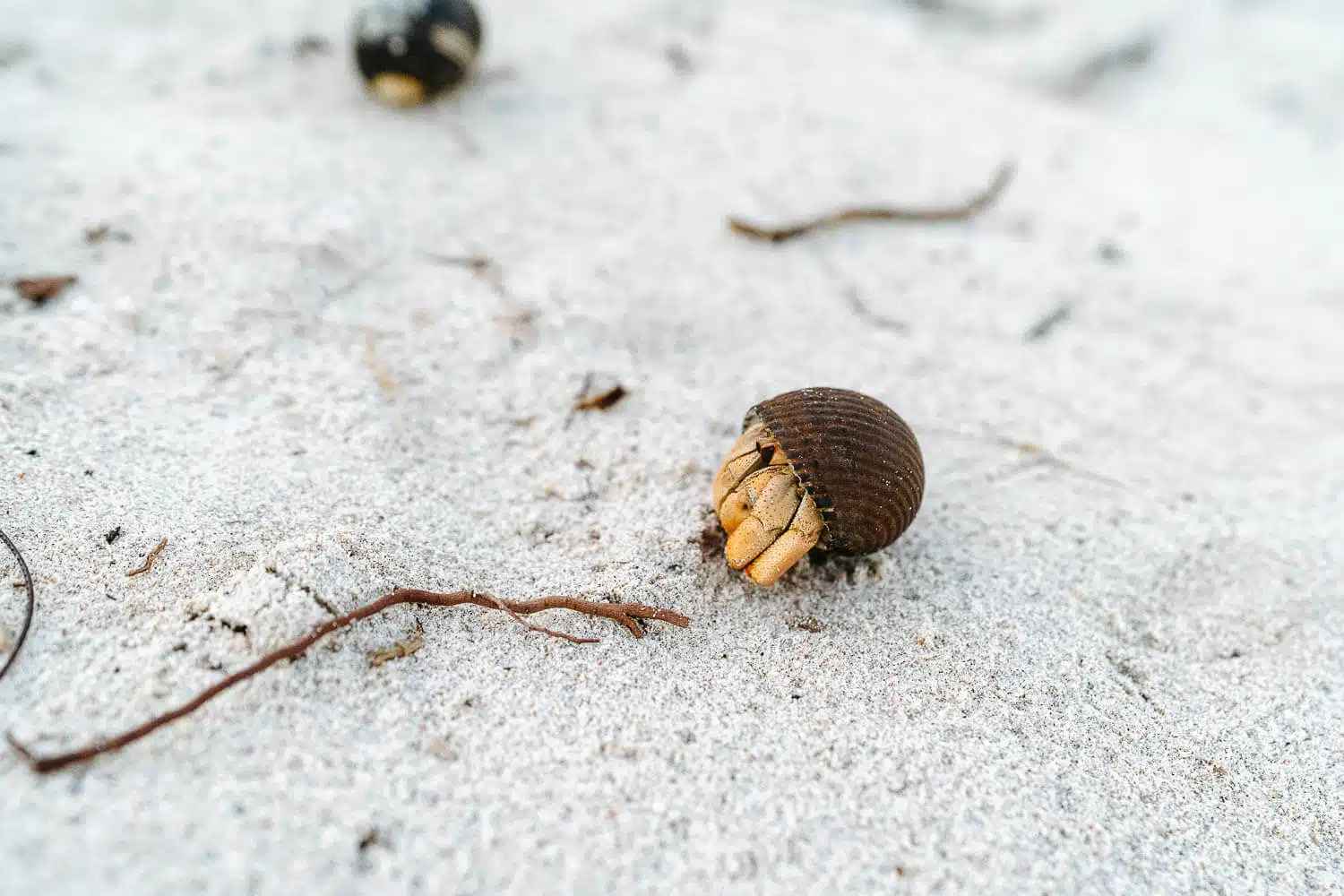
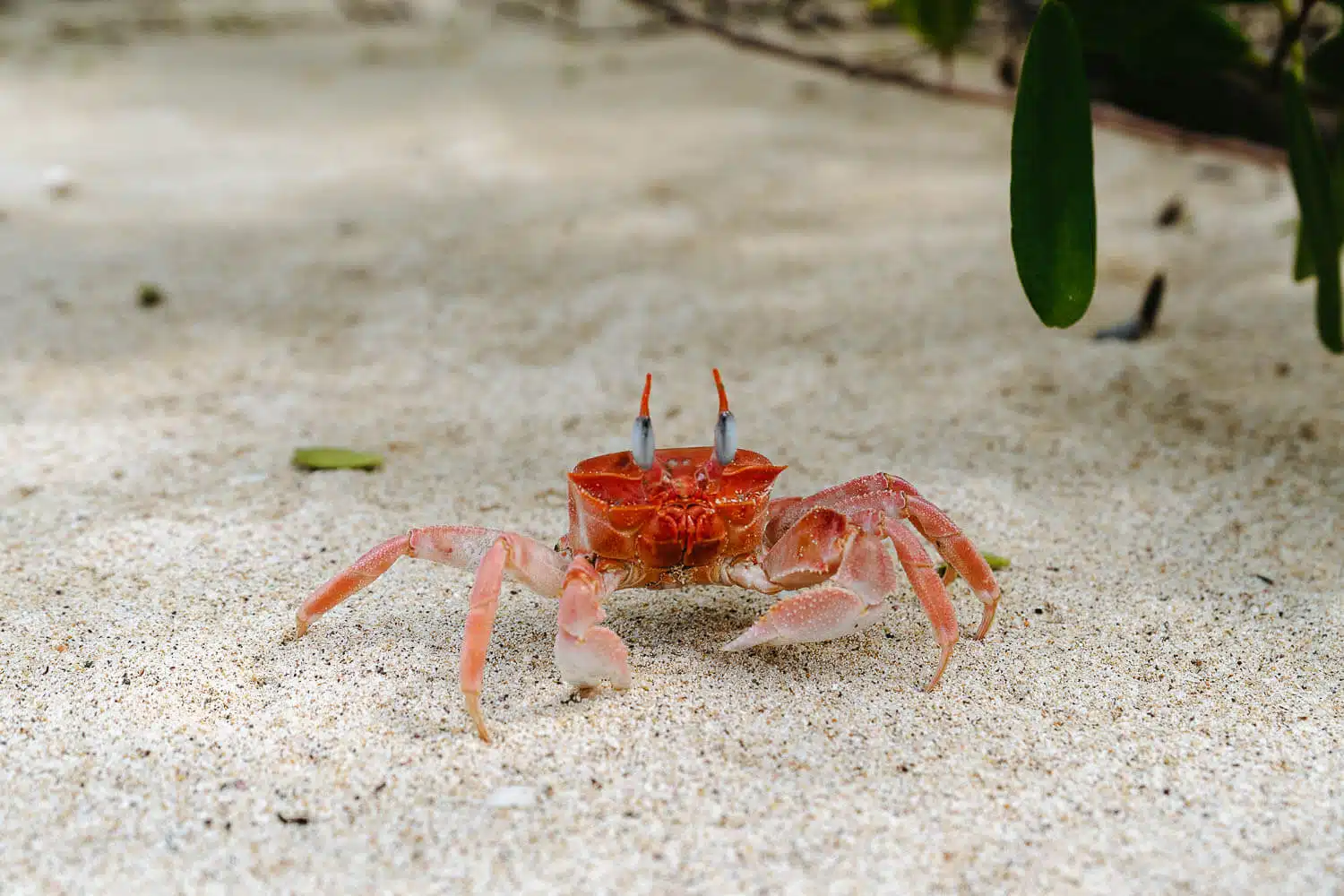
Hermit crabs use empty shells for protection and feed on detritus and plant material. Ghost crabs are nocturnal, burrowing in sandy beaches and preying on small invertebrates. Both species play vital roles in nutrient cycling and shoreline ecology.
Where to see: Sandy beaches on most islands.
The local crabs at Puerto Chino beach
An hermit crab at Puerto Chino Beach
Mr Krabs at Puerto Grande beach, a Ghost Crab
Starfish, Sea Urchins & Sea Cucumbers
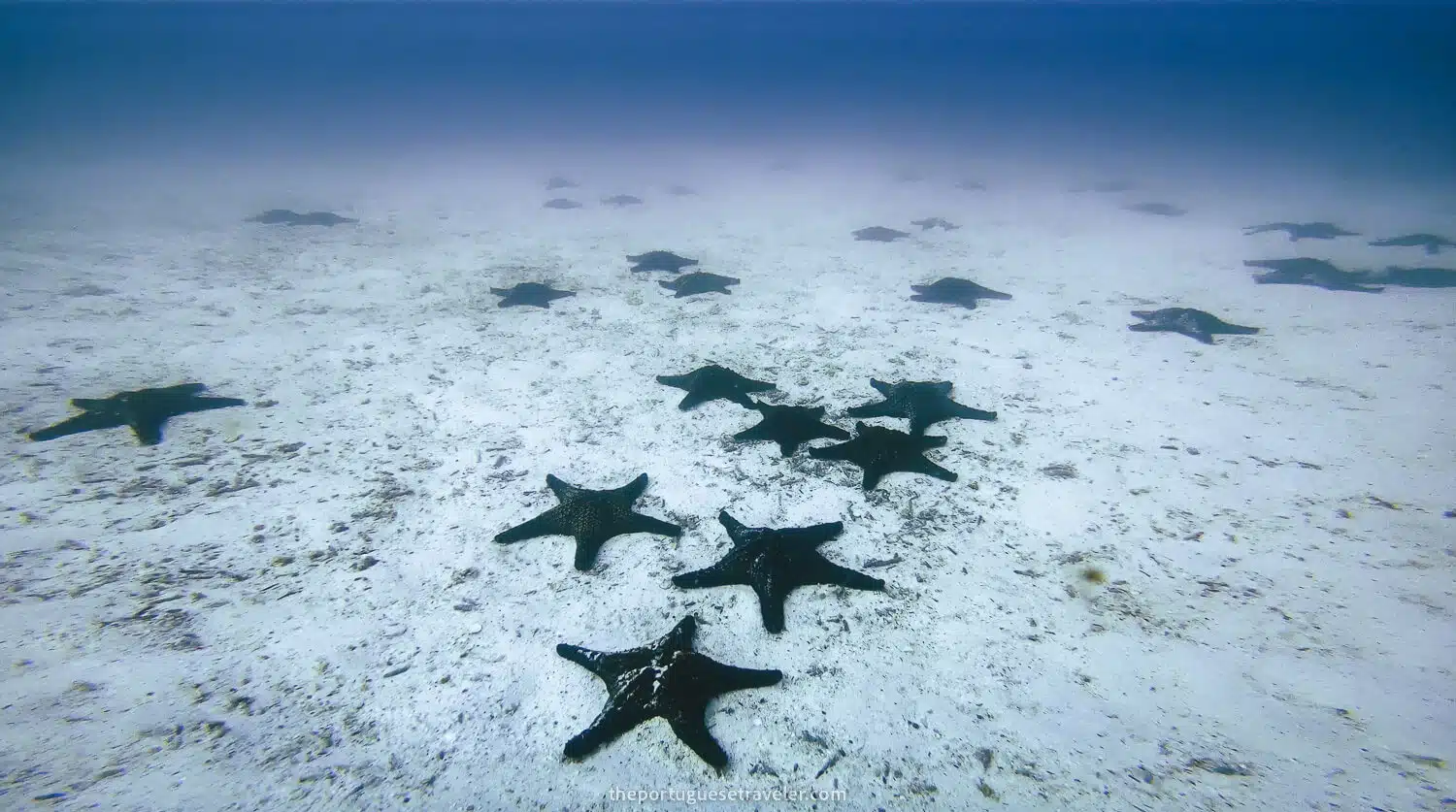
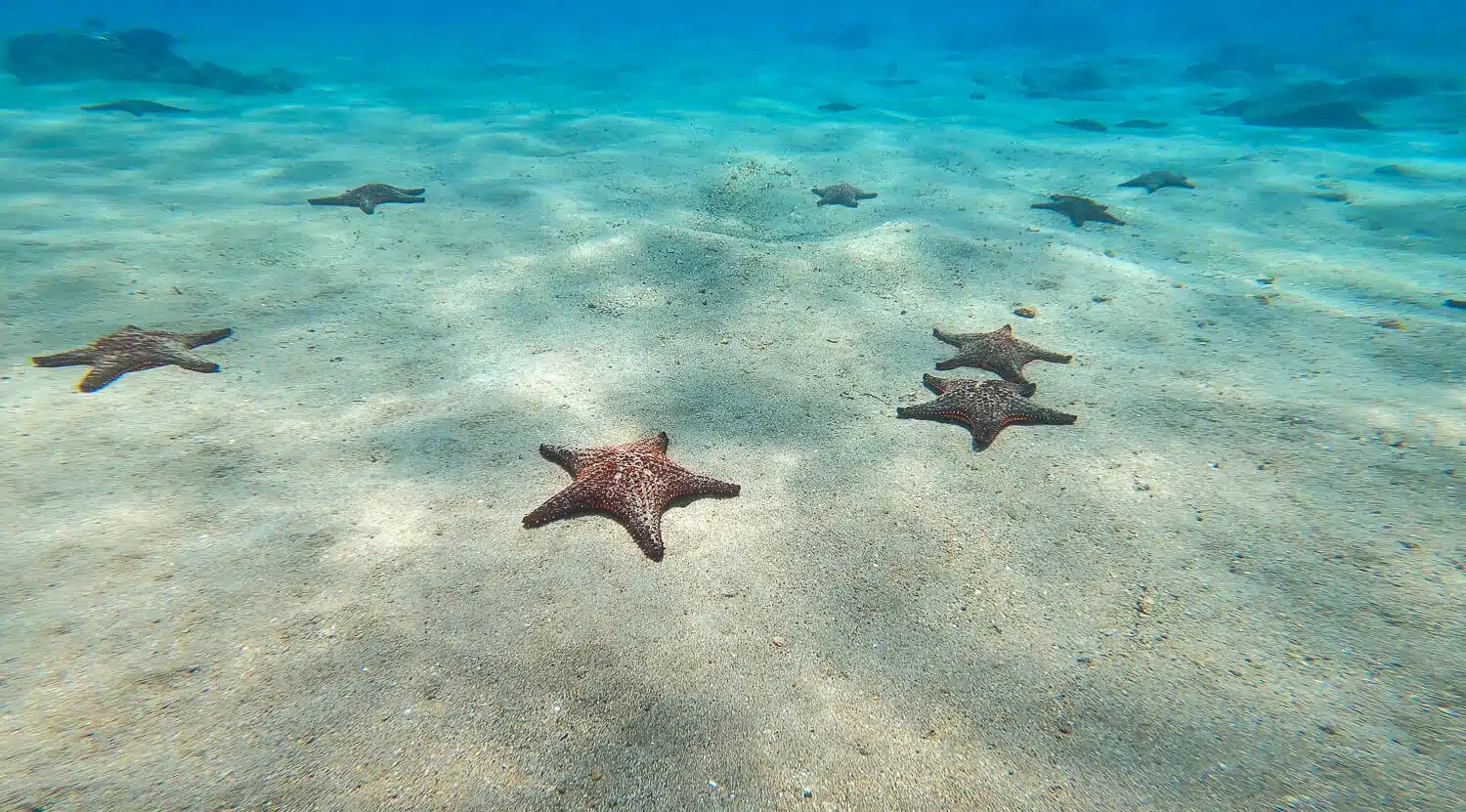
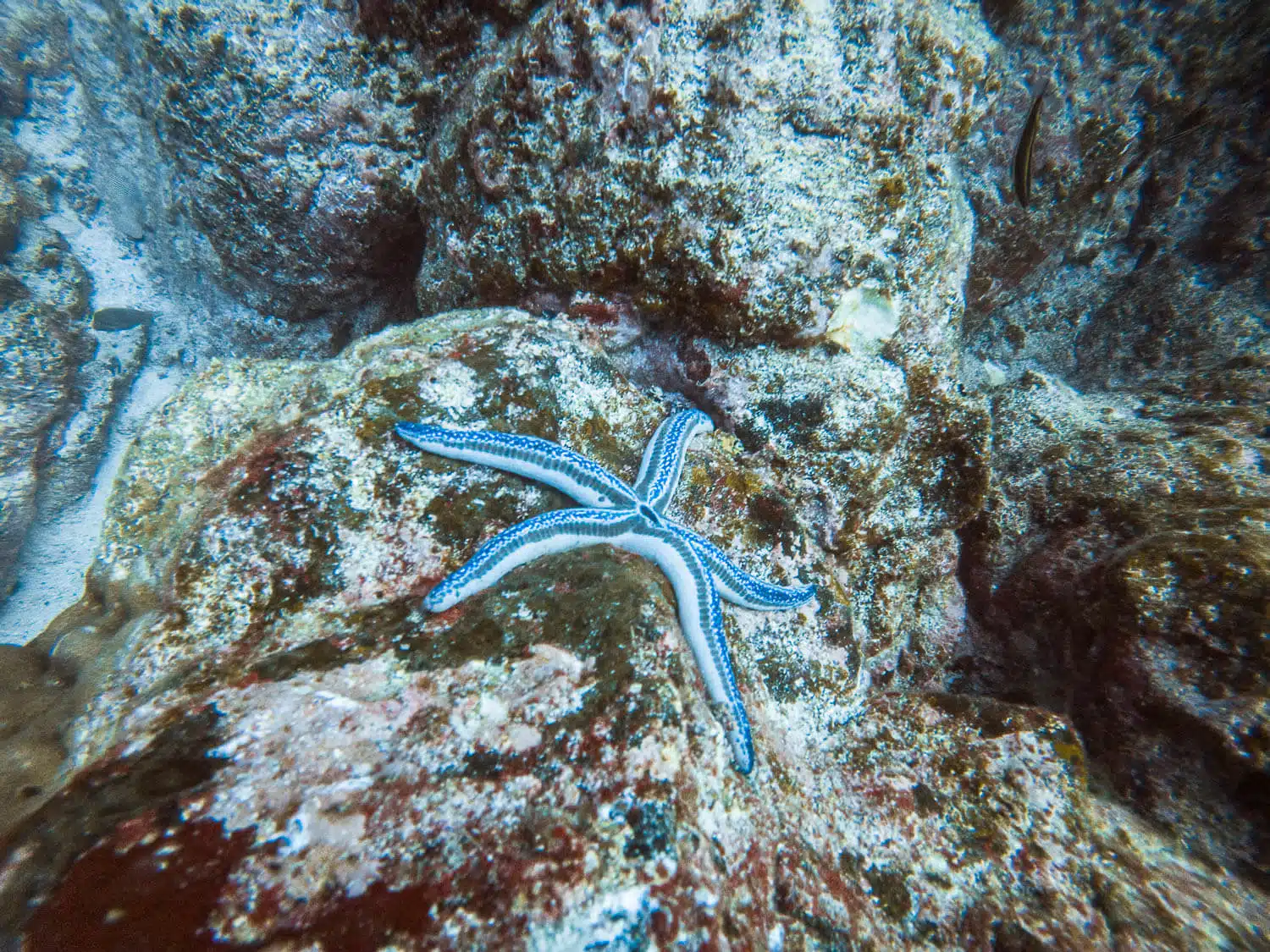
These benthic invertebrates are crucial for reef health. Sea cucumbers recycle organic matter in sediments, starfish can regulate prey populations like mollusks, and sea urchins graze algae, preventing overgrowth on coral reefs.
Where to see: Common in tidal pools and subtidal reefs across the archipelago.
A sea of starfish in Mosquera Islet dive site
A sea of starfish around Bartolome Island
A starfish in North Seymour Dive Site
Best Islands to Spot Galapagos Wildlife
The Galapagos Archipelago is composed of 13 major islands and several smaller islets, each with its own unique habitats and species. Wildlife viewing opportunities vary by island due to differences in terrain, vegetation, and the presence of endemic animals. Some islands are better known for iconic land species like giant tortoises and iguanas, while others are hotspots for seabirds, marine mammals, or unique reptiles. Understanding the strengths of each island can help visitors maximize their chances of seeing the archipelago’s extraordinary biodiversity.
San Cristobal Island
San Cristobal is the easternmost of the Galapagos Islands and a hub for visitors arriving by air. The island features a mix of coastal mangroves, dry lowlands, and volcanic highlands. It is famous for its sea lion colonies, frigatebirds, and marine iguanas. Visitors can often spot giant tortoises in the highlands and a variety of Darwin’s finches throughout the island. Its coastal waters are rich with sea turtles, rays, and reef fish, making snorkeling and diving rewarding experiences.
Land: Giant tortoises (breeding center), San Cristobal mockingbird.
Santa Cruz is home to the largest human settlement in the Galapagos and offers a wide variety of ecosystems. The lush highlands are famous for giant tortoise reserves, while the lowlands host land iguanas, lava lizards, and endemic birds. The island’s diverse marine environment includes sea lions, sharks, and tropical fish. Santa Cruz is also a center for conservation projects, providing opportunities to learn about ongoing efforts to protect the archipelago’s wildlife.
Gordon Rocks: hammerheads, manta rays, reef sharks, eagle rays.
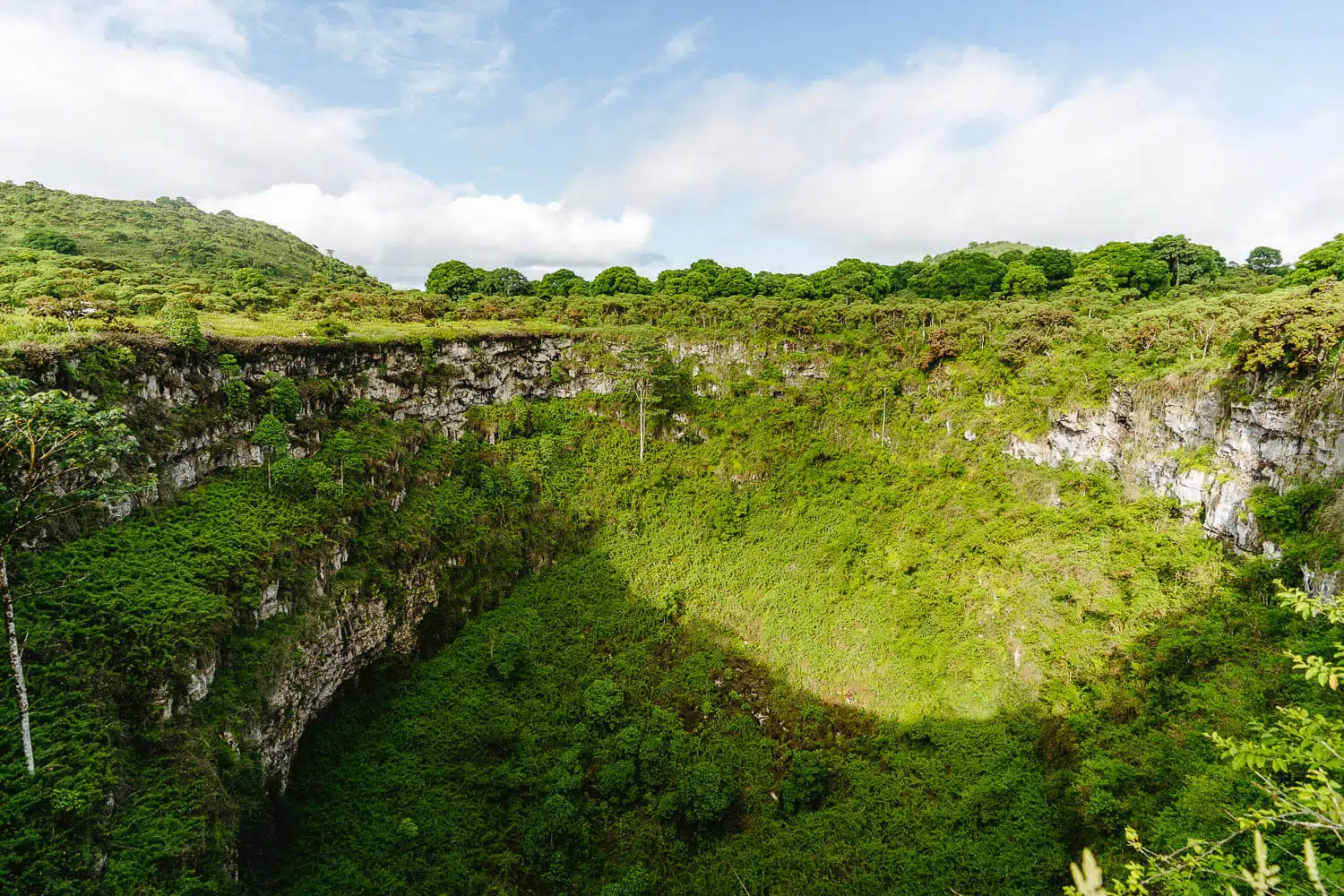
Los Gemelos, Highlands Tour in Santa Cruz
Isabela Island
Isabela is the largest island in the Galapagos, formed by the merging of six volcanoes. Its vast landscapes support populations of giant tortoises, flightless cormorants, and penguins, making it a hotspot for endemic species. Coastal waters around Isabela are excellent for observing sea turtles, marine iguanas, and numerous seabirds. The island’s remote beaches and lava flows also make it one of the best locations for spotting wildlife in relatively undisturbed habitats.
Land: Giant tortoises (several subspecies on volcanoes), Land iguanas (Urvina Bay).
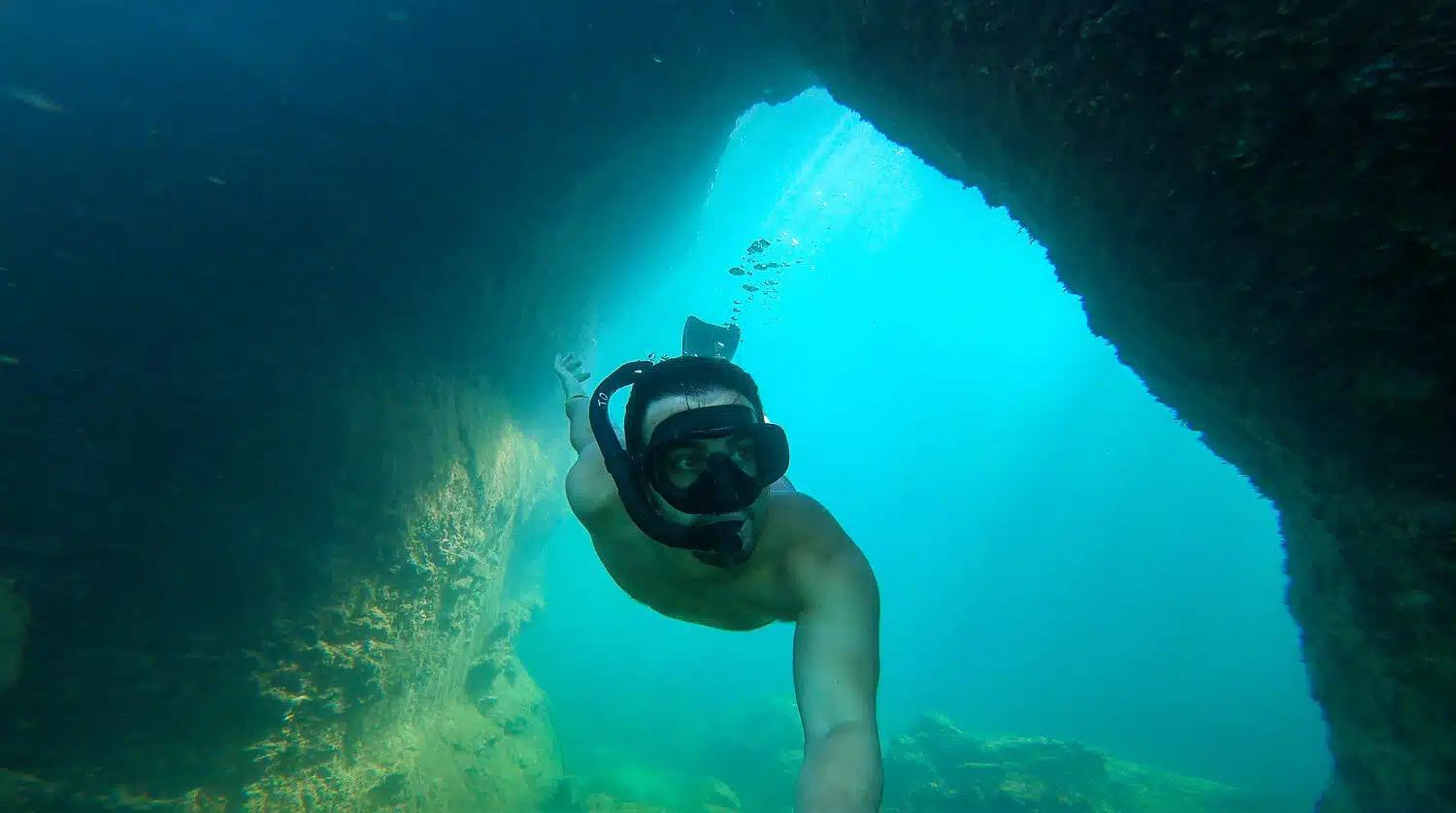
Me exploring the underwater passages of Los Tuneles on Isabela Island
Española Island
Española is one of the oldest islands in the archipelago and a sanctuary for some of the most iconic endemic species. It is home to the famous “Christmas” or Española marine iguanas, waved albatrosses, and blue-footed boobies. The island’s cliffs and beaches provide nesting grounds for seabirds, and its isolated location ensures that many species can be observed in concentrated colonies. Visitors come here specifically for birdwatching and to witness courtship displays of the waved albatross.
Land: Christmas Iguanas (red/green during breeding), Lava lizards (endemic subspecies).
Floreana is known for its rich history of human settlement and unique wildlife. It hosts sea lions, marine iguanas, and a small population of giant tortoises. The island’s coastal lagoons attract flamingos and shorebirds, while snorkeling offers chances to encounter reef fish, rays, and turtles. Floreana is also home to rare and endangered bird species, including the short-eared owl and Galapagos mockingbird.
Devil’s Crown: best snorkeling: reef sharks, turtles, rays, schools of fish.
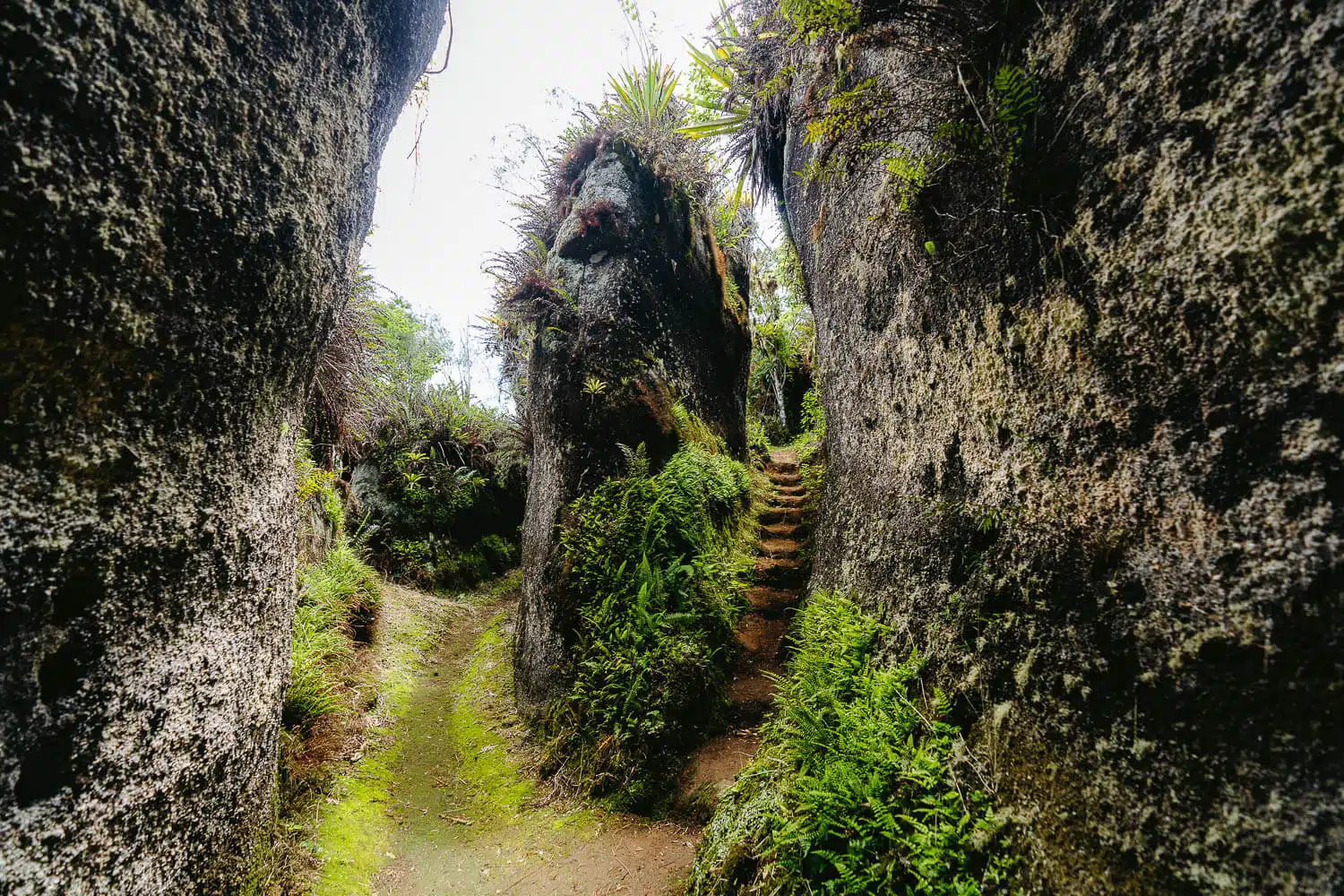
Isla Floreana Labyrinths
Fernandina Island
Fernandina is the youngest and most volcanically active island in the archipelago. Its pristine landscapes are ideal for observing marine iguanas, flightless cormorants, and sea lions in relatively untouched habitats. Fernandina’s lava fields are home to endemic plant species, and its surrounding waters support rich marine life, including sharks and rays. The island’s isolation makes it a critical refuge for species that are sensitive to human disturbance.
Punta Espinoza: penguins, sea turtles, and marine iguanas in the water.
North Seymour Island
North Seymour is small but densely packed with wildlife. It is renowned for large colonies of blue-footed boobies, frigatebirds, and swallow-tailed gulls. Sea lions are also commonly seen on its rocky shores. The island’s flat terrain makes wildlife easy to observe, and it is one of the most visited islands for day trips. Its proximity to the main channels allows easy access to marine wildlife, including schooling fish and reef sharks.
Gordon Rocks (accessible from here, too): hammerheads, rays, turtles.
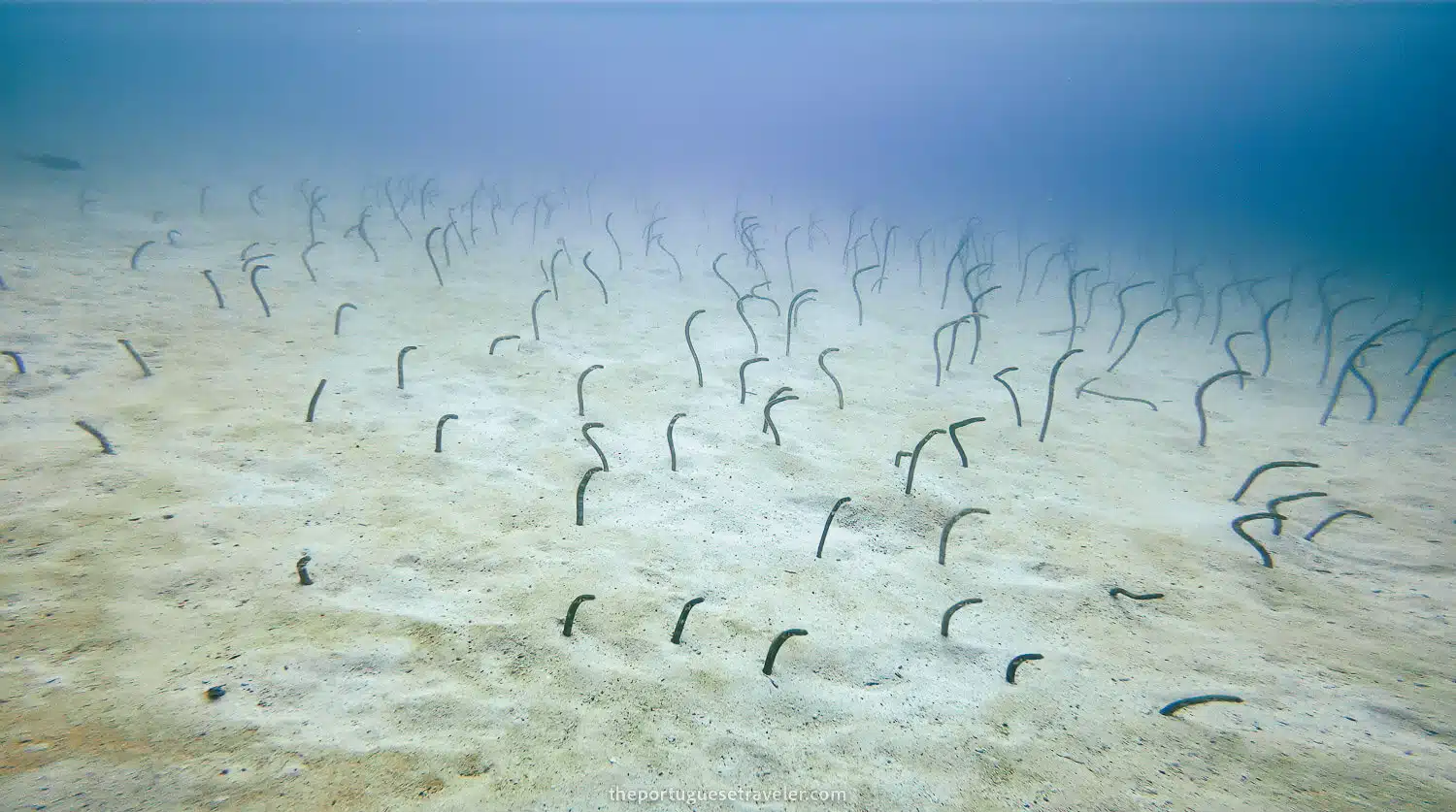
A garden of eels in North Seymour dive site
Bartolomé Island
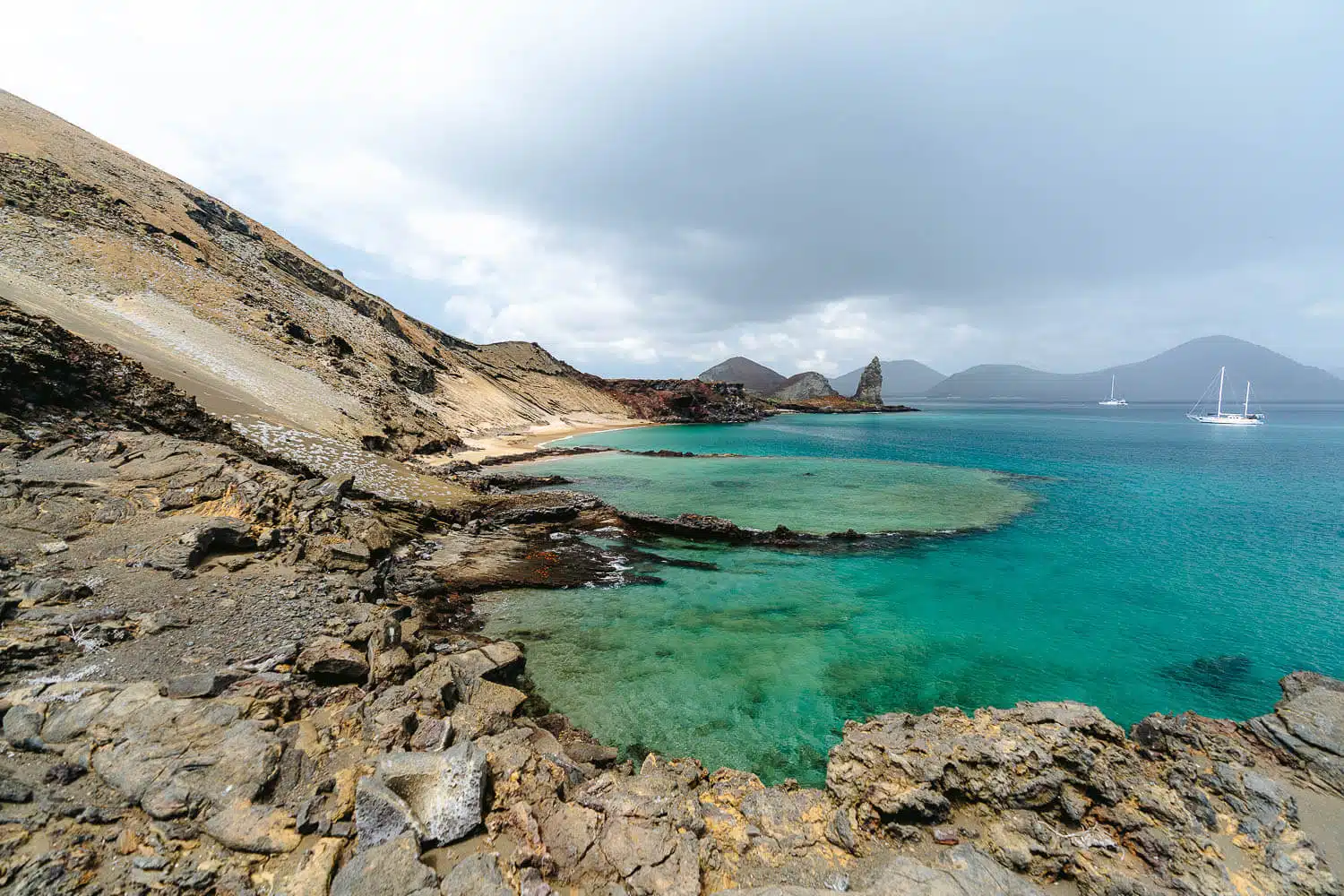
Bartolomé is famous for its dramatic volcanic landscapes and Pinnacle Rock. It provides excellent opportunities to see Galapagos penguins, lava lizards, and marine iguanas. The island’s beaches and tide pools support a variety of fish, rays, and sea turtles. Hiking trails offer panoramic views and close encounters with wildlife, making it a favorite for photographers and nature enthusiasts.
Santiago Island combines rocky lava fields with sandy beaches and tidal pools. It supports populations of Galapagos sea lions, marine iguanas, and shorebirds. The island is a key site for observing lava lizards and seabird colonies. Its surrounding waters are rich with reef fish, rays, and occasional sharks, making it a prime snorkeling and diving location.
Santa Fé is a smaller, secluded island with unique endemic species. It is famous for the Santa Fé land iguana, which is distinct from other land iguana populations. The island’s beaches and cliffs also host sea lions, frigatebirds, and swallow-tailed gulls. Its relatively undisturbed habitat provides excellent opportunities to observe wildlife in natural settings, away from the more frequented islands.
Land: Santa Fe land iguana (unique).
Birds: Galapagos hawks, Darwin’s finches.
Marine: Sea lions, rays, reef fish.
Genovesa Island
Genovesa, also known as Bird Island, is renowned for its incredible seabird colonies. Red-footed boobies, Nazca boobies, and swallow-tailed gulls nest in large numbers along its cliffs and lava fields. The island’s isolation and arid climate make it a haven for seabird observation. Its tide pools and surrounding waters also provide habitats for marine iguanas, sea lions, and tropical fish.
Darwin Bay: rays, reef sharks, turtles, moray eels.
Rábida Island
Rábida is distinguished by its striking red volcanic sand beaches. It hosts populations of sea lions, pelicans, and marine iguanas. The island’s waters are rich with fish, rays, and occasional sharks. Rábida’s unique coloration and concentrated wildlife make it a popular destination for photographers and snorkelers.
Land: Lava lizards.
Birds: Flamingos (seasonal), Brown pelicans (nesting), finches.
Wolf and Darwin are remote northern islands, famous for large pelagic species. They are some of the best places in the world to observe hammerhead sharks, whale sharks, manta rays, and other migratory marine life. The islands’ isolation has preserved pristine habitats for seabirds and pelagic fish. These islands are usually visited by liveaboard boats and are renowned for exceptional diving experiences.
The plants of the Galapagos are as unique as its animals, shaped by harsh volcanic landscapes, salt spray, and shifting microclimates. From mangroves that stabilize coastlines to highland forests that shelter rare birds, the flora provides the foundation for the islands’ ecosystems.
Costal Zone Plants
Along the shorelines, salt-tolerant plants such as mangroves and beach creepers thrive where few others can survive. These species protect coasts from erosion and provide vital habitat for fish, crabs, and seabirds.
Red Mangrove, Black Mangrove, White Mangrove, Button Mangrove
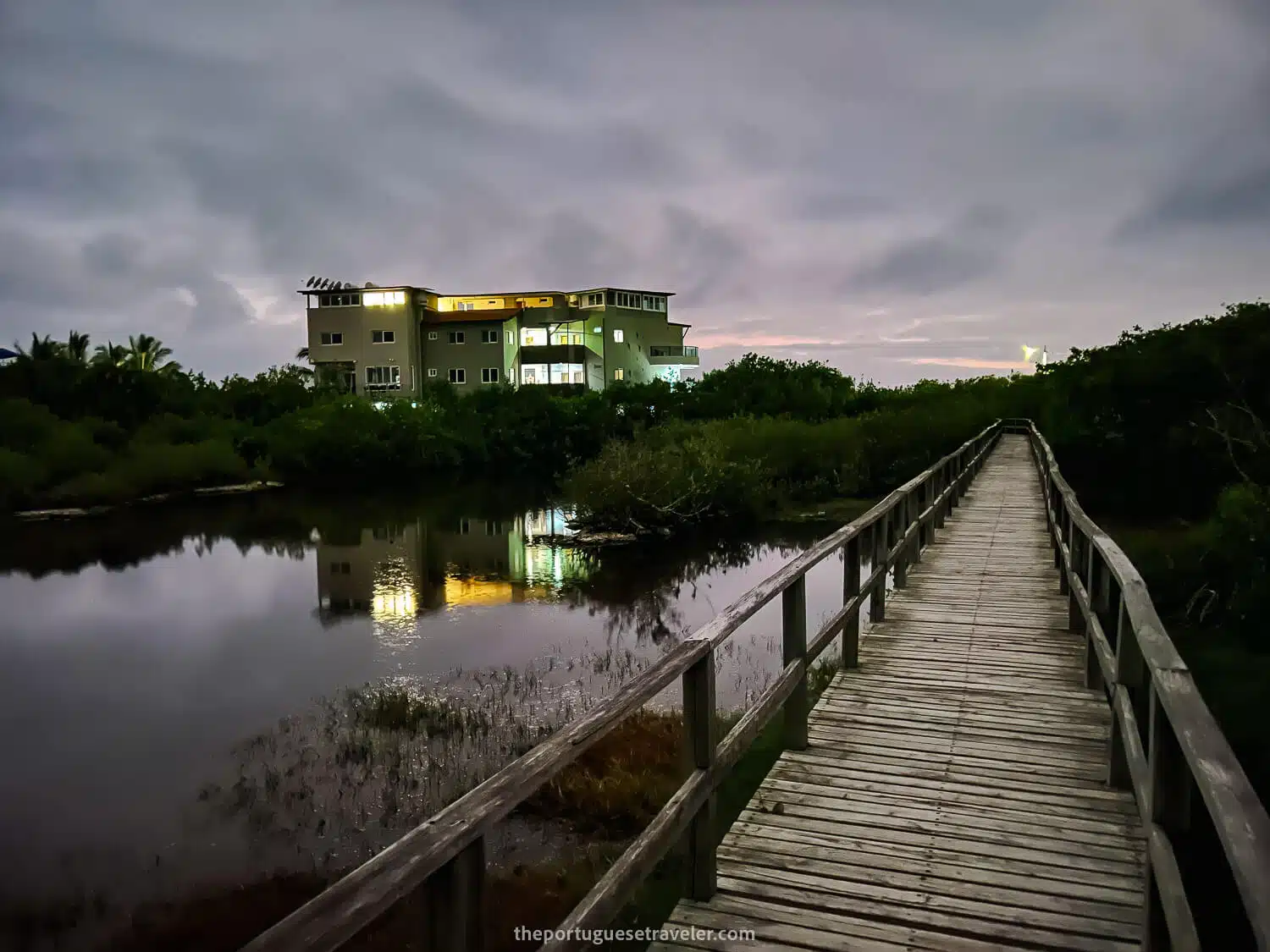
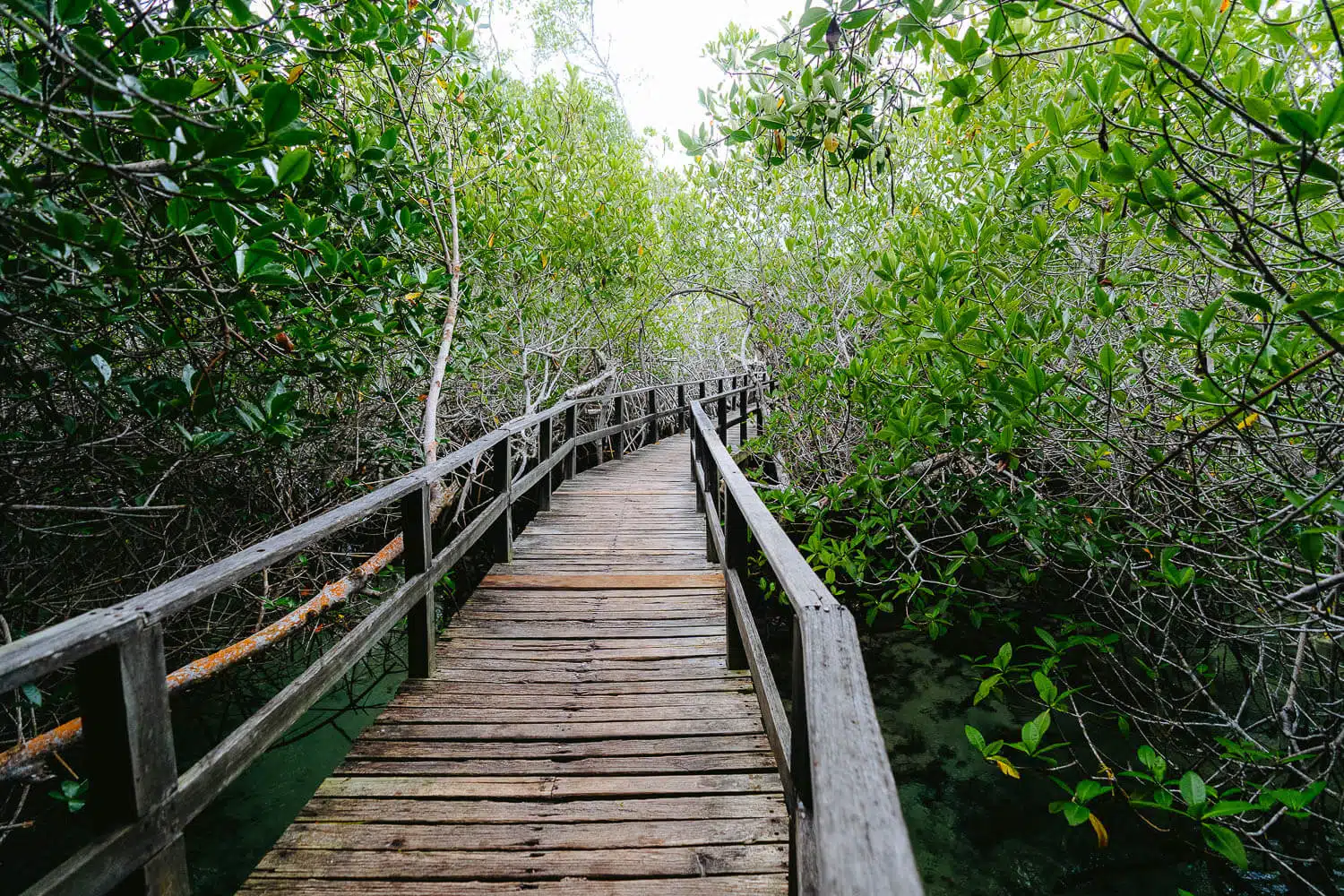
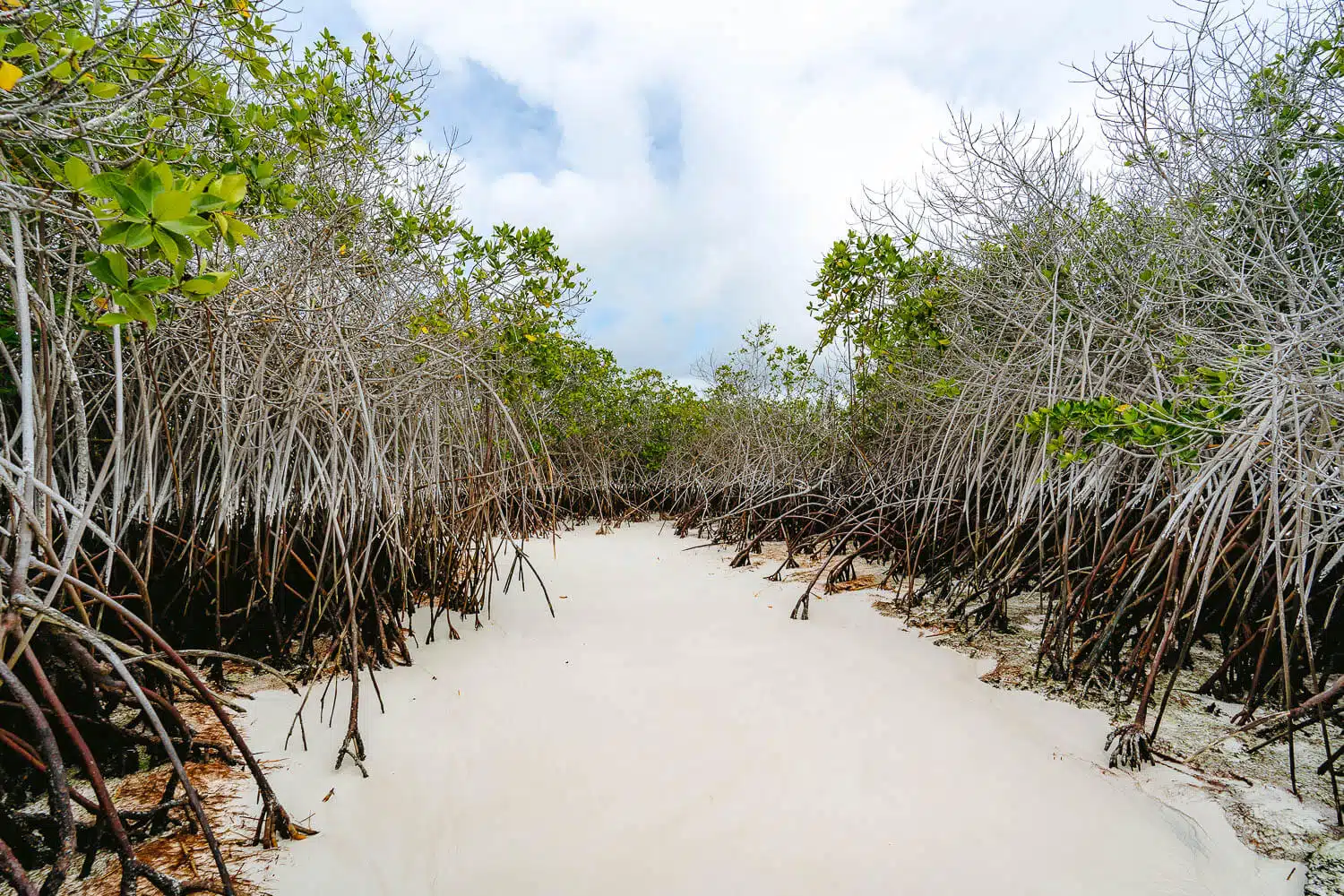
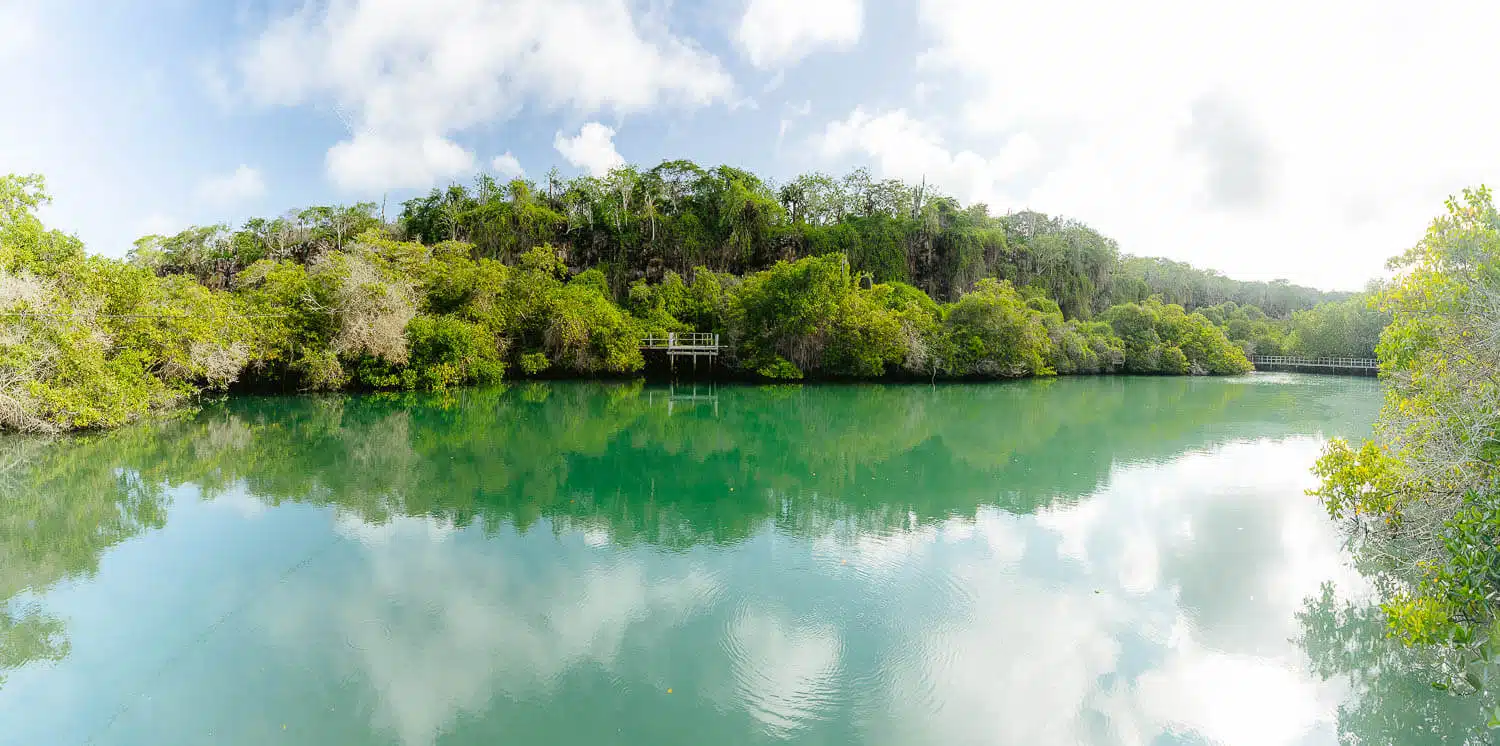
These four mangrove species thrive along the sheltered coastlines of San Cristobal, Santa Cruz, Isabela, Floreana, and many smaller islets. They form dense coastal forests that act as nurseries for fish, protect the shoreline from erosion, and provide roosting spots for birds like pelicans and herons—playing a vital role in sustaining Galapagos wildlife.
The wooden passage to Concha de Perla surrounded by mangrove
Mangrove at the entrance of Bahia Rosa Blanca beach
Panoramic of the Nymphs Lagoon
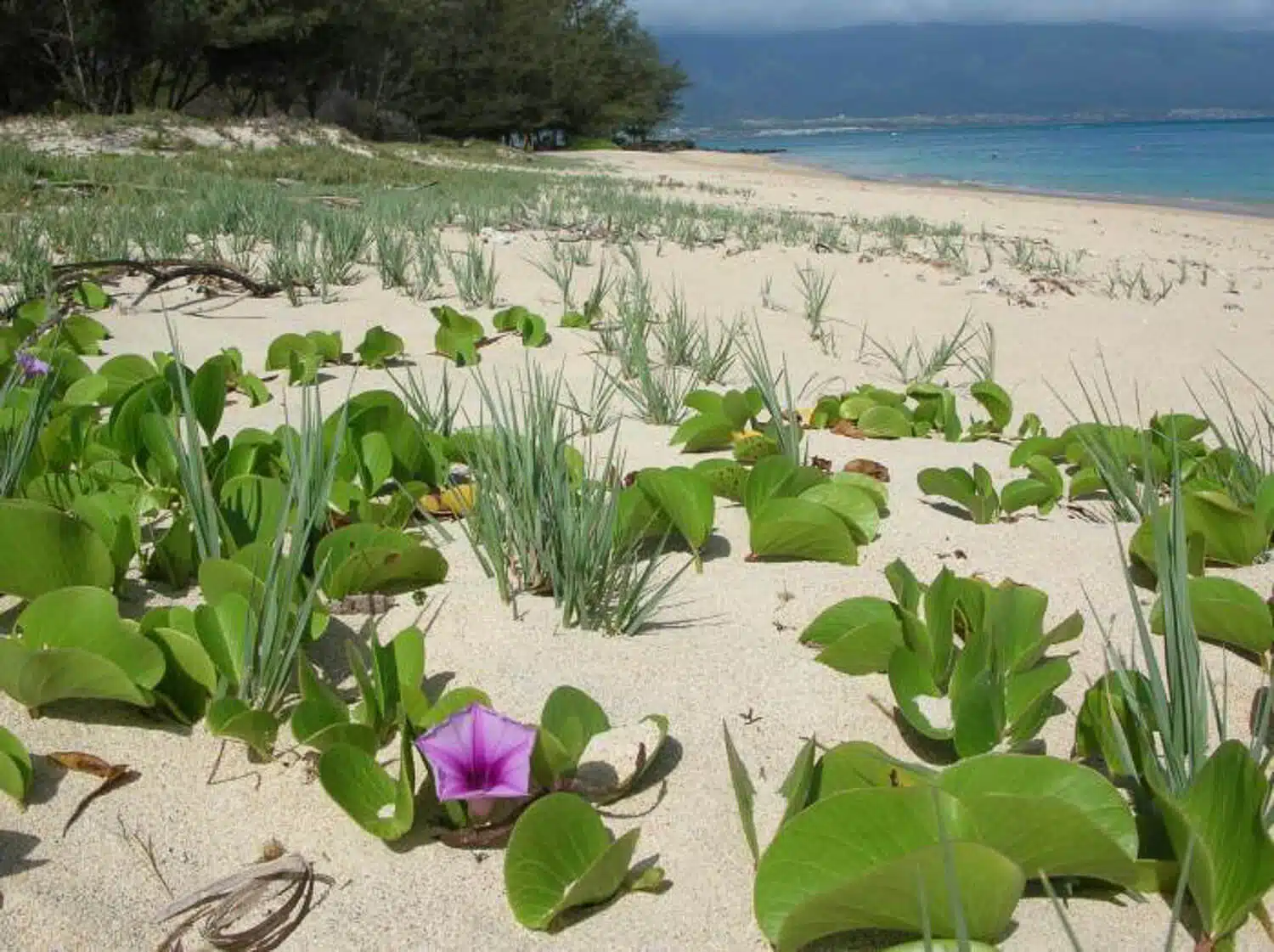
Saltbush & Beach Morning Glory
Hardy plants adapted to sandy soils, commonly found along the beaches of Española, Floreana, and Santa Cruz. They stabilize dunes, reduce erosion, and add greenery and flowers to otherwise harsh coastal zones.
Beach Morning Star | Credit: Forest & Kim Starr @ https://www.inaturalist.org/
Arid Zone Plants
Most of the islands are dry, and the arid zone is dominated by cacti, succulents, and drought-resistant trees. These hardy plants are well adapted to volcanic soils and seasonal drought, often supporting land iguanas, birds, and other unique Galapagos wildlife.
Opuntia Cactus
Prickly Pear
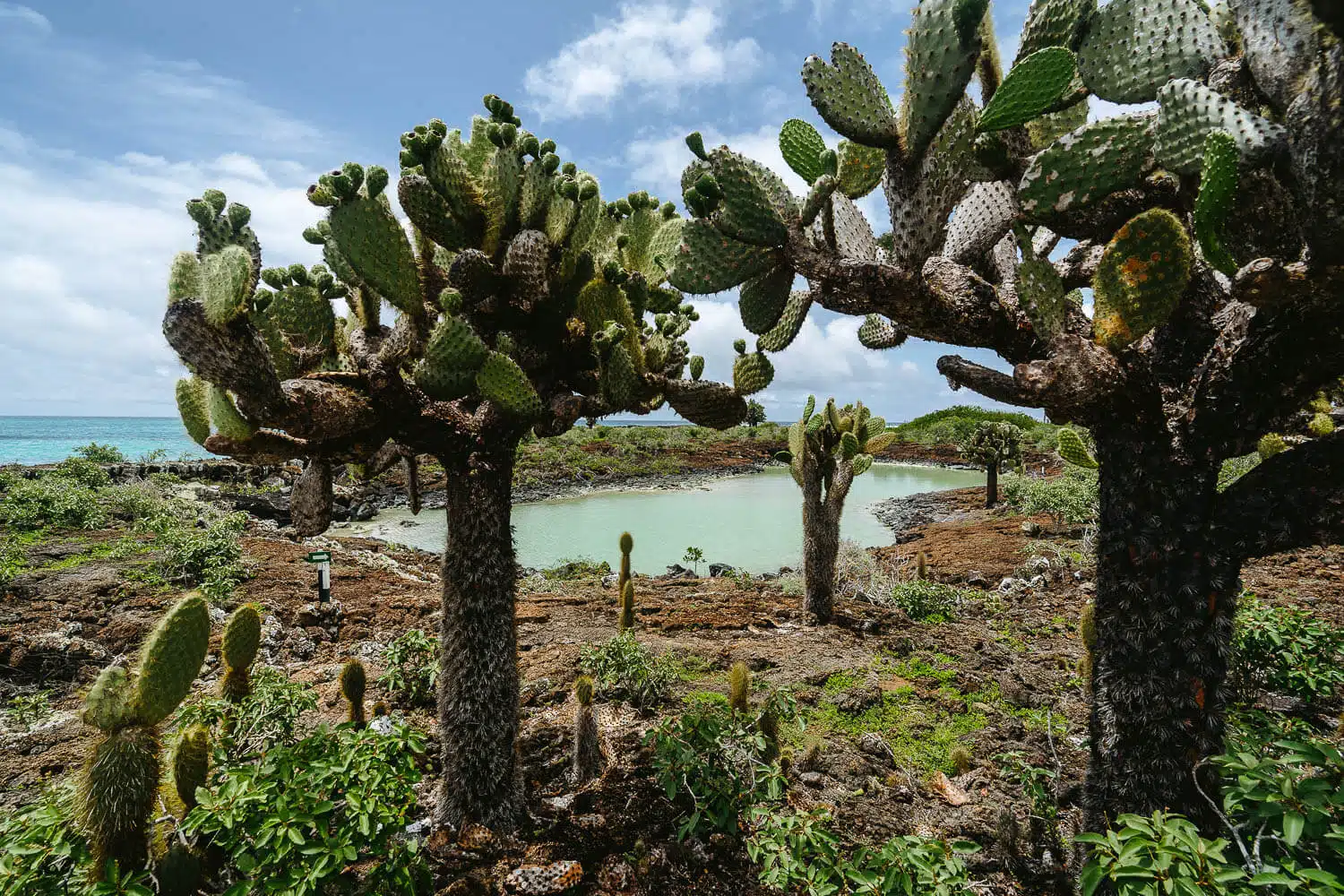
One of the most iconic plants of the Galapagos, growing into tree-like forms on islands such as Santa Cruz, Española, North Seymour, and Isabela. Each island has its own subspecies, with unique adaptations to local conditions and iguana grazing.
Opuntias cactus next to Bahia Rosa Blanca beach on the 360 Tour in San Cristobal
Candelabra Cactus
Jasminocereus
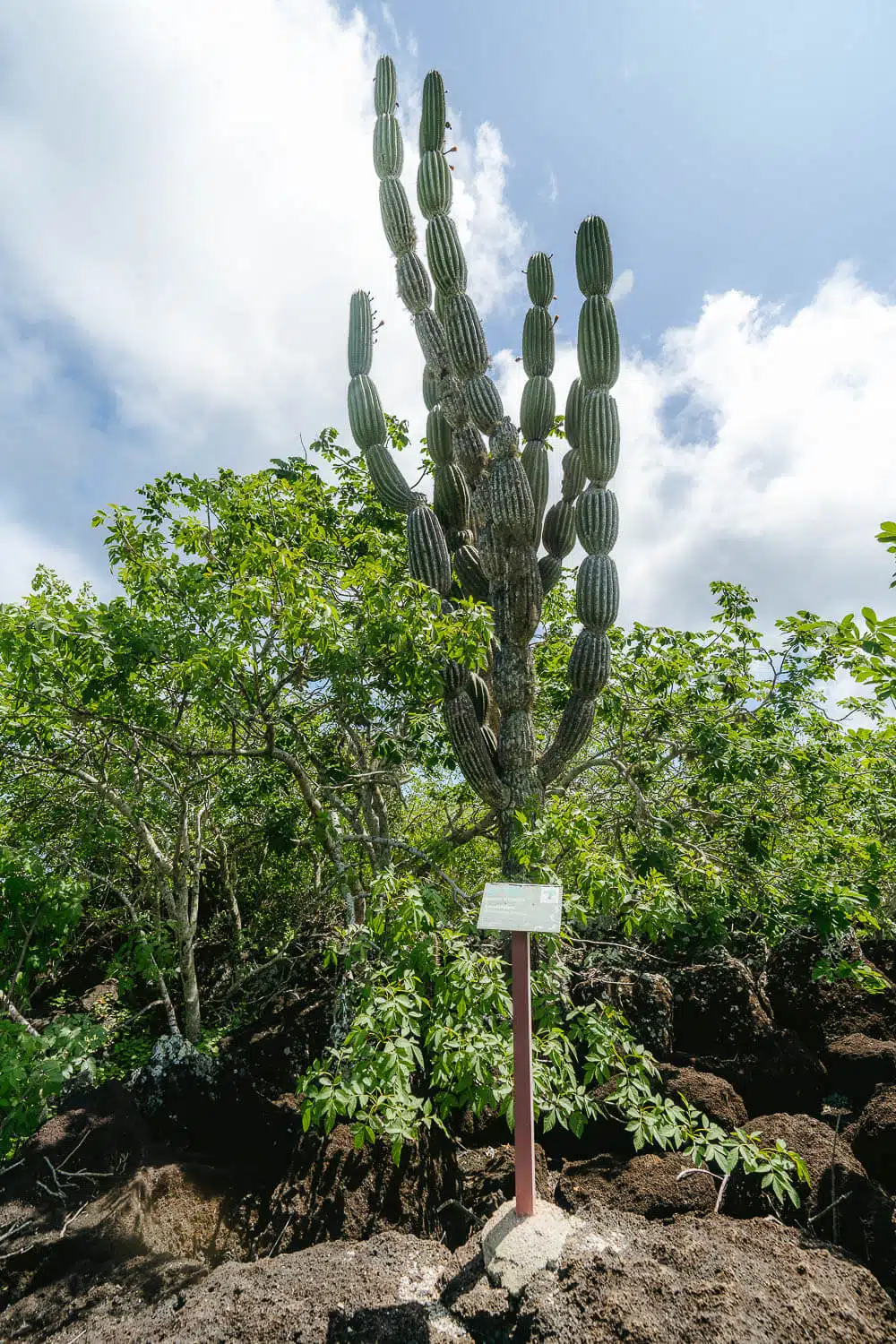
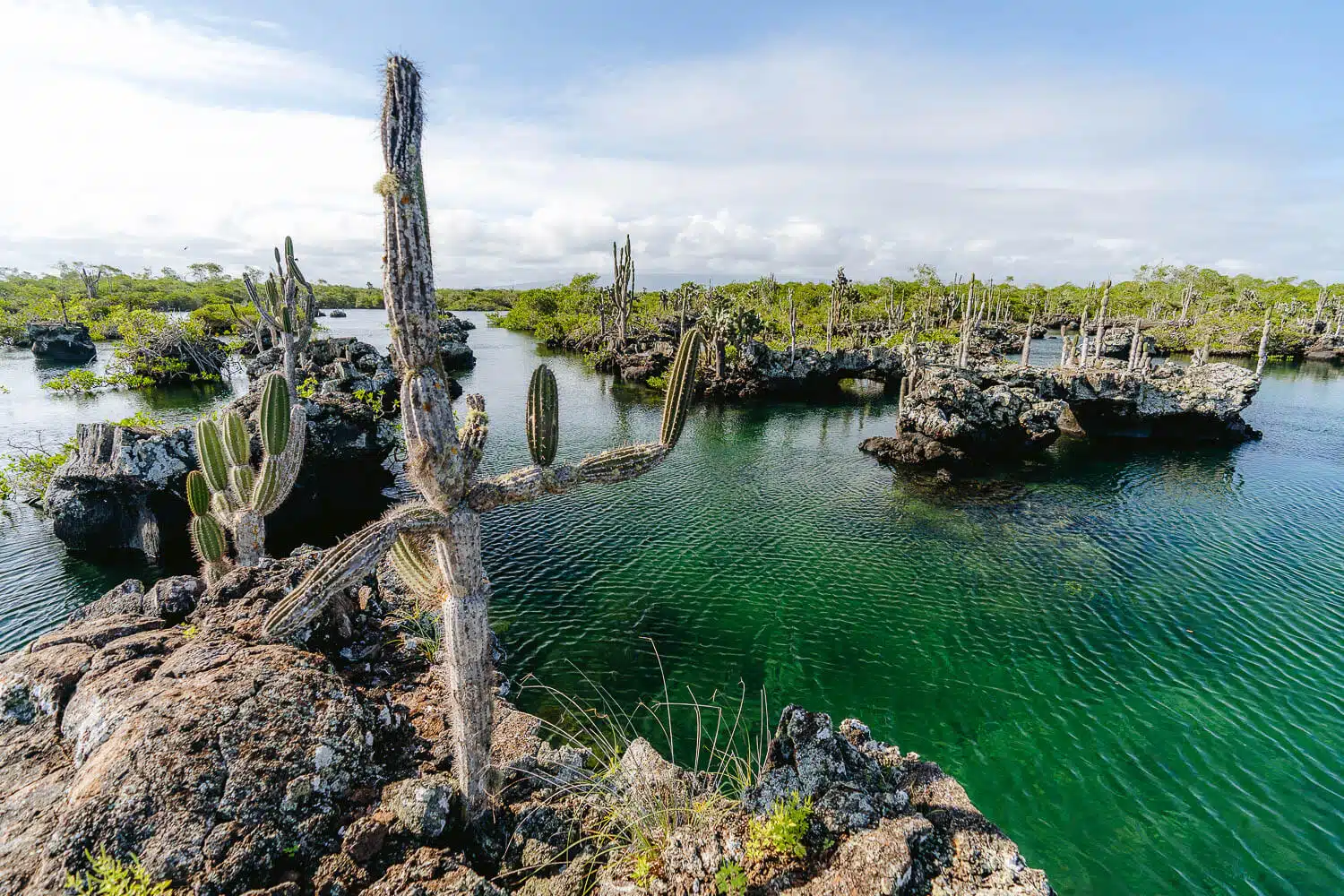
A striking cactus with branching, candle-like stems found on dry lava landscapes of Isabela, Santa Cruz, and Santiago. It grows in harsh volcanic soils, where few other plants can survive.
A Candelabra Cactus before Playa Tijeretas
Los Tuneles tour, or Cabo Rosa in Isabela island, Galapagos
Palo Santo
Bursera graveolens
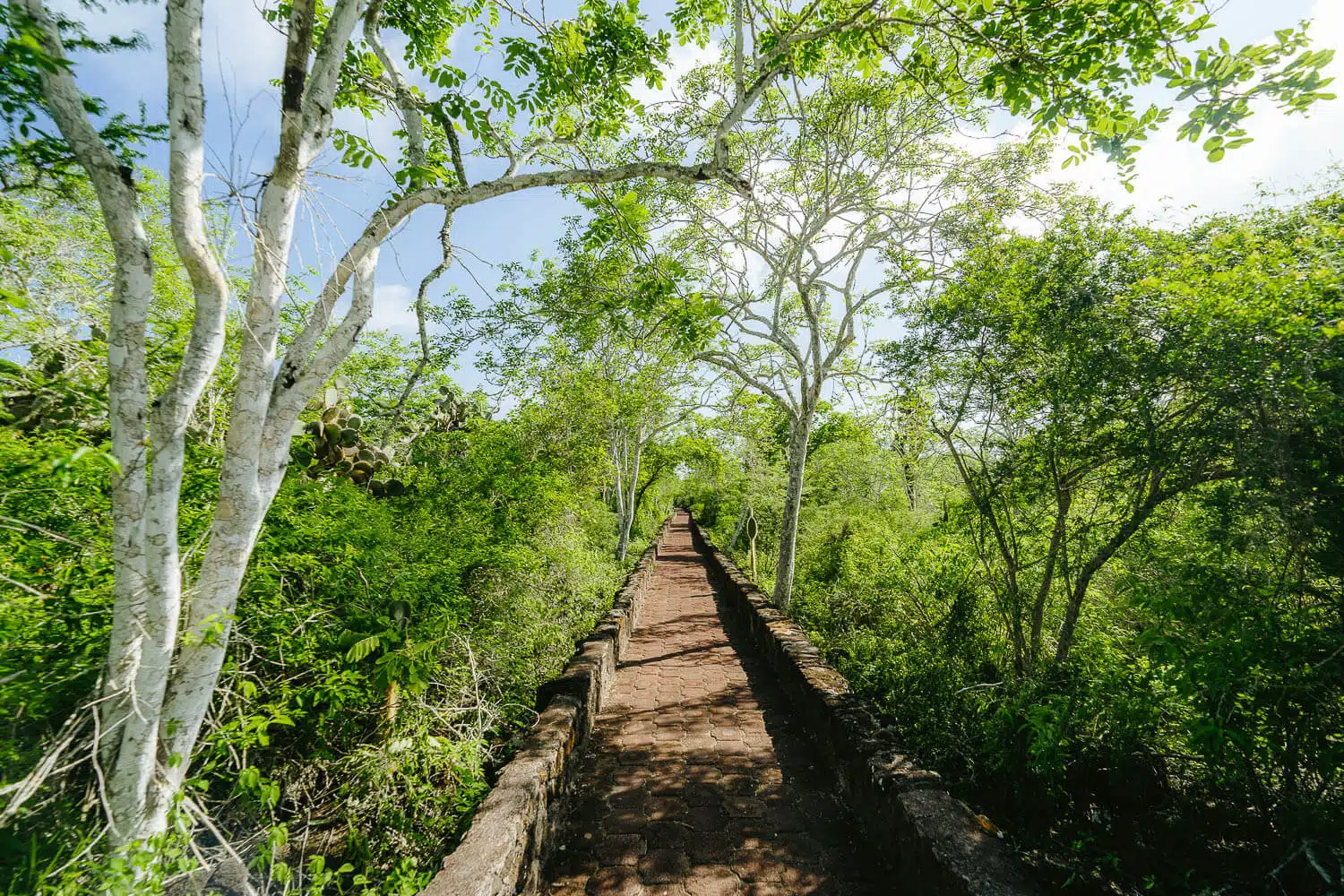
This aromatic tree dominates the dry forests of Española, Floreana, Santa Cruz, and San Cristobal. Its resin-scented wood is especially fragrant after rainfall, filling the air with a spicy, sweet aroma.
Palo Santo trees on the way to Tortuga Bay in Santa Cruz Island
Lava Cactus
Brachycereus nesioticus
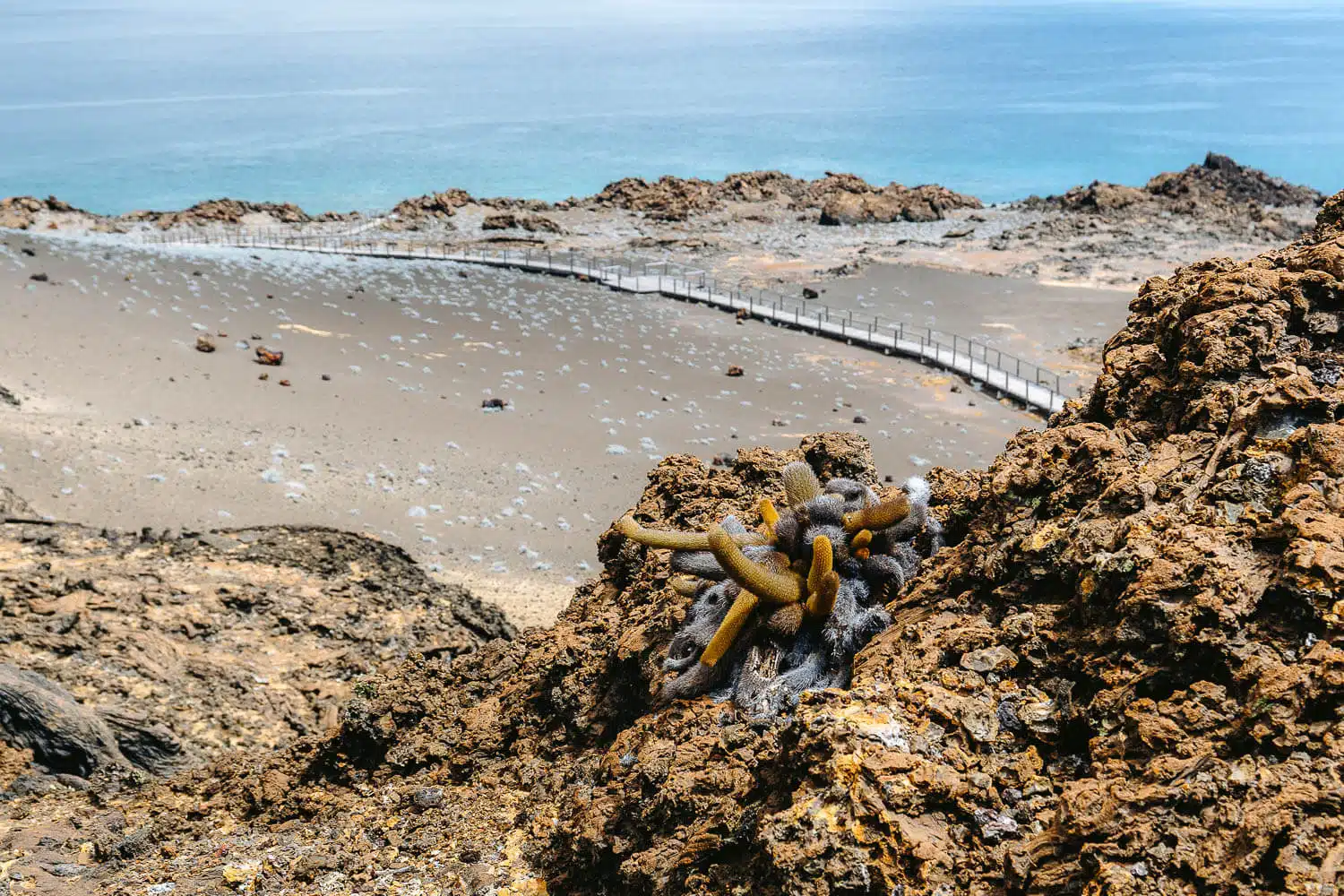
Among the first plants to colonize fresh lava flows, especially on Fernandina and Santiago. These small, spiny cacti form clumps on the stark black lava, creating one of the most dramatic contrasts in the islands.
A lava cactus on the desolated Bartolome island
Humid Zone Plants
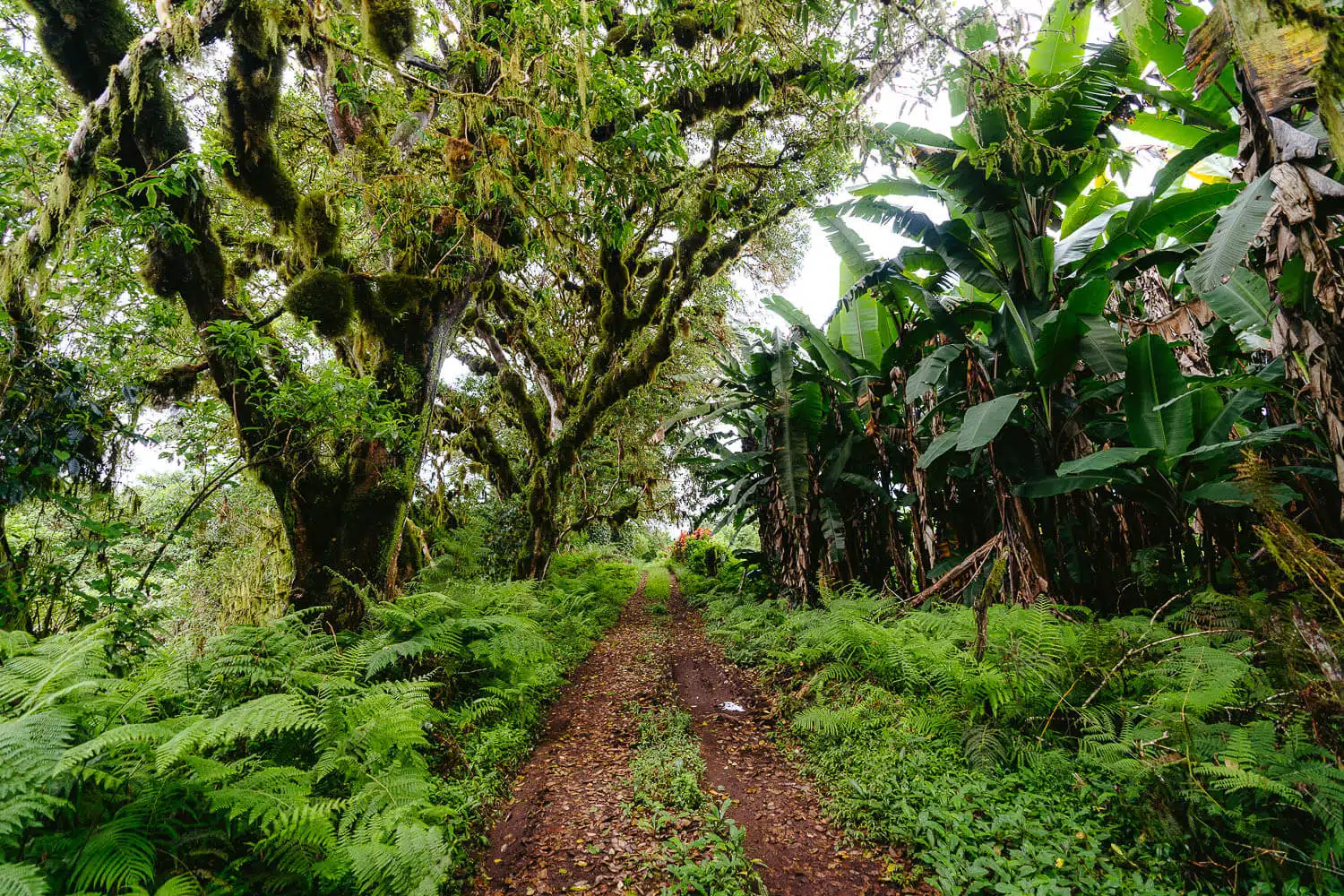
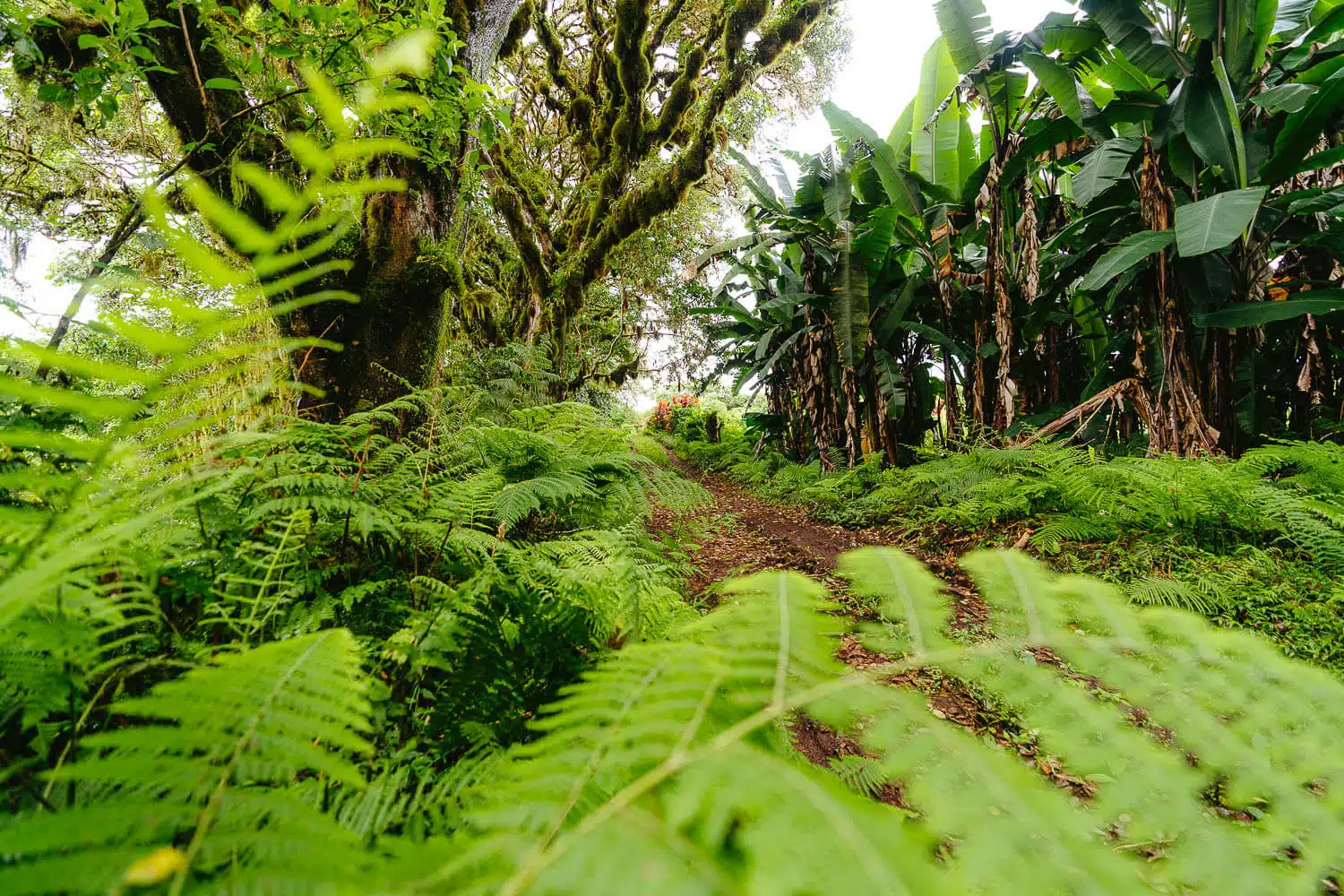
In the highlands where mist and rain are more common, lush forests develop. Here, giant Scalesia daisies, ferns, and orchids form unique habitats that contrast sharply with the barren coasts below.
Scalesia Forests
Known as the “Darwin’s finches of the plant world,” Scalesia are giant daisy trees that form lush highland forests on Santa Cruz, San Cristobal, Floreana, and Isabela. Many species are endemic and provide habitat for countless birds and insects.
The road leading up to Ulises and Jhan's farm with Scalesias on the left
Miconia Shrubs
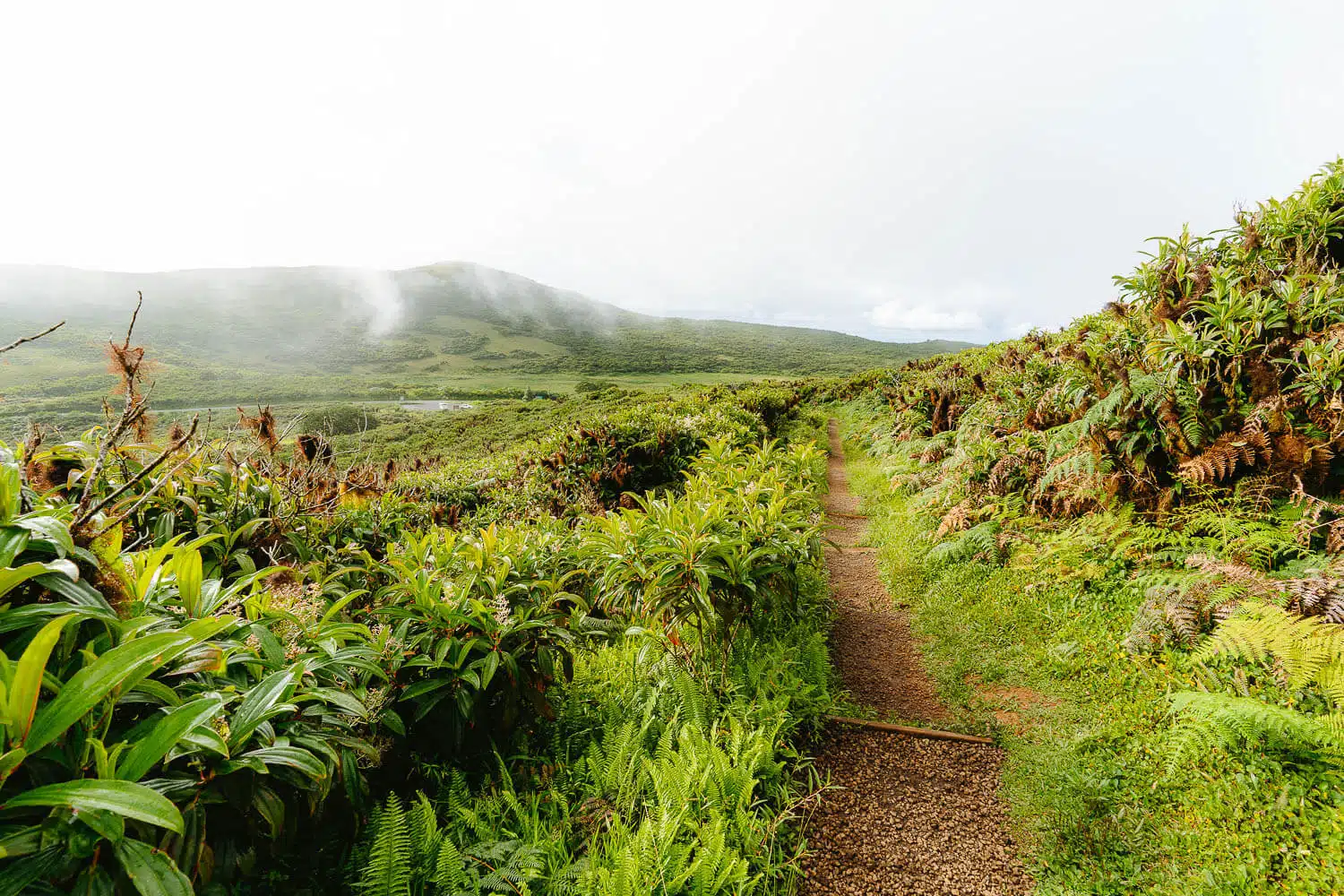
Endemic shrubs that once covered large areas but now survive mainly in the highlands of San Cristobal and Santa Cruz. Their misty, humid habitat is crucial for water catchment in the islands’ ecosystems.
The landscape around El Junco crater, on the left miconia shrubs
Ferns, Mosses, and Orchids
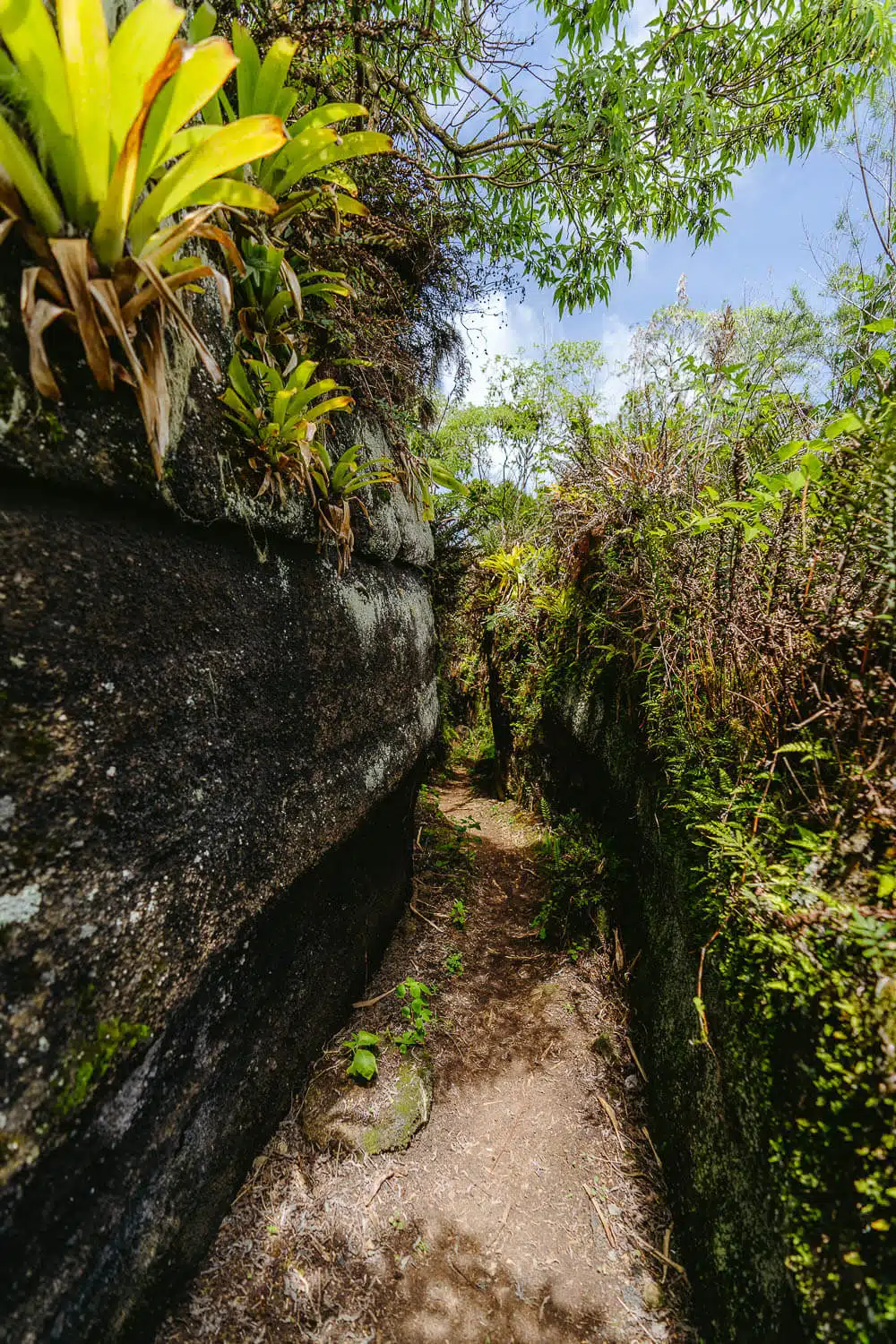
Thriving in the cloud-covered highlands of Santa Cruz, Isabela, and San Cristobal, these plants bring a lush, almost tropical feel. Orchids add splashes of color, while mosses and ferns cloak the trees in a green carpet.
The lava labyrinth completely covered with vegetation
Scalesia Trees on the left, in Isabela Island
Endemic Trees & Shrubs
Some plants evolved only in the Galapagos, giving the islands their botanical identity. These include rare trees and shrubs like guayabillo and Darwin’s cotton, which exist nowhere else on Earth and contribute to the unique habitats that sustain Galapagos wildlife.
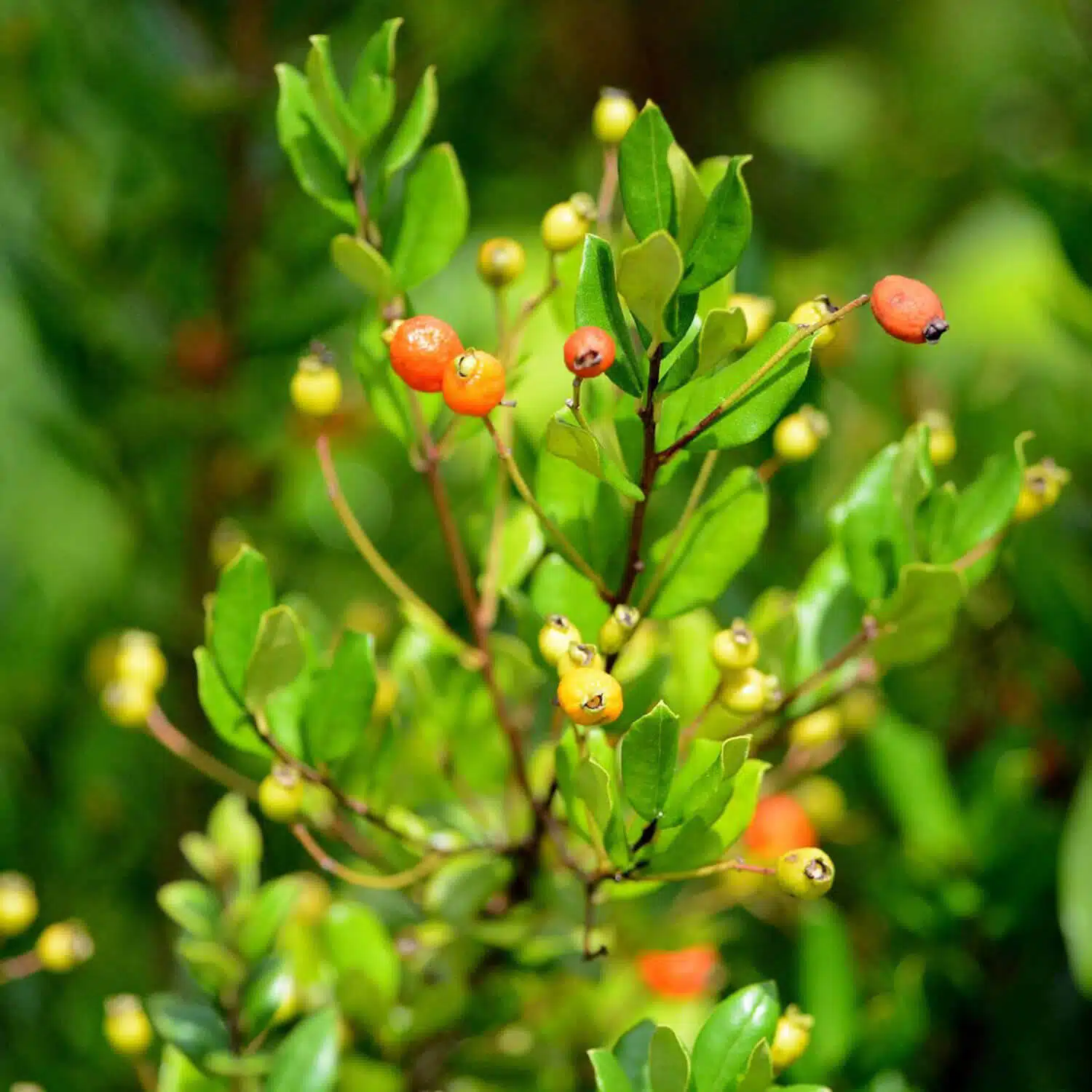
Guayabillo
Psidium galapageium
An endemic relative of the guava, common in the highlands of Santa Cruz, Floreana, and San Cristobal. Its fruits feed both wildlife and people, and its wood is valued locally.
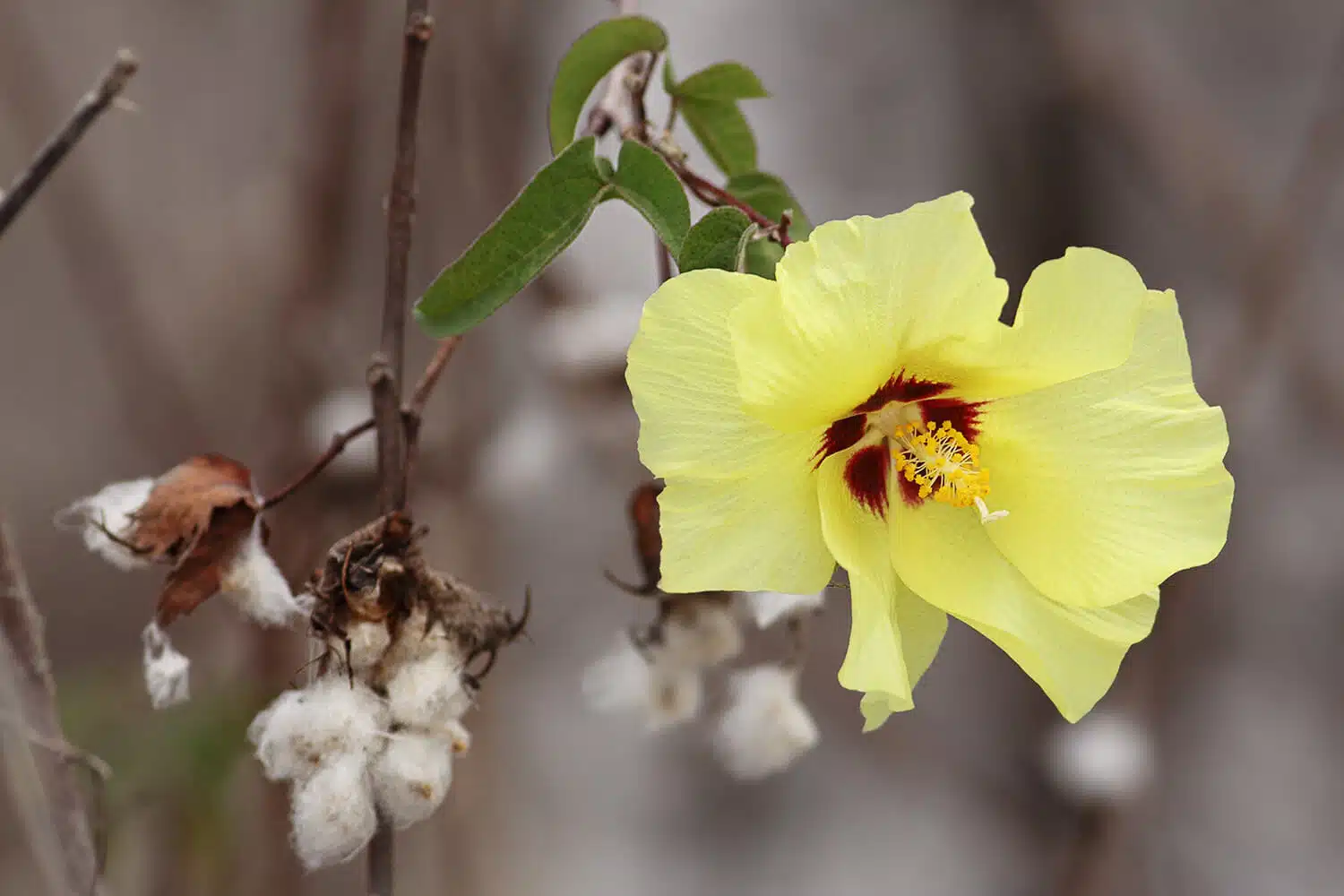
A hardy plant of the arid lowlands, with bright yellow flowers and fluffy seed fibers. Found on Española, Santa Cruz, and Isabela, it’s a close relative of cultivated cotton but unique to the Galapagos.
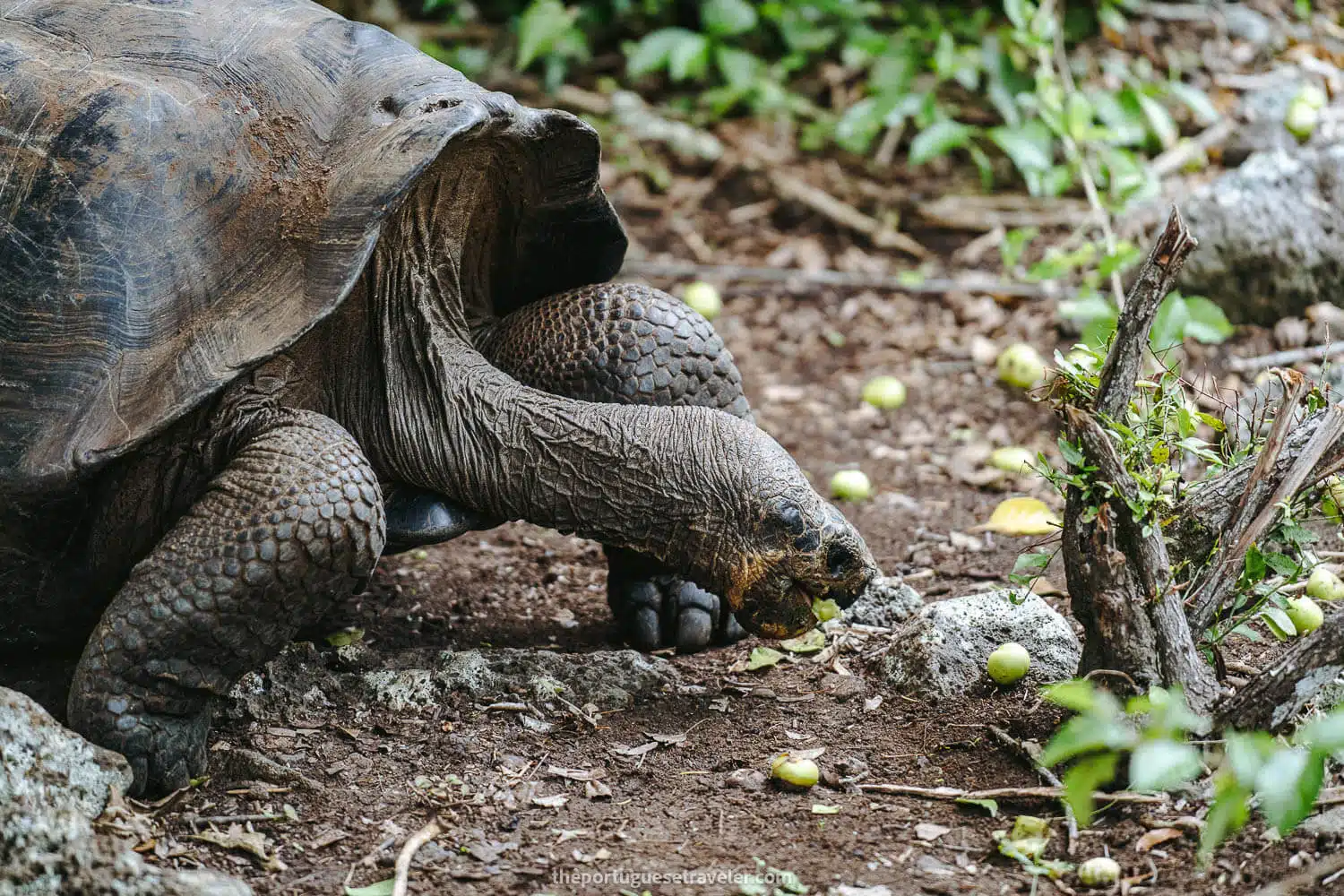
A coastal tree with glossy leaves and small green apples that are highly toxic. Found on Floreana, Santa Cruz, and Isabela, it provides shade but must be avoided due to its poisonous sap and fruit.
A giant Galapagos tortoise eating a Manzanillo fruit
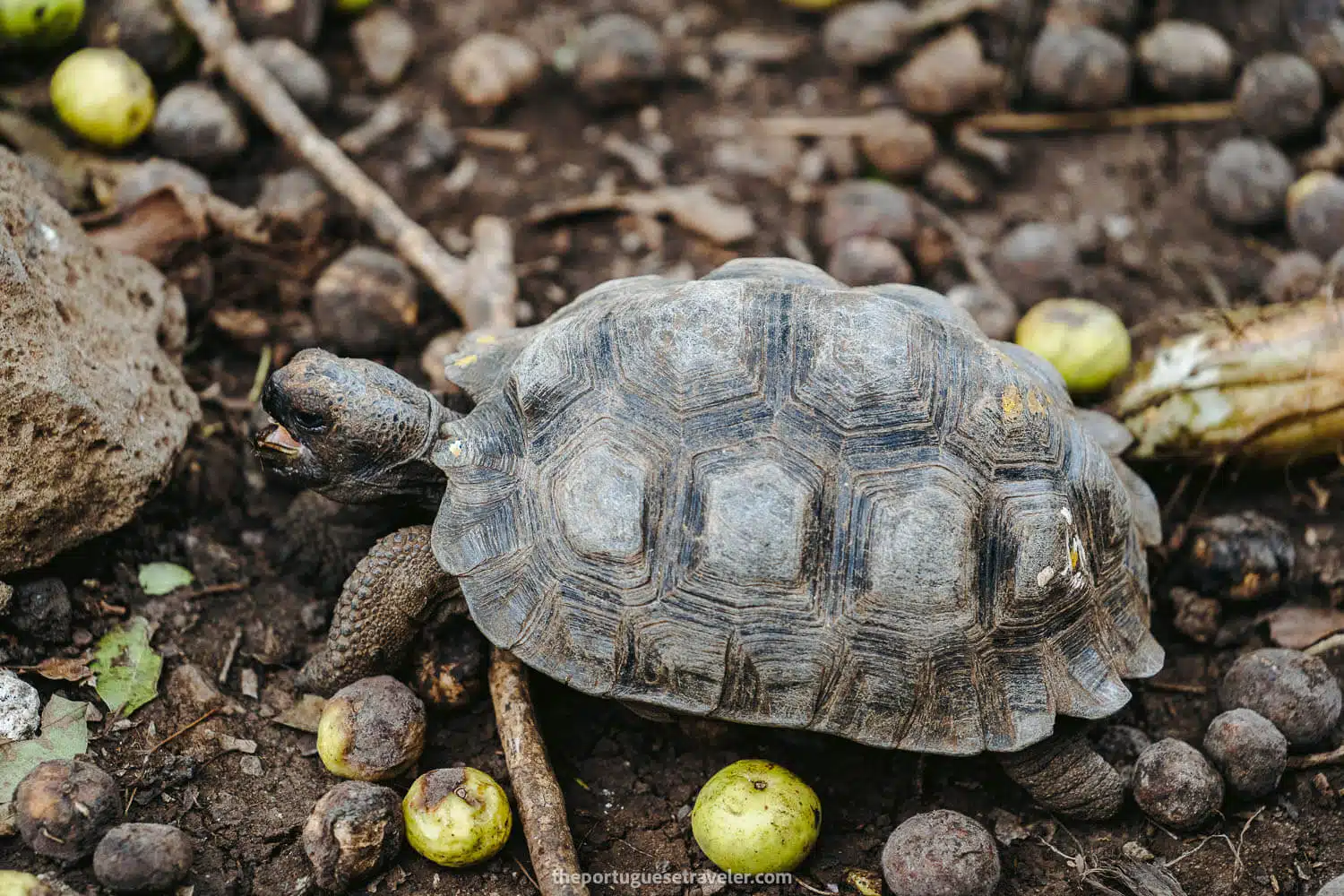
A baby Galapagos tortoise eating poisonous apples
Introduced Flora (Threats)
Not all plants belong in the Galapagos. Species brought by humans, such as blackberry and guava, spread aggressively and compete with native plants, making invasive control one of the greatest conservation challenges.
Guava, Blackberry, Cinchona, Elephant Grass
Introduced species that threaten native ecosystems, especially in the fertile highlands of Santa Cruz, San Cristobal, and Isabela. They outcompete endemic plants, disrupt habitats, and require ongoing control efforts.
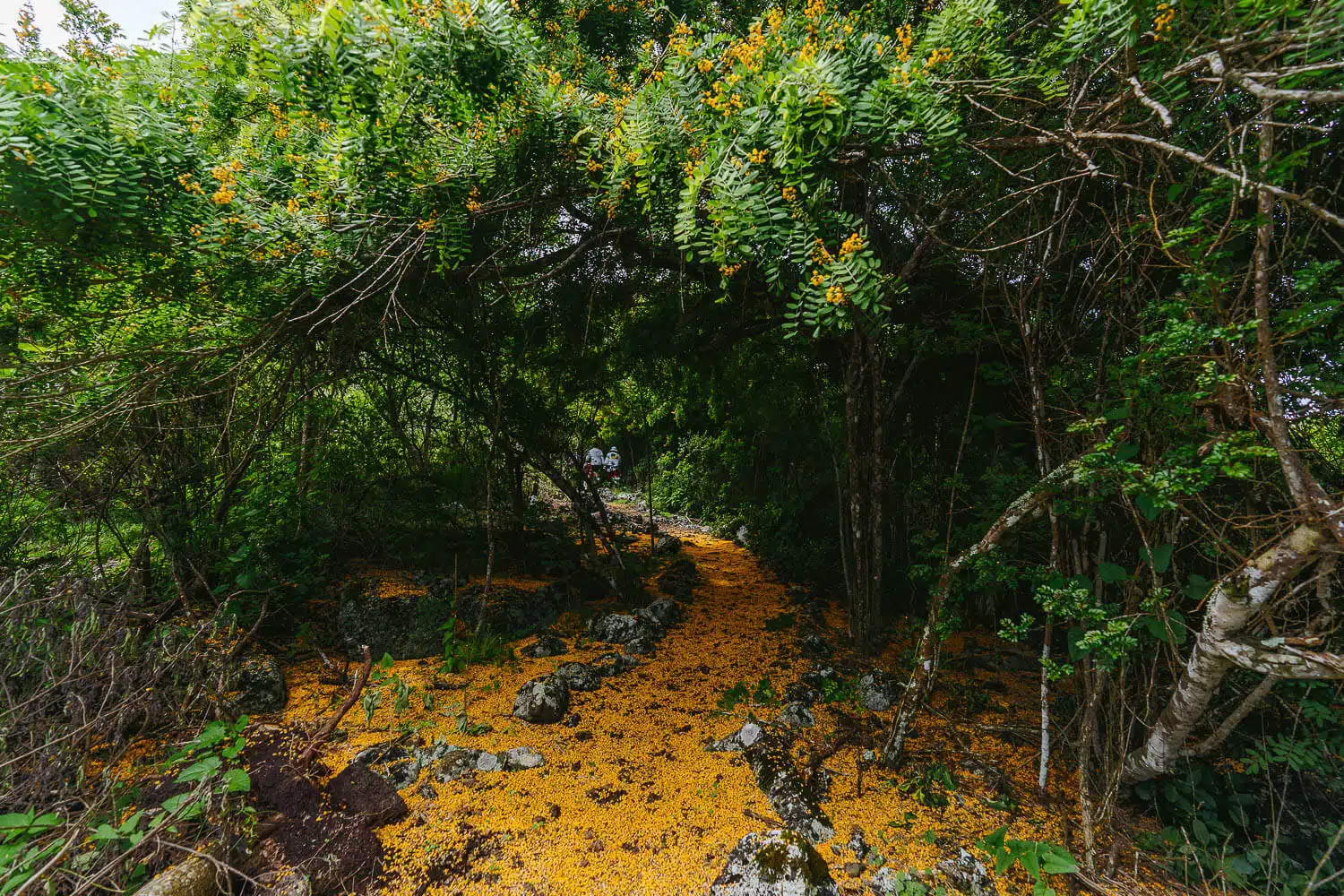
A beautiful Cinchona Trees - orange flowers path
Responsible Galapagos Wildlife Viewing
One of the greatest privileges of visiting the Galapagos is the chance to be so close to animals that don’t fear humans. To keep it that way—and to protect these fragile ecosystems—it’s important to follow responsible viewing practices. Always stay at least two meters (about six feet) away from Galapagos wildlife, no matter how tame they seem. Avoid touching, feeding, or blocking their path, and never remove natural objects like shells, rocks, or plants.
Stick to marked trails with your guide, and move slowly so animals don’t feel threatened. When snorkeling or diving, maintain good buoyancy control to avoid accidentally touching coral or marine life. By respecting these rules, you’ll help preserve the Galapagos’ unique harmony between people and wildlife, ensuring future visitors can enjoy the same encounters.
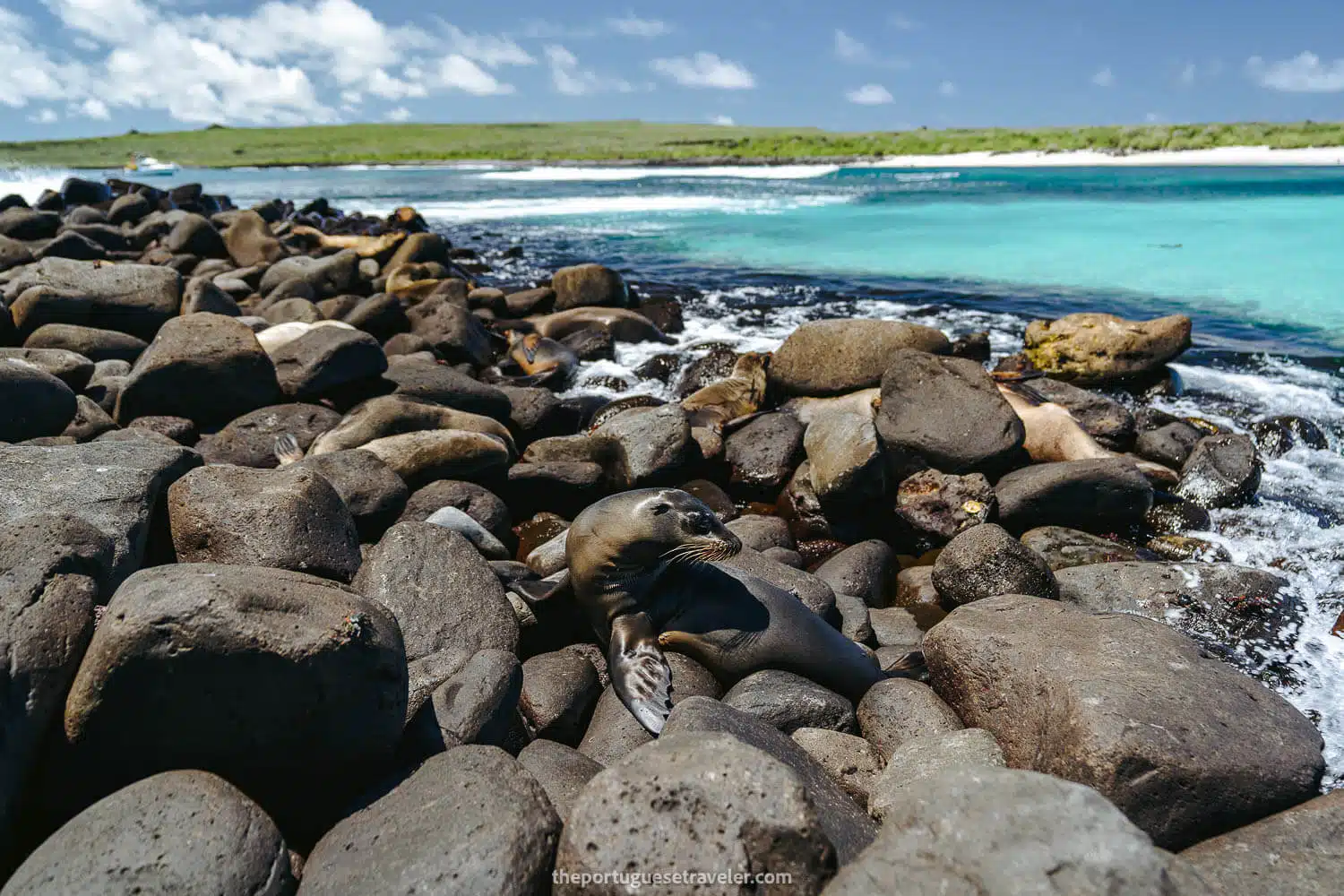
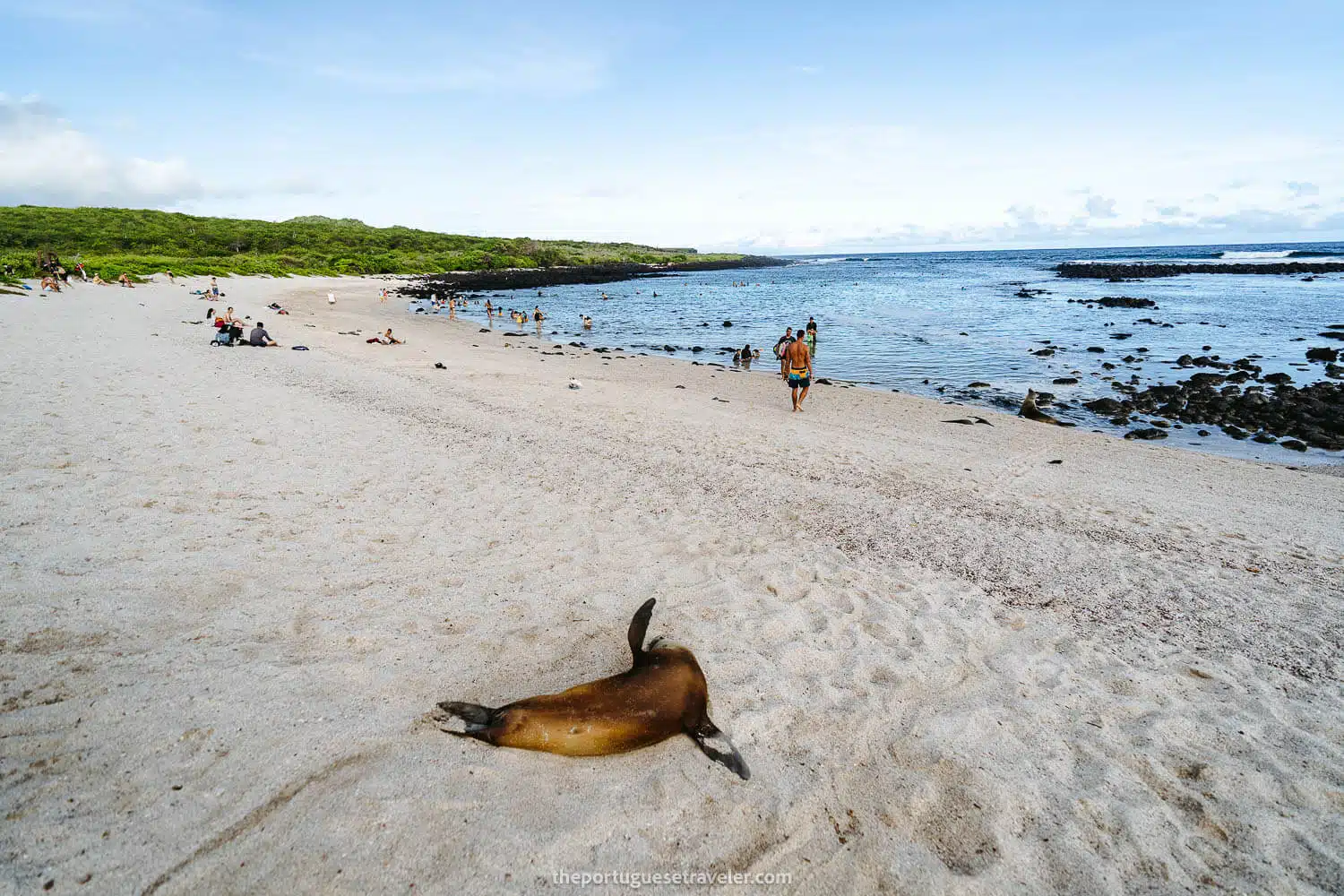
La Loberia beach with a sea lion in San Cristobal
Tips for Photographing Galapagos Wildlife
The Galapagos is a dream for photographers—wildlife often comes incredibly close, and the landscapes shift from volcanic rock to lush greenery within a single hike. To make the most of your shots, bring a zoom lens for capturing birds in flight and a wide-angle lens for sweeping landscapes and volcanic scenery.
Underwater, you don’t need a big professional rig—an action camera like a GoPro is usually more than enough to capture sea lions twisting around you, turtles gliding past, or schools of tropical fish. The compact size also makes it easy to carry on long snorkel sessions.
Light matters here just as much as wildlife. Early mornings and late afternoons give the softest, most flattering tones. Sunset, especially, is magic for golden light—but remember that many beaches and visitor sites close around 6 p.m., so enjoy those last rays before park rangers ask you to leave.
Patience is key: sit quietly and let the animals come to you rather than chasing them for the perfect shot. And don’t forget to look beyond the obvious—moments like marine iguanas piled together or a blue-footed booby mid-dance can be even more memorable than the classic portraits. Most importantly, no image is worth disturbing the natural behavior of the wildlife—respect always comes first.
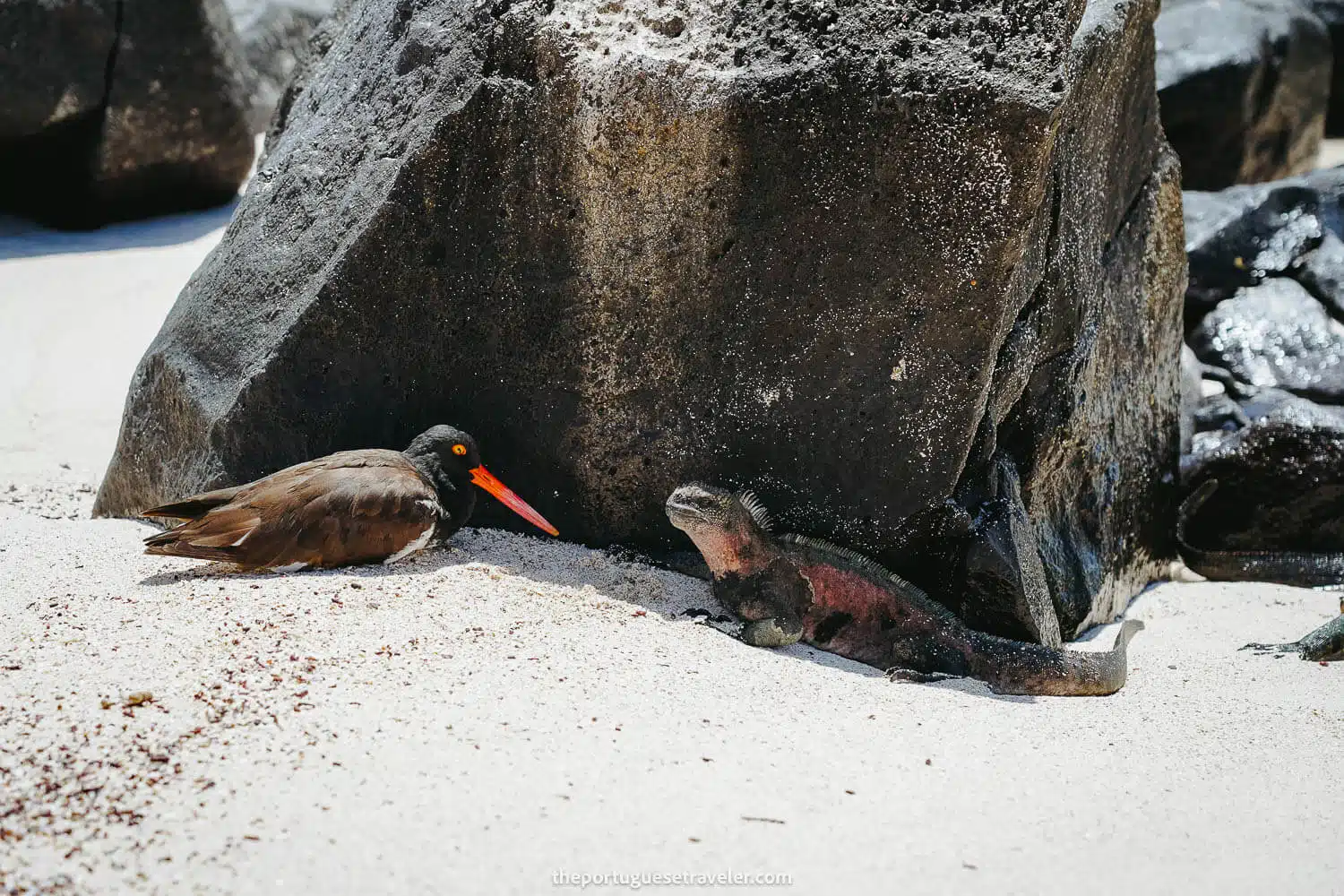
Friendly meetups at the beach
Pink and Green Christmas Iguana in Espanola Island
Sea Lion chilling in the Galápagos (can you spot the sneaky iguana?)
White Iguana in Espanola Island
Accommodation Options for your Galapagos Trip
Where you stay in the Galapagos can really shape your experience. You can choose a cruise, which doubles as your floating hotel, or land-based stays on islands like Santa Cruz, San Cristobal, and Isabela, ranging from cozy guesthouses to luxury hotels with ocean views.
Personally, I love staying on the islands—it’s magical to wake up to the sound of waves and explore nearby beaches or towns before heading out on day tours. No matter what you choose, booking early is key, especially in high season, to get the best spots and make the most of your trip.
The Galapagos feels unlike anywhere else I’ve ever been. Every island, every trail, and every snorkel brings something new—sometimes it’s a waved albatross clacking beaks in courtship, other times it’s sea lion pups sprawled across a beach or giant tortoises slowly making their way through the highlands. And then there are the moments underwater, where schools of hammerheads glide past in the blue. These are the kinds of encounters with Galapagos wildlife that stay with you long after you leave.
There really isn’t a wrong time to visit. Each season has its own rhythm, and what you experience depends on what you’re hoping to see or do. For me, the best trips have been the ones where I stayed flexible, let the islands set the pace, and remembered to simply enjoy being surrounded by such extraordinary Galapagos wildlife.
If you go with patience, curiosity, and respect for the place, the Galapagos will give you more than you expect—it has a way of surprising you in the best possible ways.
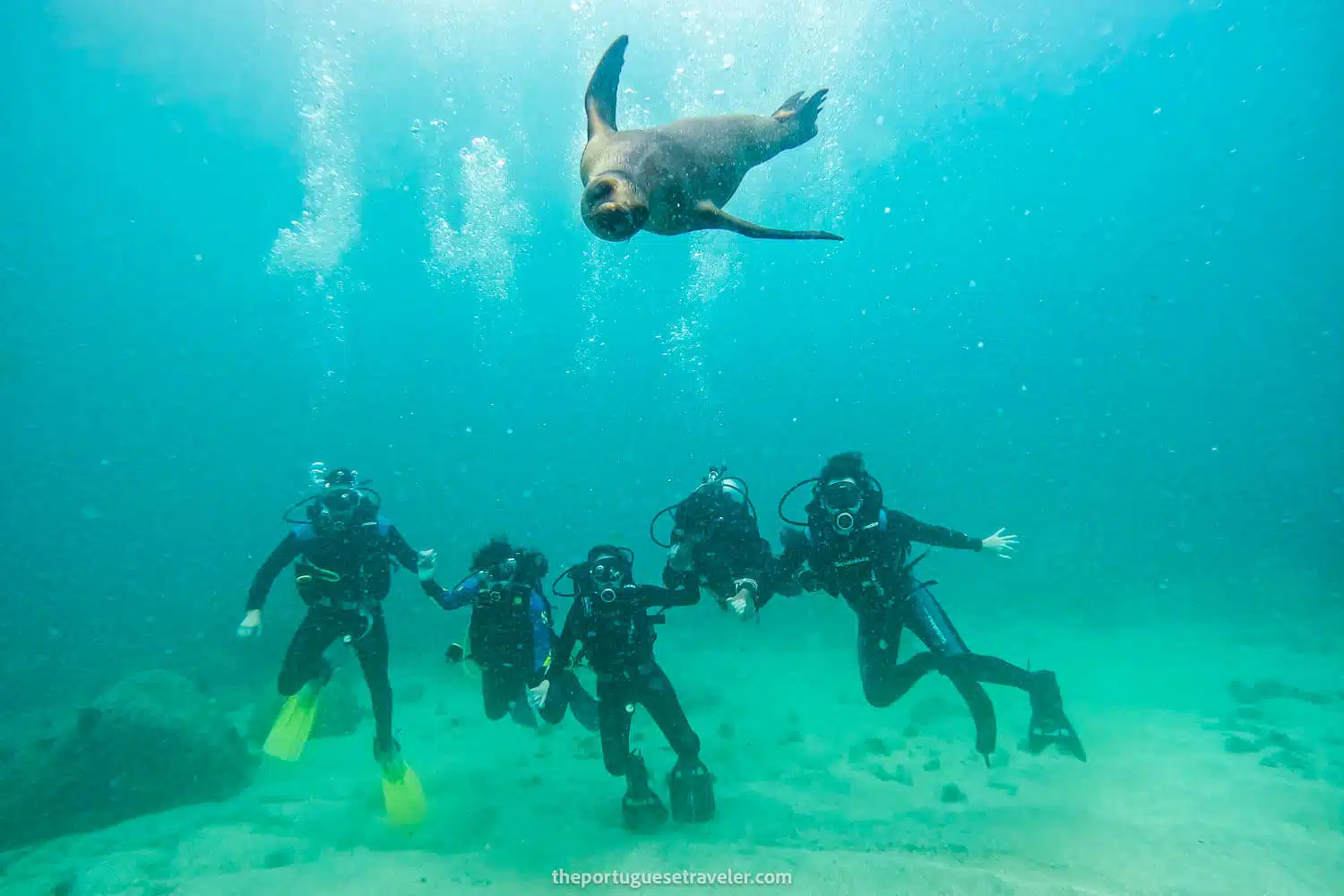
A sea lion photo-bombing the divers in Tijeretas Bay
Plan your next adventure with us!
Here are the links we use and recommend to plan your trip easily and safely. You won’t pay more, and you’ll help keep the blog running!
Car Rental: Rent the perfect car for your trip with Discovercars.
Accommodation: Book your hotels with Booking.com or Expedia. For hotels in Asia, we usually reserve with Agoda.
Flights: We typically purchase our flight tickets through Trip.com or directly with the airlines for the best options and flexibility. If a flight is canceled or delayed, we use Airhelp for compensation.
Trains and Buses: In Europe, we typically use Omio, while in Asia, 12Go is our go-to choice for seamless transportation, and in Latin America, Busbud is what we always use.
Tours and Tickets: Book your tours and skip-the-line tickets with GetYourGuide, or Viator.
Internet: Get connected wherever you go with Holafly (5% discount) or Airalo.
Travel Insurance: For comprehensive global coverage, check out Heymondo (get 5% off with my link). If you’re a digital nomad, explore Safetywing for flexible insurance options.
I’m João Petersen, an explorer at heart, travel leader, and the creator of The Portuguese Traveler. Adventure tourism has always been my passion, and my goal is to turn my blog into a go-to resource for outdoor enthusiasts. Over the past few years, I’ve dedicated myself to exploring remote destinations, breathtaking landscapes, and fascinating cultures, sharing my experiences through a mix of storytelling and photography.
SUBSCRIBE
Don’t Miss Out! Be the first to know when I share new adventures—sign up for The Portuguese Traveler newsletter!